










China’s geopolitical wildcard: the bet on Pakistan Corridors, technology, influence
The Arab magazine Al Majalla has published an article dedicated to the recent visit of Pakistan’s Prime Minister Muhammad Shehbaz Sharif to China. Caliber.Az presents the most telling parts of the article.
When Pakistan’s Prime Minister Shehbaz Sharif landed in Hangzhou on 23 May, the choreography looked familiar enough: A Pakistani premier travels to China; the two governments invoke their ‘all-weather strategic cooperative partnership’; and the communiqués promise a new chapter in the China-Pakistan Economic Corridor.
That reading misses what this geopolitical moment represents. Sharif arrived in Beijing carrying something no recent Pakistani leader had: leverage. For 75 years, Pakistan’s value to China was geographic and military—a wedge against India, a corridor to the Arabian Sea, and a reliable buyer of Chinese arms. This spring, however, Islamabad acquired a new form of strategic capital. It has become an indispensable interlocutor in the war threatening China’s economic lifeline, and the custodian of overland routes that have kept goods moving while sea lanes remain shut.
To understand why a routine state visit suddenly matters, look no further than the Strait of Hormuz. When the US and Israel launched coordinated strikes on Iran, targeting its leadership, nuclear infrastructure, and missile programme, the Islamic Revolutionary Guard Corps responded by laying sea mines, boarding merchant vessels, and warning that no ship would be permitted to pass.
No major power has more at stake in the outcome than China. Beijing imports roughly half its crude from the Middle East, and in a normal year more than a third of its oil supply transits the Strait of Hormuz.
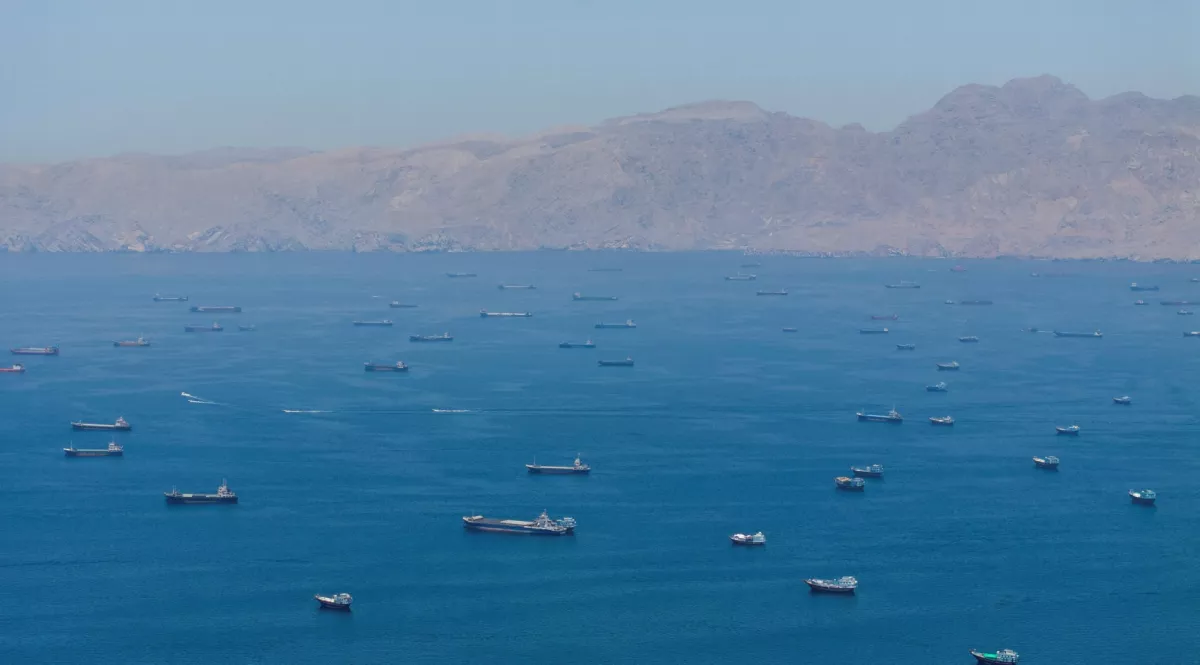
The disruption of Iranian supplies created an immediate shortfall of well over a million barrels a day, while by March, bilateral China-Iran trade had collapsed by roughly 80% year-on-year.
Upon Sharif’s arrival, China was not only receiving a debtor. It was receiving the one government that had shown it could reach into the conflict and move the pieces—brokering ceasefires, carrying messages, and helping shape the war's diplomatic tempo. Just as importantly, it was receiving the one country that sits astride the overland corridor keeping commerce alive between Tehran and Beijing while the Strait remains closed.
Enter CPEC
The China-Pakistan Economic Corridor (CPEC) was conceived, in its grand strategic logic, precisely to replace US-controlled global maritime chokepoints. The idea predates its 2015 launch by two decades: as far back as 1993, Chinese vice premier Zhu Rongji and Pakistani economist Shahid Javed Burki discussed unlocking western China through a road, rail, and pipeline network linking Kashgar in Xinjiang to a warm-water port on the Arabian Sea. That port became Gwadar, which Xi Jinping inaugurated as the southern terminus of a roughly 3,000km corridor of highways, a 1,800km railway, energy projects, and planned pipelines stretching north to Kashgar.
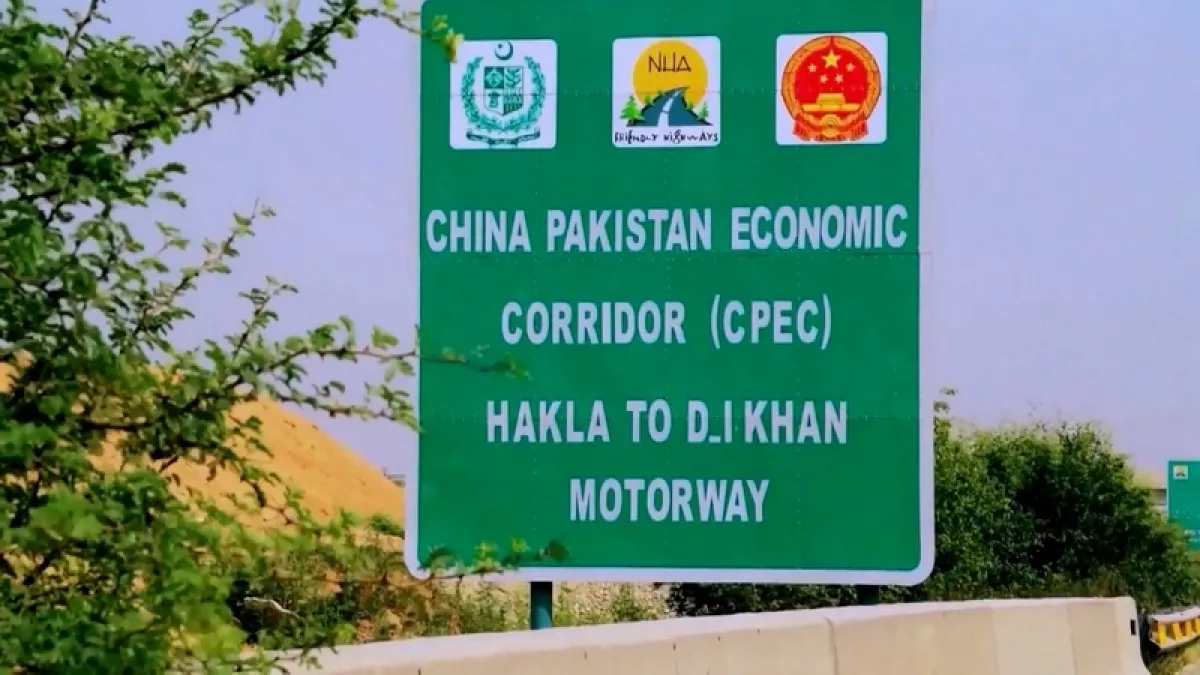
The most striking confirmation of CPEC's strategic value came not from Beijing but from Islamabad, via a customs order. On 25 April, Pakistan's Commerce Ministry brought into immediate effect the 'Transit of Goods through the Territory of Pakistan Order 2026', formally legalising the movement of third-country cargo from China and other parts of Eurasia across Pakistani territory into Iran. The order activated six overland routes running from Gwadar, Karachi, and Port Qasim to the Iranian border, with the Gwadar–Gabd crossing offering transit times of just two to three hours.
Critical relief
The reasons Sharif began his trip in Hangzhou is worth dwelling on. It reveals what the second phase of CPEC is meant to be. Hangzhou is no longer simply the picturesque home of the West Lake and Alibaba. It has become, in the space of a few years, China's pre-eminent deep-tech hub: home to AI company DeepSeek and the cradle of the country's so-called 'Six Little Dragons', a cluster of firms spanning AI, robotics, gaming, brain-machine interfaces, and spatial computing.
The original CPEC was built around roads, ports, and power plants—the physical scaffolding of an industrialising economy. The pivot to Hangzhou signals an upgraded layer: digital infrastructure, data connectivity, AI, and the platforms built atop the physical. With Pakistan's minister of information technology, Shaza Fatima Khawaja, joining the delegation, the message was clear: Pakistan aspires to be more than a land transit route for Chinese goods. It aims to become a key participant in China's digital and technological order.
For China, the appeal is equally strong. Beijing's deep-tech champions face tightening access to Western markets. A digitally integrated Pakistan—with Chinese cloud infrastructure, fintech rails, telecoms and surveillance systems, and AI models—would extend the technological ecosystem incubated in Hangzhou across a strategically vital region. The physical corridor moves oil and containers; the digital corridor moves data, standards, and technological systems.
Historic parallels
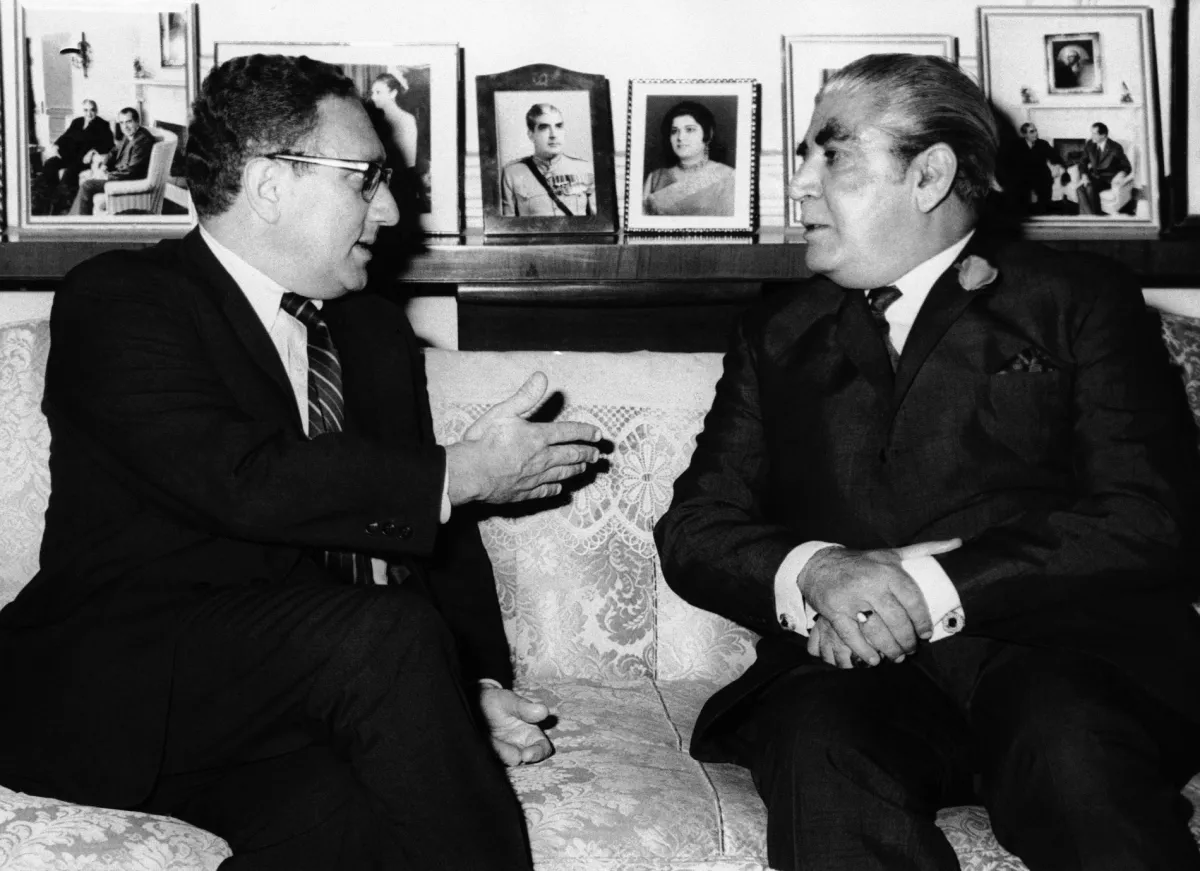
This is not the first time Pakistan has leveraged its unusual diplomatic position to shape a geopolitical realignment. In 1971, at the height of the Cold War, Pakistan secretly facilitated Henry Kissinger's trip to Beijing, laying the groundwork for the opening of diplomatic relations with a People's Republic of China the US did not yet recognise. As Kissinger's aide, Winston Lord, later put it, Pakistan had the advantage of being "a friend to both sides". The parallel is imperfect, but the underlying asset is familiar: Pakistan's ability to maintain working relationships with actors unable or unwilling to speak directly to one another. In 1971, those actors were Washington and Beijing. In 2026, they are Washington, Tehran, the Gulf monarchies, and Beijing.
When the war erupted, Beijing and Islamabad jointly advanced a five-point peace proposal, while China intervened at the last-minute, helping push Tehran toward the two-week ceasefire that took effect in early April. Organised by Pakistan and negotiated through what became known as the Islamabad Talks, the ceasefire ultimately collapsed, triggering the US blockade. Yet the process established Pakistan as the venue through which Washington and Tehran could, however briefly, be brought into the same room.
Why this arrangement suits Beijing is straightforward. China needs the war to end—or at least to de-escalate enough to reopen the Strait of Hormuz—but it cannot be seen as the broker delivering the settlement. To do so would risk reinforcing American suspicions of Beijing's alignment with Tehran and complicate China's effort to present itself as a stabilising actor rather than a partisan one.
Pakistan offers Beijing a form of strategic distance: the ability to shape the conflict's trajectory while preserving plausible neutrality. Sharif's visit was, in effect, a coordination meeting—a chance to align on what comes next.
Broader pattern
A broader geopolitical pattern is taking shape. In the first five months of 2026, roughly a dozen heads of state and government have passed through Beijing. The sequence is striking. President Donald Trump arrived for a summit on 14-15 May. Russia's President Vladimir Putin followed days later for a state visit on 19-20 May. The back-to-back hosting of American and Russian leaders within a single week is almost unheard of. Shortly before Trump's visit, Iran's foreign minister travelled to Beijing for the first time since the war began. France's Emmanuel Macron came in December, the UK's Keir Starmer in January, while leaders from South Korea, Spain, Ireland, Canada, Germany, and Finland have also made the trip. Now Sharif.
At minimum, the diplomatic revolving door points to a shift in geopolitical gravity. The simple fact that global leaders—adversaries and partners alike—now pass through Beijing to address pressing international issues signals a redistribution of diplomatic influence.
Pakistan's wager is that, in a multipolar world, the state that can speak to all sides—and control the land bridge when sea lanes close—is ultimately more valuable than a great power aligned too narrowly with one camp.
Fifty-five years ago, a Pakistani leader put an American on a secret plane to Beijing and helped remake the world. Last month, another Pakistani leader flew to China openly to remind his hosts that the geography that made Pakistan indispensable then still makes it indispensable now.







 editor@caliber.az
 +994 55 444-88-98
 Азербайджан, Баку, ул. Низами, 203, Af Business House, 5-й этаж