










True message that Taliban deal with Moscow holds for Islamabad, Washington
A recently signed military-technical cooperation agreement between Russia and the Taliban administration may be limited in scope, but analysts caution it reflects broader geopolitical calculations involving regional security, US and Pakistan's involvement while also being reflective of Moscow's efforts to expand its influence as Western involvement in Afghanistan recedes.
Signed on May 27, the agreement does not constitute a defense pact or mutual security arrangement, as highlighted by both parties repeatedly. Instead, it focuses on the repair and maintenance of Soviet- and Russian-made military equipment already in Afghanistan's arsenal, including helicopters and other aircraft.
Afghanistan continues to operate a significant inventory of Soviet-era weaponry, much of it dating back to the Soviet military presence in the country until 1989. Although US and NATO forces introduced large quantities of Western equipment after 2001, many Soviet-made systems remain in service.
Russia's special envoy for Afghanistan, Zamir Kabulov, emphasized that the agreement is currently limited to restoring existing equipment. However, he acknowledged that it could serve as a foundation for future defence contracts between the two sides.
The Taliban administration's acting defence minister, Mullah Muhammad Yaqoob, echoed that position during his visit to Moscow, stressing that the agreement centers on maintenance rather than new arms acquisitions. He also suggested that similar arrangements could theoretically be pursued with the United States, noting that large quantities of American military equipment remained in Afghanistan following the rushed US withdrawal in 2021 amid the Taliban's return to power.
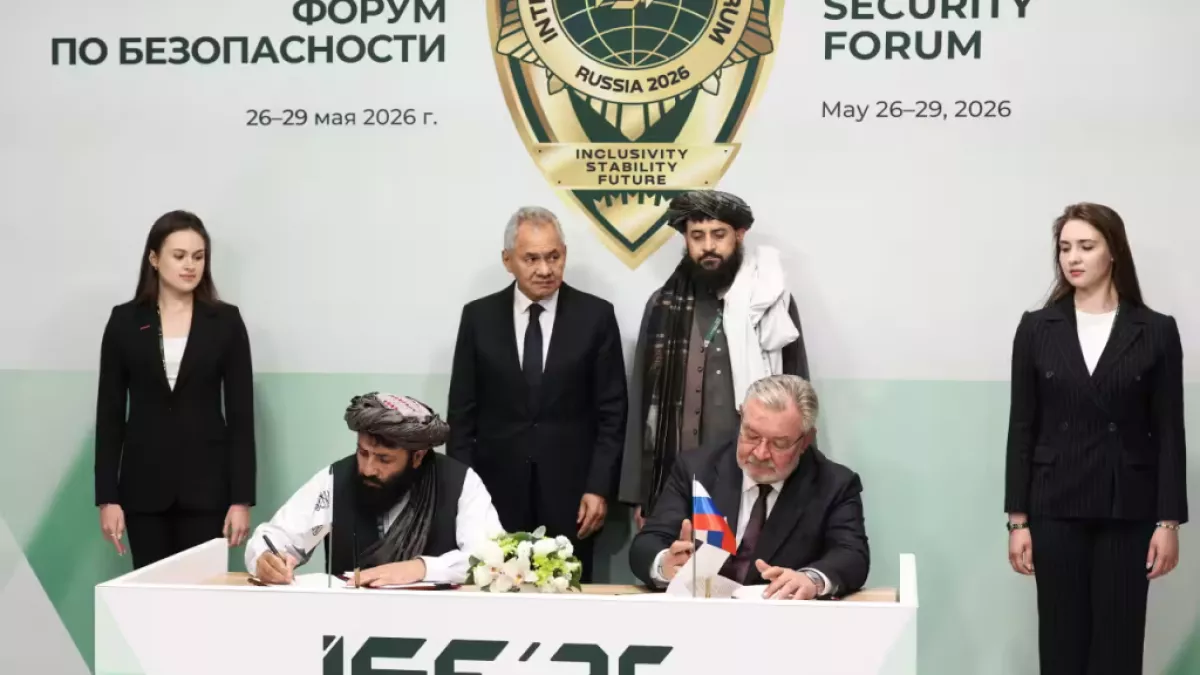
Yaqoob appeared to have not only the West in mind when travelling to Moscow for the agreement. Upon returning to Kabul, he urged that Pakistan would "soon no longer dare" to carry out attacks inside Afghan territory following the military-technical cooperation agreement he had just signed in Moscow, adding that its implementation would begin shortly.
The remarks came amid ongoing tensions between Afghanistan and Pakistan, including border clashes, shelling and airstrikes. Islamabad has repeatedly accused the Taliban of harbouring members of Tehreek-e-Taliban Pakistan, allegations the Taliban deny.
Driving force behind Moscow-Kabul bond
Analysts argue that the agreement serves different purposes for each side. According to the Deutsche Welle's analysis on this new cooperation, it offers an opportunity to strengthen military capabilities for the Taliban, gain international legitimacy and diversify foreign partnerships. For Russia, it represents a chance to reinforce its role as a regional security actor while limiting the return of Western military influence.
That objective was underscored by Sergei Shoigu, Russia's former long-time defence minister and currently serving as Security Council Secretary, who recently reiterated Moscow's opposition to the deployment of US or NATO military infrastructure in Afghanistan or neighbouring states.
According to political analyst Abas Basir, a former minister in Afghanistan's previous government, the relationship between Moscow and the Taliban is driven primarily by practical interests rather than ideology.
He told DW that one of Russia's principal concerns is the threat posed by the regional branch of the Islamic State, Islamic State Khorasan Province (ISKP). Moscow fears the group could use Afghanistan as a base to destabilize Central Asia, a region of significant strategic and economic importance to Russia.
Because the Taliban have actively fought ISKP, Russia increasingly views them as a useful buffer against extremist spillover. As thousands of migrant workers reside in Russia, originating from countries that could become a breeding ground for the ISKP, such as Tajikistan, Kyrgyzstan, and Uzbekistan, Moscow views issues relating to the Islamic group as a threat to its national security. This fear was tragically given legitimacy when terrorists associated with the ISKP performed the 2024 deadly terrorist attacks on Moscow's Crocus City Hall.
The Taliban, meanwhile, stand to gain economic and political benefits, including expanded trade opportunities and access to Russian energy and grain supplies at a time of continued economic hardship. Basir argues that the movement is also seeking to avoid excessive dependence on any single external partner by cultivating a broader network of regional relationships.
While the military-technical agreement remains modest for now, analysts see it as another step in the gradual normalization of relations between Moscow and the Taliban administration and a reflection of shifting power dynamics across the wider region.
Security and politics Analyst Besmillah Taban told the outlet that he believes the Taliban is using the Moscow visit for domestic messaging, describing it as an attempt to extract propaganda value and raise morale at home after a series of devastating Pakistani strikes weakened confidence within the group's ranks.
By Nazrin Sadigova







 editor@caliber.az
 +994 55 444-88-98
 Азербайджан, Баку, ул. Низами, 203, Af Business House, 5-й этаж