










Artificial intelligence 'foreman robots' to help factory workers PHOTO
Journeyman robots have been developed at the Middle East Technical University (METU) that assist factory workers with artificial intelligence.
METU Robotics and Artificial Intelligence Technologies Research and Application Center (ROMER) Director and Computer Engineering Department Lecturer Assoc. Dr. Erol Şahin, in his statement, stated that the centre was officially established at the beginning of last year, TRT Haber reports.
Pointing out that robotics and artificial intelligence technologies, which are an interdisciplinary field, are advancing very rapidly, Şahin said, "This field creates a new revolution in a sense. Because paradigms are being developed that will radically change not only one sector but also many different sectors. Robotics in our centre, in Turkey and around the world and we are working to take artificial intelligence research to the next level," said.
Emphasizing that robotics is one of the key technologies of the future, it is accepted worldwide and that the uncertainty will only be about which countries will come to the fore in these technologies, Şahin said that in this context, studies are carried out to increase the manpower trained in robotics and artificial intelligence technologies at ROMER.
Stating that they started to provide robotics education to students from different disciplines such as computer, mechanical, electrical-electronic and aerospace engineering by opening postgraduate robotics programs with the support of ROMER, Şahin explained the importance of robotic systems as follows: "While robotic systems can physically affect their environment, they are also programs that can be programmed. Currently, robotic systems are used successfully on assembly lines in factories, but they have begun to enter daily life as well. We see autonomous vehicles, autonomous UAVs and vacuum cleaners in homes. Robots, It has the potential to take over many of the things you do physically at home in the near future. Robotics will perhaps come to life more slowly than computers because it is a more difficult medium to interact with. With recent developments, all parts of mechatronics, physical structure and artificial intelligence are in a sense overlapping and It is predicted that the world market for robotics will increase 10 times in maybe 10 years."
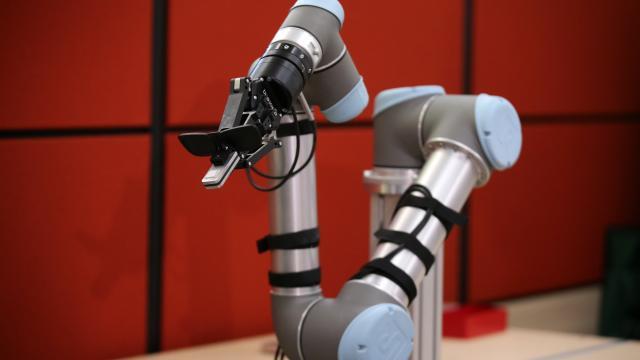
Potential to increase the productivity of factories
Stating that they follow the developments in the world at ROMER and work on nearly 100 robot platforms, Şahin emphasized that they need more students for this reason.
Assoc. Dr. Providing information about the "foreman robot" they developed with Sinan Kalkan, Şahin noted that they received support from TÜBİTAK within the scope of two separate projects.
Pointing out that robotic manipulators are already doing certain jobs on assembly lines, Şahin stated that these systems are not capable of doing all the assemblies that workers can do.
Stating that there is a limited time for each worker in assembly lines to carry out the assembly process, Şahin continued as follows:
"At the end of this period, the assembled part moves forward and is replaced by a new part. We aim to develop an assistant robot that can reduce the work done in 60 seconds to 50 seconds, by extending the necessary parts and tools to the workers at the right time during assembly. The use of such journeyman robots increases the productivity of the workers, "Artificial intelligence technologies and human-robot interaction technologies are needed for the development of journeyman robots. The robot, which will monitor the movements of the worker and follow the assembly process with artificial intelligence technologies, will be able to help the worker by giving parts and tools when it is his turn."
Stating that workers are social beings like all human beings and they need social interaction, Şahin said, "These robots need to have a certain social communication with the worker so that workers do not feel social deficiency. Employees should not get bored with the robot in the long run and be satisfied with working together." said.
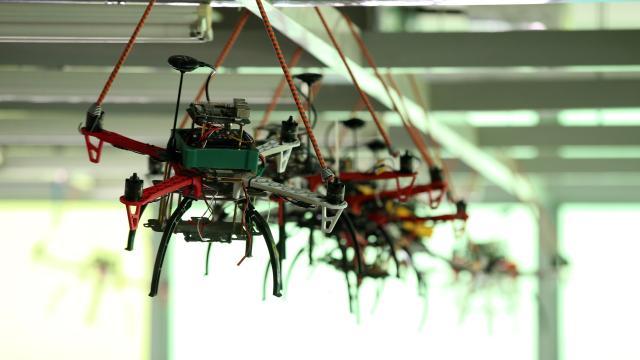
"Taken from animation systems and adapted to robots"
Şahin stated that robotic manipulator technologies with humanoid features are not yet available in factories, and they are doing research to realize a first in their projects.
Explaining that there are nonverbal clues in human communication, Şahin said, "For example, the other person's head nodding, gaze, and breathing are necessary for communication. When these are not present, communication can become frightening with the perception of zombies. Movement is more important than appearance. Here are these basic concepts in human communication. "We adapt it to robots. We give robots humanoid and lifelike abilities, albeit vaguely. We take the animation principles from cartoons and apply them to robots. So, some ideas in this field are actually taken from these animation systems and adapted to robots." he said in his assessment.
Erol Şahin, regarding the features they bring to journeyman robots, said: "We gave our journeyman robot arm the appearance of a swan. In our experiments, we saw that pointing this robot arm, which has been given the 'living' ability, has a positive effect on humans directly, and thus a closeness to the robot is created. Secondly, we also gave the robot a breathing movement. The fact that it feels like it's breathing builds confidence in people and gives a feeling that the robot is smarter."







 editor@caliber.az
 +994 55 444-88-98
 Азербайджан, Баку, ул. Низами, 203, Af Business House, 5-й этаж