










Fishermen discover 2,000-year-old Roman shipwreck off Sicily
Two Italian divers have discovered a Roman shipwreck carrying hundreds of ancient amphorae off the coast of Sicily, in what Italy's culture minister has described as one of the most important underwater archaeological finds in recent years.
Spear fishermen Giacomo De Mola and Igor Bisulli were diving off Mazara del Vallo last week when they spotted what they initially believed was a large rock between 40 and 50 metres below the surface, CNN reports.
De Mola said he decided to investigate and discovered a large concentration of amphorae on the seabed.
“I get closer. And my heart stops. It wasn’t a rock. Beneath me was an immense expanse of amphorae. Hundreds of amphorae that had lain on the seabed for over 2,000 years,” he wrote on Instagram.
The divers reported the discovery to Sicily's Regional Superintendency of the Sea, which alerted the Carabinieri's unit responsible for protecting cultural heritage.
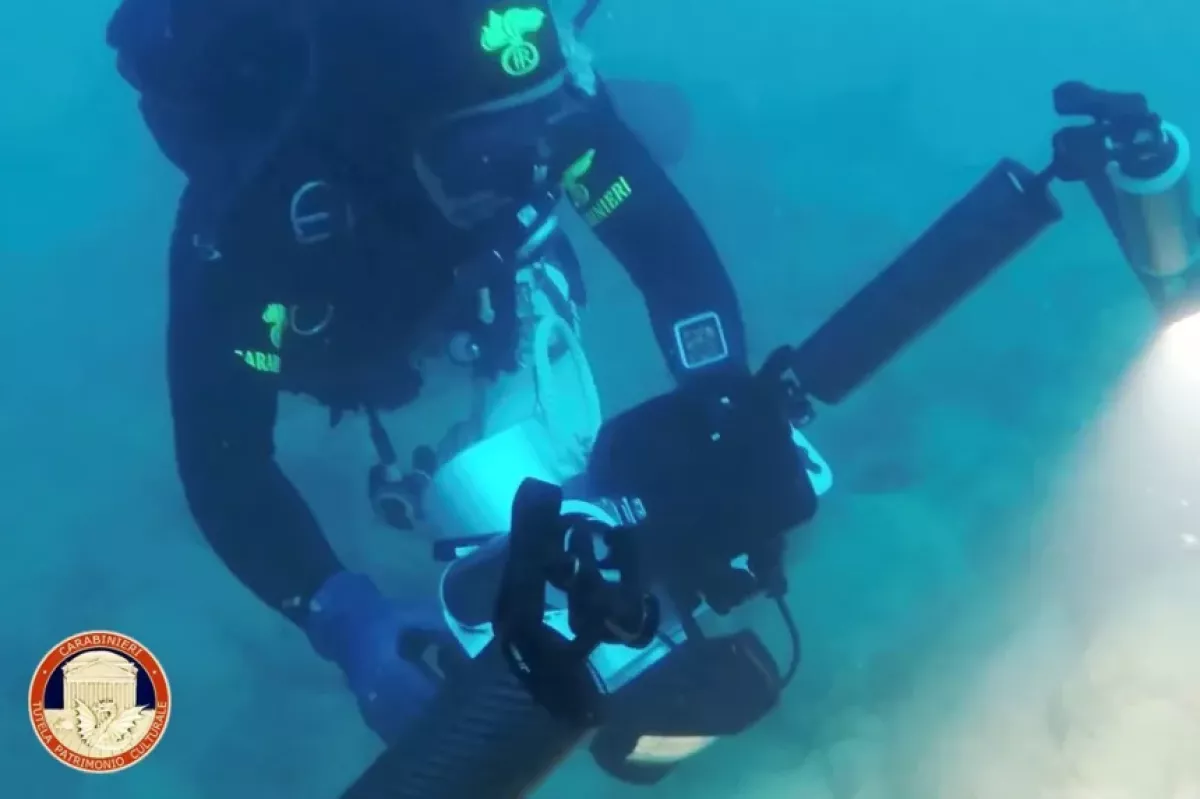
Officials confirmed that the wreck dates from between the second and first centuries BC. It lies about three miles off Mazara del Vallo at a depth of 46 metres.
The seabed contains hundreds of clay amphorae, mostly of the Dressel 1A type, which were used to transport goods including wine and olive oil. Archaeologists also found two lead anchor stocks and another structure made of lead.
The amphorae form a pile almost two metres high, stretching more than 20 metres in length and about six metres in width. Some of the vessels are of North African origin, while one is an older Neo-Punic amphora.
Culture Minister Alessandro Giuli said the discovery could provide new information about the people, trade routes and exchanges that made the Mediterranean a major crossroads of ancient civilisations.
Further archaeological work will now be carried out to document the site, understand its wider context and determine how best to protect it.
There are currently no plans to raise the entire wreck. Some artefacts could be recovered for research, while authorities will also assess the condition of the site and whether it has previously been disturbed or looted.
Maritime archaeologist Lucy Blue of the University of Southampton, who was not involved in the discovery, said the relatively intact wreck could provide further insight into trade and exchange before the Roman Empire.
She also said the large number of amphorae could have helped preserve more of the ship's wooden hull, potentially offering new evidence about Roman shipbuilding technology.
The waters around Sicily were an important trading corridor in antiquity. Sicily was colonised by the ancient Greeks before coming under Roman control around 240 BC.
The two divers are expected to receive special state recognition for their discovery.
By Aghakazim Guliyev







 editor@caliber.az
 +994 55 444-88-98
 Азербайджан, Баку, ул. Низами, 203, Af Business House, 5-й этаж