










Chang’e-7 puts Beijing’s state-led lunar strategy on display despite delay
One of Beijing’s most ambitious lunar missions has suffered a setback this week, with the launch of Chang’e-7 delayed just as international interest in the potentially valuable water resources at the Moon’s south pole continues to grow. Despite the impediment, Chang’e-7 is among China’s most sophisticated lunar missions to date and stands out from other international efforts chasing a spot in the booming space race.
Chang’e-7 had been scheduled to launch during the week of August 24 from the Wenchang Space Launch Site in China’s Hainan Province. However, Chinese authorities announced on August 23 that the mission would no longer proceed during its planned 2026 launch window, saying only that the spacecraft did not currently “meet the conditions for launch.”
No new launch date has yet been announced for the mission, which is designed to directly investigate the presence and distribution of water ice near the lunar south pole.
Seven international partners are contributing scientific payloads to Chang’e-7, including Thailand. Wiphu Rujopakarn, executive director of Thailand’s National Astronomical Research Institute, told CNN that information from the Chinese mission team indicated that the launch could be postponed until next year, potentially until the spring or middle of 2027. Rujopakarn said weather conditions in Hainan, particularly strong winds at high altitudes, may have contributed to the delay.
However, Chang’e-7 faces unusually demanding launch requirements because of its destination. A mission targeting the lunar south pole must take into account not only weather conditions on Earth, but also orbital mechanics, lighting conditions and the constantly changing relative positions of the Sun, Earth and Moon. Missing an appropriate launch window by just several days can therefore result in a much longer wait for the next opportunity.
The mission is designed to explore permanently shadowed regions around the lunar south pole, where scientists believe water ice may have remained preserved for billions of years, as explained in a feature by the Vision Times outlet.
Researchers have known for years that water exists on the Moon in some form, but major questions remain about how much accessible ice is present inside permanently shadowed craters, how deeply it is buried and what physical form it takes.
Chinese scientists will therefore not simply be searching for evidence that water exists. There is already compelling evidence of water at the lunar poles. Instead, Chang’e-7 will attempt to determine where the water is located, its concentration and composition, and whether it could realistically be accessed and used by future lunar missions.
Mysteries of Earth’s orbit
Water is believed to be concentrated in the bottoms of deep, difficult-to-reach craters where sunlight never reaches the surface. Temperatures in these permanently shadowed areas can fall below –200°C, potentially allowing ice deposits to survive for billions of years. These regions may be among the Moon’s most valuable locations for future exploration, while simultaneously being some of its most challenging environments to reach.
Lunar exploration has advanced considerably since the Soviet Union’s Luna-1 probe reached the vicinity of the Moon in January 1959. The Apollo missions and subsequent robotic exploration demonstrated that the challenge is no longer simply reaching the lunar surface. The next challenge is accessing environments that humans and conventional rovers cannot easily explore and determining whether the Moon contains resources that could support sustained human activity.
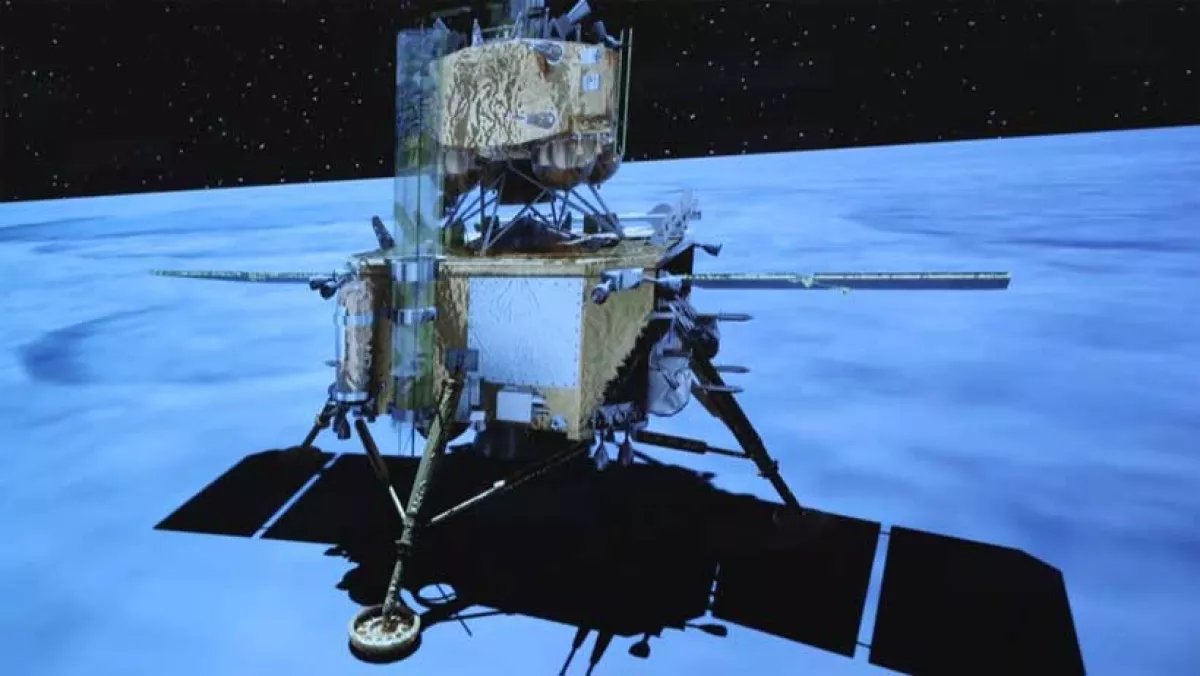
Chang’e-7 is among China’s most sophisticated lunar missions to date. The spacecraft consists of an orbiter, lander and rover, as well as a small mobile “hopper” designed to investigate terrain that would be difficult or impossible for a conventional rover to reach.
The hopper is particularly important because it is designed to make short jumps across cratered terrain and perform measurements directly on the lunar surface. Those observations could help establish whether water ice exists in concentrations and locations that might eventually make its extraction practical.
Scientists have already accumulated considerable evidence of lunar polar ice through radar, spectroscopy and other remote-sensing techniques. The next step is to obtain more detailed information from the surface itself.
What makes Chang’e stand out
Other countries are pursuing the same broader objective of determining whether lunar resources can support sustained exploration. The United States, in particular, is working toward establishing a long-term presence on the Moon, although NASA has chosen a substantially different approach.
Rather than developing every lunar delivery system itself, NASA is attempting to build a commercial lunar marketplace through its Commercial Lunar Payload Services (CLPS) programme. Under the initiative, the agency purchases delivery, mobility and technology services from private companies that develop and operate their own spacecraft. NASA currently has 17 contracted deliveries carrying more than 60 scientific instruments.
Chang’e-7, by contrast, is a coordinated state-run mission whose different components have been designed around a single scientific objective. It will also be able to make use of China’s already operational Queqiao-2 communications and relay infrastructure.
China has spent roughly two decades developing an increasingly ambitious lunar exploration programme, named after Chang’e, the ancient Chinese goddess of the Moon. The programme has progressed from orbiters to increasingly complex landing and sample-return missions and is now moving toward exploration of the lunar south pole.
Meanwhile, US companies are pursuing the same goal. Intuitive Machines attempted to deliver water-searching equipment near the lunar south pole in 2025, but its lander tipped over after landing and was unable to complete its planned experiments.
Astrobotic and Jeff Bezos-founded Blue Origin are also developing lunar missions, while NASA’s VIPER rover remains intended to investigate the distribution and characteristics of lunar water in greater detail.
The growing focus on lunar water reflects its potential importance for future exploration. Water could potentially be processed into drinking water and oxygen, while its hydrogen and oxygen components could also serve as rocket propellant, reducing the need to transport supplies from Earth.
Crewed exploration is expected to follow these robotic missions, with the longer-term ambition of establishing permanent infrastructure on the lunar surface. One of the most significant projects envisioned for the future is the International Lunar Research Station, which is being jointly developed under the leadership of the China National Space Administration and Russia’s Roscosmos.
By Nazrin Sadigova







 editor@caliber.az
 +994 55 444-88-98
 Азербайджан, Баку, ул. Низами, 203, Af Business House, 5-й этаж