










Famed German painter’s art discovered to contain hidden Nazi symbols
A painting by a famous German artist beloved by the Nazis for his celebration of German industry has been found to have been doctored to hide Nazi imagery and sell in the post-WWII art market.
But questions began to emerge after German filmmaker Thomas Schuhbauer found one of the paintings at his parents’ home, as a TVP World News article reports.
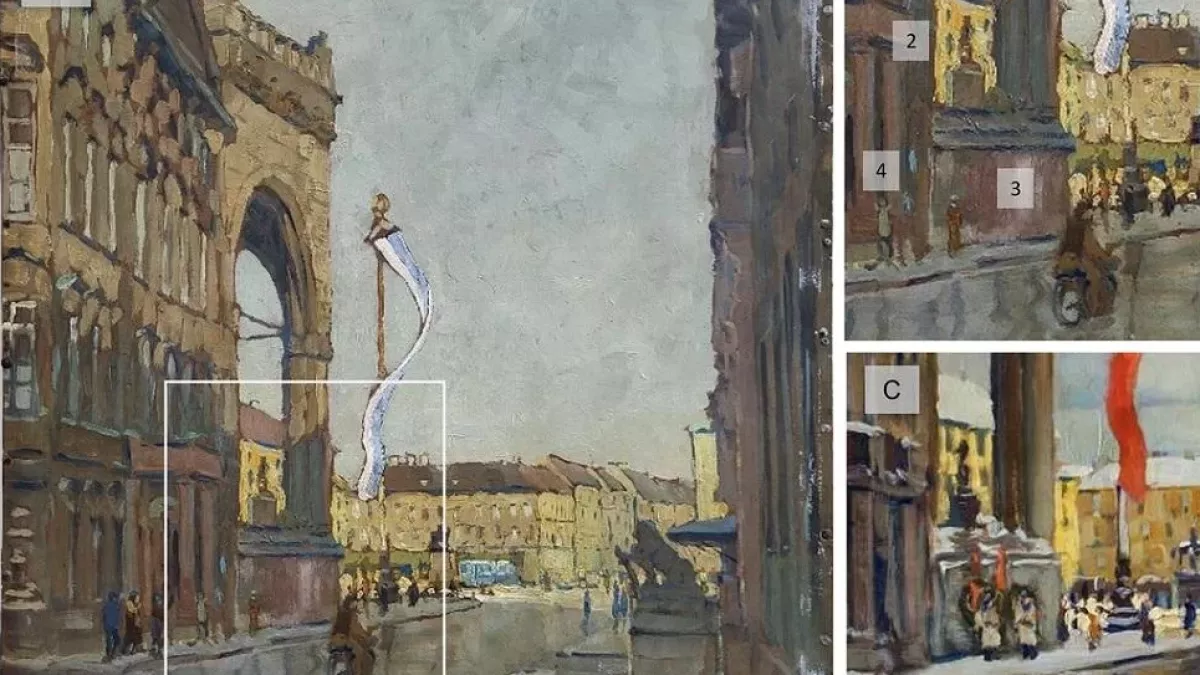
Although the painting showed a Bavarian flag and no visible Nazi symbols, traces of the Nazi memorial at the Feldherrnhalle remained detectable despite the monument's demolition after Germany's defeat in 1945.
Schuhbauer then turned to researchers at the Helmholtz-Zentrum Berlin, where scientists used X-ray fluorescence spectroscopy — a technique that identifies chemical elements hidden in underlying paint layers without damaging the artwork.
The scans uncovered features beneath the visible paint that researchers say are consistent with Nazi-era imagery, reinforcing the conclusion that parts of the original composition had later been painted over.
According to the researchers, X-ray fluorescence scans revealed that several elements associated with Nazi symbolism had been deliberately concealed beneath the painting's visible surface.
The art work in question is “Die Stätte des 9. November,” which showed the Feldherrnhalle in Munich, which carried strong meaning for the Nazi Party being the site of Adolf Hitler’s failed 1923 coup, also known as the Beer Hall Putsch.
After the fall of Nazi Germany and the end of WWII, Mercker went on to become President of the Munich Artist’s Association, where he continued to paint scenes of Munich, though without Nazi imagery.
Laboratory results reflect deeper societal patterns
Beneath the Bavarian flag, the team identified what they believe to be a red Nazi flag. The scans also uncovered hidden wreaths on the monument, uniformed figures throughout the scene, and raised arms that researchers interpreted as Nazi salutes.
The researchers also found that the overpainted areas contained unusually high concentrations of titanium white pigment, a material absent from the rest of the painting, suggesting those sections had been deliberately altered.
Researchers later identified a tube of paint labelled "Titanium White 10103 Schmincke" to have been found among materials from Mercker's studio, which they said was consistent with the overpainting.
Based on the technical analysis, the researchers concluded that the modifications were likely made after the painting's original completion and may have been carried out by Mercker himself.
The study said some of the alterations appeared hurried, with traces of the underlying imagery remaining visible.
Publishing their findings in the journal npj Heritage Science, the researchers said: “It can be concluded that the selection of Mercker’s tube oil paints matches the paints used both in executing the original painting and the overpainted schemes.
“The act of simply overpainting Nazi symbolism shows symbolically how parts of the German society handled the trauma of the Nazi period.
“The act of re-using incriminated political art shows a rather mercantile attitude towards controversial work and exemplifies the continuity of art after World War II, which is similarly found in literature, economy and even politics.”
By Nazrin Sadigova







 editor@caliber.az
 +994 55 444-88-98
 Азербайджан, Баку, ул. Низами, 203, Af Business House, 5-й этаж