










How black holes can shape galaxies around them
Astronomers studying nine nearby galaxies have found that activity around supermassive black holes can reshape their surroundings and influence the formation of new stars.
The researchers examined galaxies with active galactic nuclei (AGNs) at their centres. AGNs are bright, turbulent regions powered by supermassive black holes, which can be millions or billions of times more massive than the Sun and actively feed on gas and dust.
As energy from an AGN flows into the surrounding interstellar medium, it produces powerful, fast-moving shock waves known as AGN feedback. These shocks can move gas and dust, the raw material needed to form stars.
The researchers used the Very Large Telescope and its Multi Unit Spectroscopic Explorer instrument to study AGNs in which the central black holes were actively accreting matter, SPACE reports.
They found arcs and rings of star formation between 2,600 and 20,000 light-years from the centres of the galaxies. The team also observed cones of radiation extending from the accretion disks, with fast-moving shocks travelling through the central regions and perpendicular to the radiation cones.
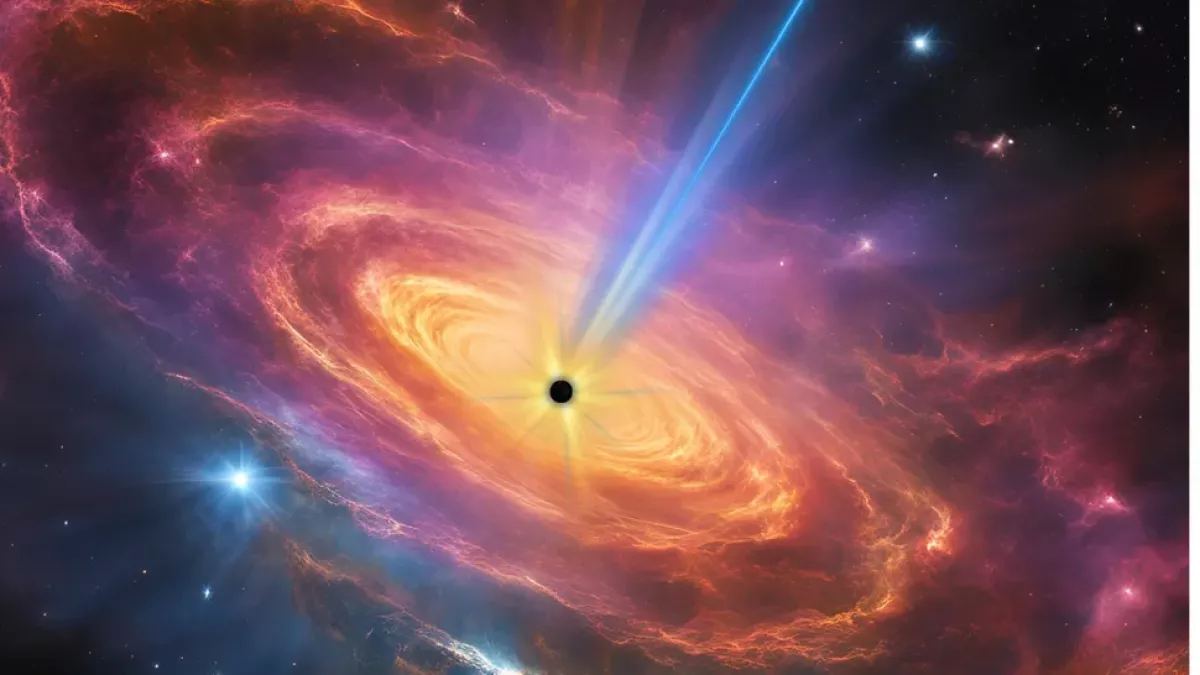
An illustration of a supermassive black hole at the heart of an AGN.
“The injection and accretion are linked with each other,” Peixin Zhu of the Center for Astrophysics said.
The researchers found that the shocks consistently travelled perpendicular to the direction of the black holes’ outflows across all nine galaxies. They said that in galaxies with less powerful jets, winds from the black holes may also contribute to generating the shocks.
The findings provide a clearer picture of the complex cycle of accretion and outflow around AGNs and how this activity interacts with host galaxies and influences star formation.
By Aghakazim Guliyev







 editor@caliber.az
 +994 55 444-88-98
 Азербайджан, Баку, ул. Низами, 203, Af Business House, 5-й этаж