










James Webb Telescope captures stunning new view of "Lion Nebula" PHOTO
NASA’s James Webb Space Telescope has captured a remarkably detailed new view of NGC 2392, better known as the “Lion Nebula,” revealing its intricate clouds of gas and dust in vivid pink and indigo hues.
The new imagery provides one of the clearest views yet of the ancient planetary nebula. Webb’s Near Infrared Camera (NIRCam) and Mid-Infrared Instrument (MIRI) reveal structures that were not visible in earlier observations, while distant galaxies appear as bright orange points and shapes in the background, according to TheDebrief.
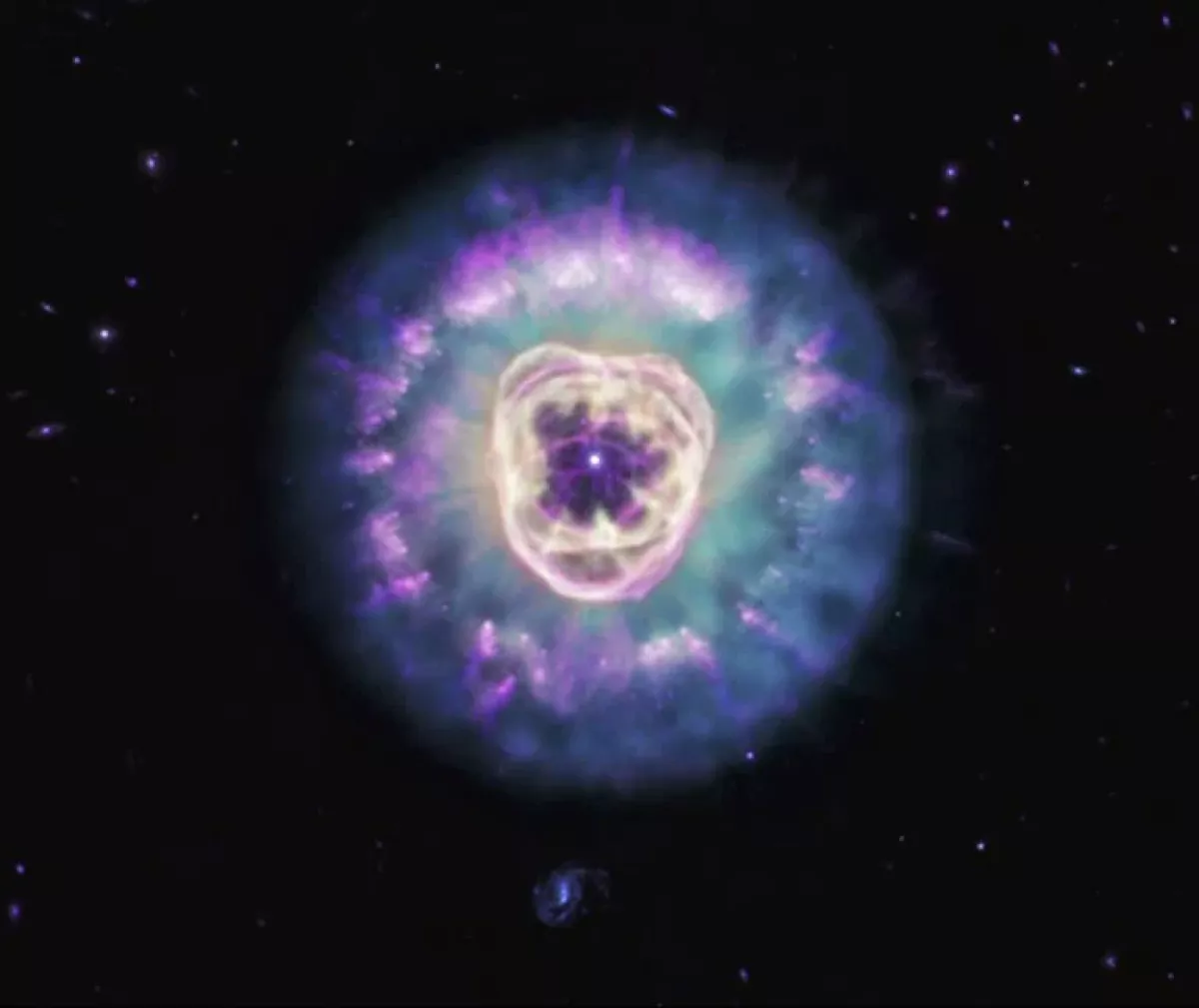
The nebula’s distinctive appearance resembles a lion’s face, with a hazy “mane” formed by stellar gas and dust. At its centre is the remnant of a dying white dwarf star, which continues to energise the surrounding material and shape the nebula.
According to the European Space Agency, the gas and dust making up the nebula have taken thousands of years to reach their current form and are still undergoing changes.
The lion-like face is formed largely by an expanding bubble of ionised gas. Astronomers are still working to understand the mechanisms responsible for the bubble’s complex structure, which is a feature seen in other ancient nebulae.
NGC 2392 was previously photographed by the Hubble Space Telescope in 2000. Webb’s ability to observe in additional infrared wavelengths has now provided a much more detailed look at the nebula’s dust and ionised gas.
Despite its tranquil appearance, the Lion Nebula is a highly dynamic region of space. Material continues to move away from the stellar remnant at its centre, gradually dispersing into the surrounding environment.
Astronomers estimate that the nebula could eventually disappear over the next 10,000 years as its central white dwarf cools and the remaining stellar material disperses.
NGC 2392 is not the only object known as the “Lion Nebula.” The name is also used for Sharpless 2-132, a separate diffuse nebula in the constellation Cepheus whose shape resembles the body of a lion.
The latest Webb observations are giving astronomers an unprecedented look at the evolving structures of NGC 2392 and the final stages of a star’s life.
By Sabina Mammadli







 editor@caliber.az
 +994 55 444-88-98
 Азербайджан, Баку, ул. Низами, 203, Af Business House, 5-й этаж