










NASA captures Black Sea's stunning colour change as plankton blooms PHOTO
NASA has captured the Black Sea’s annual transformation into a vivid turquoise spectacle, as massive blooms of microscopic plankton changed the colour of the water in a phenomenon visible from orbit.
The US space agency’s PACE (Plankton, Aerosol, Cloud, Ocean Ecosystem) satellite observed the seasonal event this summer, with its Ocean Colour Instrument (OCI) recording striking images of bright blue and turquoise patterns spreading across the Black Sea.
Located between Europe and Asia, the Black Sea connects to the Mediterranean through a network of waterways. While its waters are typically dark in appearance, the sea can undergo a dramatic visual transformation during spring and summer, when vast swirls of turquoise appear across its surface.
According to NASA, scientists believe the unusual coloration was primarily caused by coccolithophores — microscopic phytoplankton covered in tiny calcium carbonate plates. When these organisms multiply in large concentrations, their reflective shells scatter sunlight and give the water a cloudy, milky blue appearance.
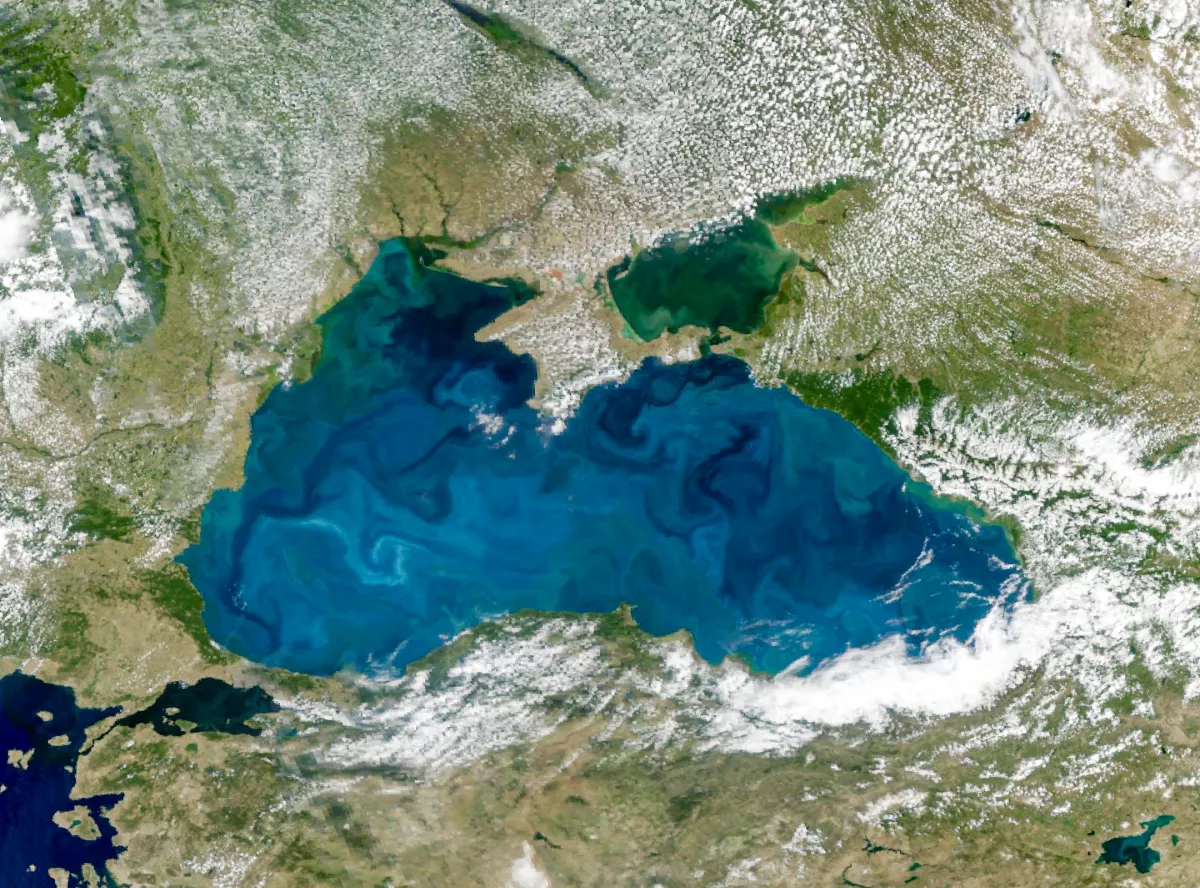
Coccolithophores are particularly common in the Black Sea during late spring and early summer. During other periods of the year, diatoms — another type of microscopic algae with silica-based shells — may become more dominant. Unlike coccolithophores, diatoms tend to make the water appear darker rather than brighter.
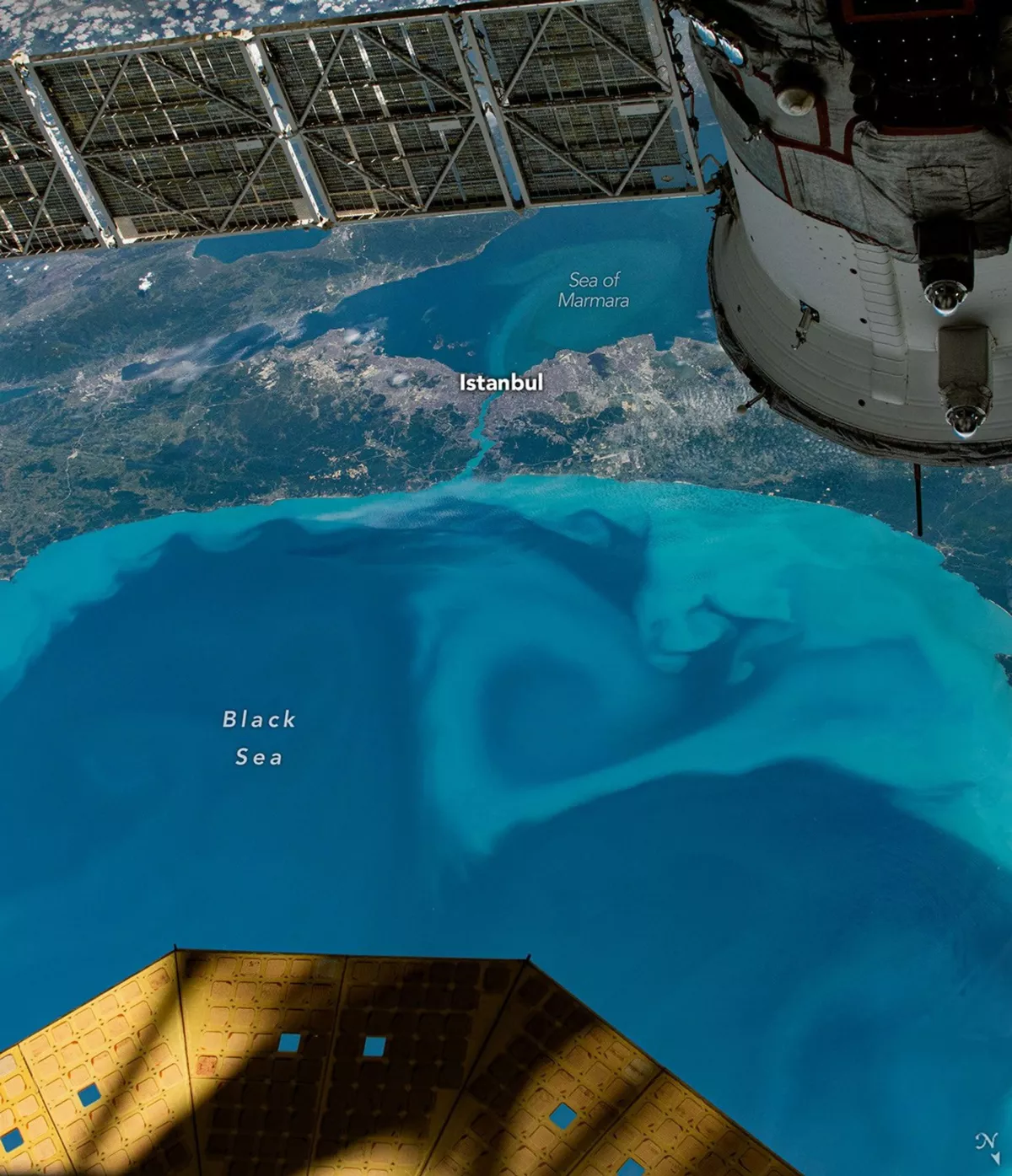
The turquoise colouration was also observed in the Bosphorus Strait, the narrow waterway running through Istanbul that connects the Black Sea with the Sea of Marmara.
Beyond aesthetic beauty
Besides creating a spectacular view from space, these plankton blooms play an important role in Earth’s carbon cycle. Coccolithophores absorb carbon dioxide as they grow, helping move carbon through marine ecosystems.
When the organisms die, some of the carbon contained in their remains can sink toward the ocean floor, where it may remain stored for extended periods of time.
On May 27, 2026 — about a month before the PACE satellite captured its images — an astronaut aboard the International Space Station also captured these colourful waters of the Bosphorus. The image showed phytoplankton blooms following the movement of ocean currents on both sides of the narrow channel.
By Nazrin Sadigova







 editor@caliber.az
 +994 55 444-88-98
 Азербайджан, Баку, ул. Низами, 203, Af Business House, 5-й этаж