










NATO allies united on spending, yet divided on long-term strategic goals An analysis by Foreign Policy
The recent NATO summit in Ankara projected a strong image of allied unity, with leaders reaffirming their “ironclad commitment to [their] collective defence under Article 5 of the Washington Treaty” and endorsing a “360-degree approach to deterrence and defence.” Yet behind the carefully crafted messaging in the alliance's joint communique, analysts argue that the alliance remains divided over a fundamental question: what is the ultimate purpose of NATO’s rapidly expanding defence spending?
An analysis published by the Foreign Policy journal explores these doubts, noting that while allies broadly agree on the need to increase military budgets, they disagree on whether those investments should reinforce Europe’s dependence on the United States or accelerate the development of independent defence capabilities.
The publication identifies NATO Secretary-General Mark Rutte and Canadian Prime Minister Mark Carney as the leading proponents of these competing visions, describing them as representing “opposing poles of a years-old debate coming to a boil in Europe,” as previously characterized by The Wall Street Journal.
Rutte's pursuit of holding transatlantic bridge together
Since becoming NATO secretary-general, Mark Rutte has earned a reputation as the “Trump whisperer,” a leader seen as particularly adept at maintaining relations with US President Donald Trump and reducing the likelihood of a US withdrawal from NATO.
His principal argument has centered on defence spending. According to the Foreign Policy analysis, NATO allies have committed an additional $1.2 trillion in military spending since Rutte took office. Germany plans to spend approximately $125 billion on defence in 2027, while Poland is moving toward allocating 5 percent of its GDP to defence.
The report argues that European countries are finally making meaningful investments in military capabilities, despite continuing disagreements over procurement, defence industries, and budget priorities.
However, Rutte has consistently maintained that higher European defence spending is not intended to replace American military capabilities. Instead, he views it as a way to preserve long-term US engagement in European security, including continued purchases of American defence equipment rather than prioritizing exclusively European alternatives.
Where many European leaders previously feared that greater defence spending could encourage Washington to reduce its military presence, Rutte has argued the opposite—that stronger European commitments demonstrate good faith and make continued US deployments more likely.
Carney’s path to renegotiate North American loyalties
Canadian Prime Minister Mark Carney has advanced a markedly different vision of NATO's future.
A vocal critic of President Trump, Carney has argued that middle powers such as Canada and European countries must become more capable of acting independently in an increasingly multipolar international system. The analysis notes that Trump's repeated criticism of Canada, along with threats of tariffs and even suggestions of annexation, likely strengthened Carney's domestic political position.
Speaking earlier this year at the World Economic Forum in Davos, Carney argued that countries such as Canada and its European partners must learn to assert themselves if they are to avoid becoming vulnerable to major powers.
His remarks attracted particular attention because they appeared to suggest that both the United States and China could play such dominant roles. This vision was underscored even further when Carney travelled to Beijing to discuss closer cooperation with Chinese officials shortly afterward.
According to the analysis, Carney continued promoting this vision during the Ankara summit, encouraging NATO's middle powers to prepare for a United States that is “reassessing its priorities.”
Unlike Rutte, Carney argues that European allies should build independent defence capabilities not only as insurance against any future reduction in US military commitments but also to reduce strategic dependence on what he sees as an increasingly unpredictable partner.
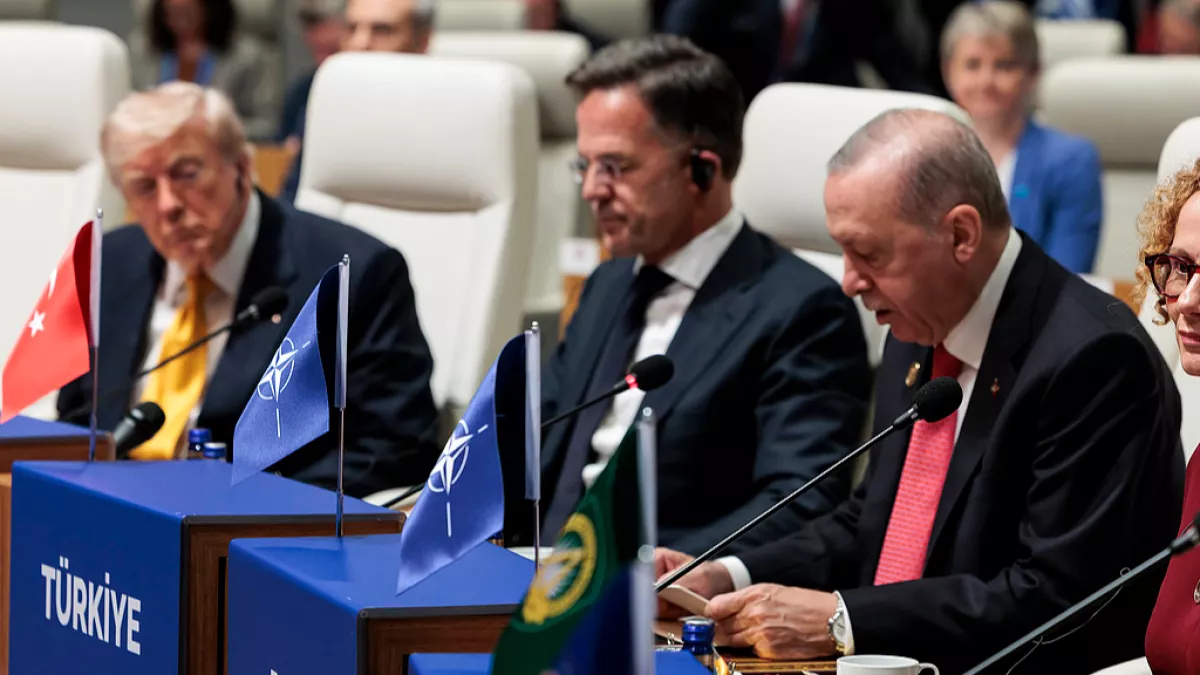
The report notes that Ankara was an especially symbolic venue for advancing this argument. Should European countries adopt Carney's approach, their defence policies could increasingly resemble those of Türkiye, which the journal describes as having long been regarded as “an important but questionably committed member of the NATO alliance,” likely referring to Ankara's multiple foreign policy strategies it pursues for its national interests rather than following a policy scripted by another country's government.
The analysis concludes that although NATO members increasingly agree on expanding defence spending, they remain divided over the strategic purpose behind those investments. French President Emmanuel Macron has long advocated European strategic autonomy, aligning closely with Carney's position, while Rutte's approach has found support from leaders including outgoing British Prime Minister Keir Starmer. The journal notes that Starmer's successor also appears likely to support Rutte's vision.
“The implications of this disagreement are profound; it strongly impacts what states feel they should invest in during this transition. Is it enough to merely emphasize increased spending? Or do European states need to move expeditiously toward specific capabilities?,” the article asks.
By Nazrin Sadigova







 editor@caliber.az
 +994 55 444-88-98
 Азербайджан, Баку, ул. Низами, 203, Af Business House, 5-й этаж