










Tehran's ruling elite reportedly torn over how to continue wielding Hormuz card
A full six months have now passed since the US and Israel launched strikes on Iran, plunging the entire region into a war that has multiple frontlines: military, political and economic. Restrictions on goods transiting the Strait of Hormuz have been at the center of the economic damage inflicted by the conflict worldwide. While military exchanges continue to this day, opposition voices in Iran suggest that the ruling establishment in Tehran has reached an impasse over how to continue leveraging the card represented by its control of the vital waterway.
The disagreement within Iran's ruling class is reportedly not over the principle of resisting the United States, but rather "when, and in exchange for what, Iran should convert the leverage it has created in the Strait of Hormuz into sanctions relief and a political agreement," as an analysis published the opposition news network Iran News Wire argues.
According to its observations, the Strait has become a dividing line within the Islamic Republic’s power structure. On one side, President Masoud Pezeshkian’s government and figures within the conservative camp favour a phased agreement, a managed reopening of shipping and securing concessions on sanctions.
On the other, the Iranian newspaper Kayhan, widely regarded as the most conservative outlet promoting hard-line views, together with a segment of the hardline camp, argues that negotiating under pressure would squander the very leverage Iran gained at the cost of war.
The dispute has become more sensitive because energy markets have not waited for the crisis to be fully resolved, as per the opposition paper. Other Iranian media reported that shipping traffic has not yet returned to normal, but that “part of the oil flow through this route has resumed.” At the same time, according to Kayhan, Washington has withdrawn waivers related to Iranian oil exports and continues maritime pressure and sanctions against Tehran’s economic channels.
This leaves the Iranian establishment with a concrete question: if other countries’ oil is moving while Iran’s oil revenues remain constrained, how long does maintaining restrictions in Hormuz remain advantageous for Tehran?
As the opposition news outlet points out, the government’s position in recent days appears to have moved toward a conditional deal. Pezeshkian has emphasized resolving disputes through negotiations, Foreign Minister Abbas Araghchi has said a return to diplomacy is possible, and Parliament Speaker Mohammad Bagher Ghalibaf told the Qatari prime minister that Washington must fulfill its commitments under the Islamabad understanding. Mohsen Rezaei, the Secretary of the Supreme National Security Council, has taken a harder but still transactional position: the United States must first take practical steps, after which Iran will decide on reopening Hormuz.
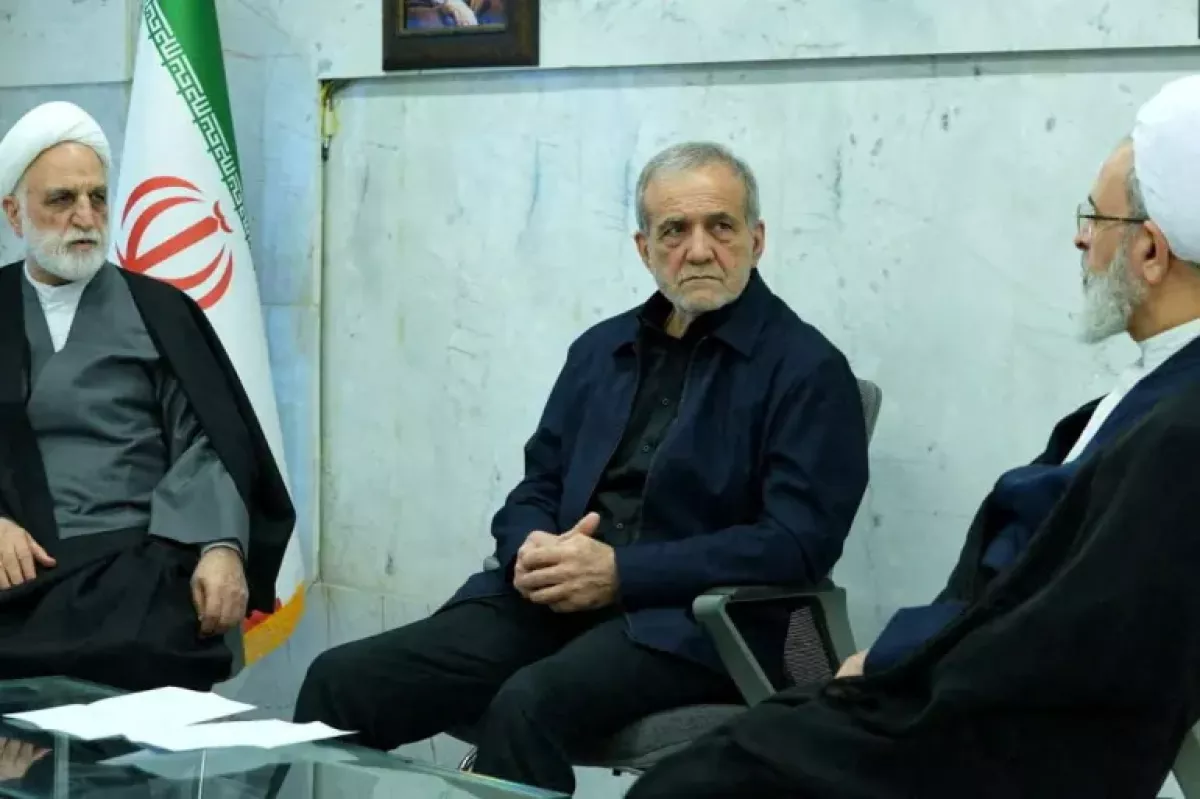
Iran News Wire's analysis suggests that the strategy of the above-mentioned figures is to turn control over Hormuz into a phased bargain. Sasan Karimi, a University of Tehran professor, has warned that the value of this leverage is not permanent: “The Strait of Hormuz is a negotiating lever that must be translated into national interests at the right time. Delay in doing so will turn the issue into its opposite.”
Karimi has even described a “managed and gradual” reopening of the strait, if it leads to arrangements that ease pressure, as being “entirely in the national interest.” This view differs significantly from the traditional argument for keeping Hormuz closed until a full US retreat. Under this framework, maritime power is not an end in itself, but an asset whose value declines if it is used too late.
However, the article points out that it is precisely this logic that the Kayhan newspaper rejects, stating that the imposition of new sanctions and the dispatch of mediators are two parts of a single American pressure campaign. The newspaper reportedly promotes the view that Tehran’s response should be to raise the costs for Washington rather than accelerate negotiations.
The piece by Iran News Wire cites a passage from Kayhan, which reads: “There is no way except to answer every threat from him with a greater threat,” adding that Iran must make its threat “credible, meaning tangible.” It then directly targeted the negotiation-oriented camp: “The most destructive political action is to lower one’s guard in the face of the enemy’s threat and speak of diplomacy and negotiations with him.”
Decision makers pulled in opposite directions
According to the article, the disagreement is not simply about rhetoric. Two different strategies for confronting oil sanctions are competing with one another: The first argues that Iran should use Hormuz to secure sanctions relief, shipping guarantees and a phased return to the Islamabad understanding, while the second holds that any reduction in maritime pressure before a US retreat would encourage Washington to maintain sanctions and demand further concessions.
Interestingly enough, a newspaper close to the Islamic Revolutionary Guard Corps titled Javan reflects a third position. It insists that the United States has failed to force Iran to change course through military means and now faces a state of “deterrence.” But that argument does not necessarily lead to Kayhan’s conclusion that negotiations should be rejected while pressure continues.
Tehran’s central question, therefore, is no longer “negotiation or resistance.” As outlined above, all three camps speak in terms of resistance and deterrence. According to the outlet, the dispute is therefore over what comes next: "Should Iran now convert Hormuz leverage into oil-sanctions relief, or does it see continued pressure on shipping as the only way to force further US concessions?"
By Nazrin Sadigova







 editor@caliber.az
 +994 55 444-88-98
 Азербайджан, Баку, ул. Низами, 203, Af Business House, 5-й этаж