










Karim Bouamrane: France's emerging political challenger Hyphen examines Muslim mayor with ambitions for Élysée Palace
The British website Hyphen Online has published an article examining the presidential ambitions of French Muslim mayor Karim Bouamrane. The article portrays Bouamrane as a politician seeking to redirect France's political debate from questions of identity towards social and economic issues such as housing, public services and inequality. At the same time, it argues that his ethnic and religious background continues to shape public perceptions of him, suggesting that these issues remain closely intertwined with his presidential ambitions despite his emphasis on policy. Caliber.Az presents excerpts from the piece below.
"Karim Bouamrane announced his bid to become France’s next president the way he does most things: on his own terms and ahead of schedule. Speaking on France Inter radio on 9 June, the Socialist mayor of Saint-Ouen said he planned to unite France’s divided left ahead of the 2027 election with La France Humaine et Forte, the political movement he launched in 2024 with former president François Hollande and centre-left politician Raphaël Glucksmann.
It is an ambitious bid from a politician who, until recently, was little known outside the Paris suburb he has governed since 2020.
'I will do everything I can to make sure I’m on the ballot — and that I win,' he said when announcing his candidacy. Speaking to Hyphen, he said he intends to reach the second round of the presidential election.
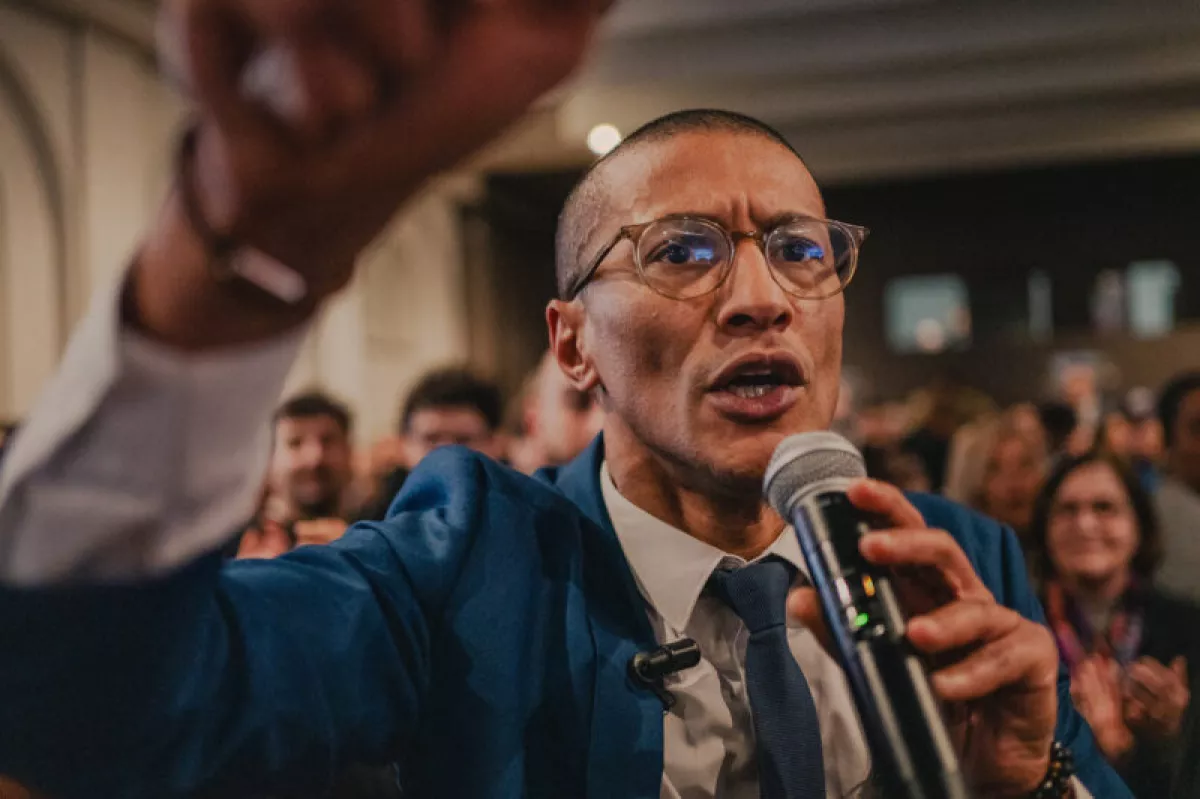
Born in 1973 to Moroccan immigrant parents, he joined the Communist Party aged 22 and the Socialists at 41 — the same year he ran for mayor of Saint-Ouen and lost. He ran again in 2020 and won, then was re-elected comfortably in March.
Six years governing one of France’s most diverse municipalities, he says, has convinced him that the country’s political class is asking the wrong questions. 'The first person who gets questioned is the mayor,' he tells Hyphen. 'You see the people every day. You build a contract of trust.'
While national politicians focus on immigration, Islam and national identity, Bouamrane says the people he meets are more concerned about housing, schools, public services and security.
Bouamrane argues that France’s political class has mistaken social problems for identity ones. Racism and Islamophobia are real, he says, but they worsen deeper problems of housing, public services and inequality rather than explaining them. 'The problem is social, exacerbated by the ethnic and the religious,' he says.
Housing is the example he returns to most often.
'France is missing half a million homes, and most candidates leave the subject alone, because they consider it local rather than presidential,' he says.
On Islamophobia, Bouamrane argues that for many: 'Islam has become synonymous with Islamism, immigration and insecurity.'
France’s National Consultative Commission on Human Rights, which publishes an annual survey of attitudes towards racism and discrimination, has repeatedly found that hostility towards Muslims is closely linked to hostility towards immigrants more broadly, echoing his argument that Islam is often treated as a proxy for wider anxieties about immigration and security.
Bouamrane also rejects the idea of a single 'Muslim vote'. By his estimate, 90% of Muslims in France simply work, pay taxes and want good schools for their children.
He argues that race and religion matter when people seek power. French elites, still overwhelmingly white, carry what he calls the vestiges of colonialism — a habit of reducing non-white public figures to their identity in a way white politicians rarely experience. The label 'Muslim politician', he argues, is part of that reflex. 'Nobody calls Macron a Catholic politician, do they?'
To make the point, he describes himself: 'I am French, my parents are Moroccan, I am Franco-Moroccan. I am Muslim.'
Before entering politics, Bouamrane worked in cybersecurity, where he says he encountered the same double standards he now criticises: expected to be compliant, but labelled arrogant the moment he showed ambition. He believes politics works much the same way. Being Black, Muslim, Arab or Maghrebi, he argues, 'doesn’t cause trouble' until 'you have ambition to govern at the highest level'.
Bouamrane asks to be judged on his record and his ideas for France. But his own story suggests that the closer he comes to national power, the harder he will have to fight to be seen as a politician rather than a Muslim, a French Moroccan or a former communist," the article writes.
By Aghakazim Guliyev







 editor@caliber.az
 +994 55 444-88-98
 Азербайджан, Баку, ул. Низами, 203, Af Business House, 5-й этаж