










Port of great expectations: Anaklia as a key link in the Middle Corridor Georgian experts on Caliber.Az
Georgia’s deep-sea Anaklia port, often referred to as the “project of the century,” had been stalled for a prolonged period. In 2020, the authorities terminated the contract with the Georgian-American consortium that was supposed to develop the project. However, the growing strategic importance of the Middle Corridor prompted Tbilisi to revive the construction plans.
In July, the government announced a shift to the “landlord model”: the state will retain a controlling stake, ownership of key infrastructure and the land, while private companies and international partners will be invited to operate individual terminals. As Economy Minister Mariam Kvrivishvili stated, abandoning the single-investor model will allow Georgia to diversify cargo flows and integrate Anaklia into international logistics networks more quickly.
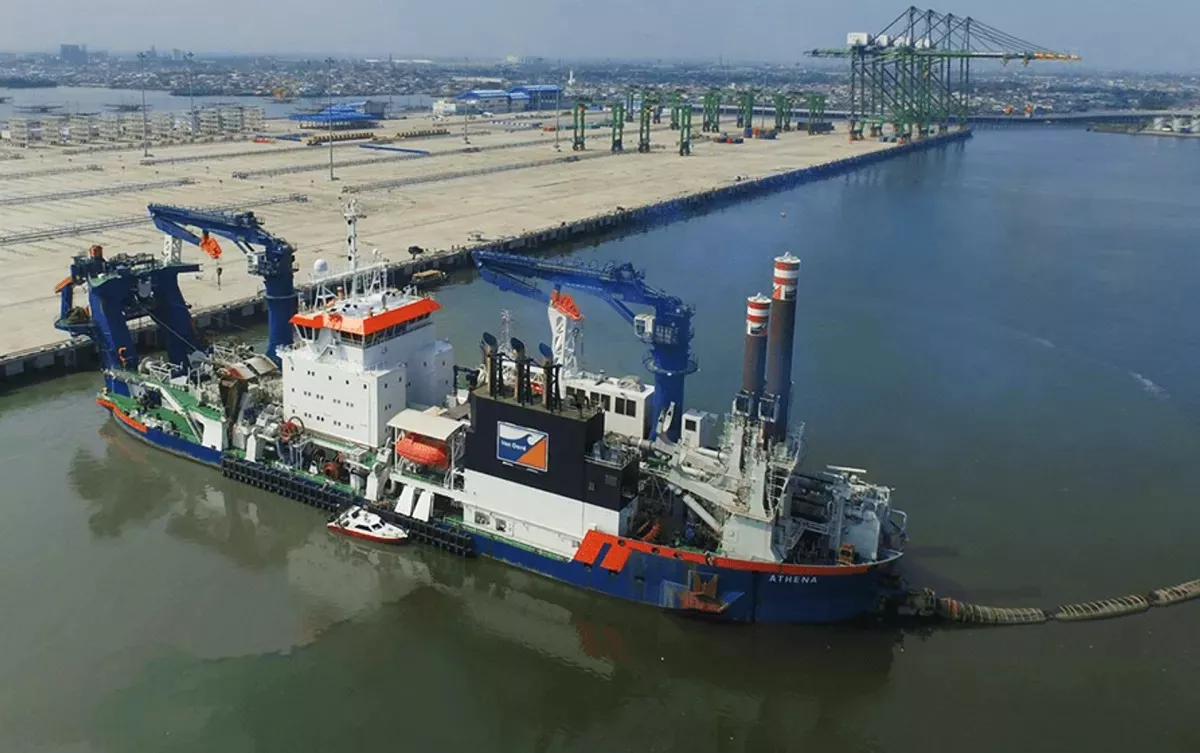
As NewsGeorgia reports, Georgia’s Ministry of Economy announced that the dredger Tristao Da Cunha had entered the waters of Anaklia and, after completing the required procedures, began dredging operations and the construction of an access channel. According to the ministry, the specialised equipment will increase the depth of the seabed to 17.5 metres. The next stage will involve the construction of a 1,380-metre-long breakwater. The ministry noted that the works are proceeding strictly according to schedule, with the dredging phase expected to be completed by May 2027.
It should also be emphasised that the maritime infrastructure is being built by Belgian company Jan De Nul Group, which was awarded the contract in 2024, together with local partners. The state is responsible for constructing the road and railway connections to the future port. The government expects to complete the first phase of construction by 2029, by which time the port will be capable of handling up to 600,000 containers annually. The required investment for this stage is estimated at $600 million.
So, do the latest developments indicate that the port’s construction has moved from a period of stagnation into an active phase? What impact will the opening of this deep-sea port have on Georgia’s economic and political landscape? And will the facility become a key factor in significantly increasing the flow of goods travelling from China and Central Asian countries to Europe? Georgian experts answer these questions for Caliber.Az.

Nika Chitadze, Professor at the International Black Sea University (Tbilisi) and Director of the Centre for International Studies, noted that, judging by Georgian Prime Minister Irakli Kobakhidze’s recent statement, the Anaklia port is expected to become operational in 2029.
“This will be a deep-sea port capable of receiving all types of commercial vessels, which will significantly distinguish it from the ports of Batumi and Poti, which are not deep-sea ports and can accommodate only 65% of vessels. According to the project, the port will be able to handle around 40 million tonnes of various types of cargo annually.
However, it should be noted that under the previous plan, the authorities had promised to launch the port in 2020, and today we are already in 2026. Therefore, it remains unclear to what extent the current statements by the prime minister will correspond with reality.
If the port is eventually completed, it will significantly enhance Georgia’s transit role and increase the country’s trade turnover, allowing it to strengthen its position in the international economic arena. At the same time, the port’s operation will be impossible without the development of supporting infrastructure — roads and railways that must ensure the delivery of cargo to Anaklia,” Chitadze said.

Meanwhile, political analyst and founder of the SIKHA Foundation research centre Archil Sikharulidze said that the Anaklia deep-sea port project has always been viewed as a crucial alternative to Novorossiysk and therefore received active support from all political forces in Georgia.
“Even opposition figures were involved in the process and considered the project’s implementation essential. The main problem was that, as in many other cases, neither the Americans nor the Europeans were willing to invest due to the high risks involved.
For many years, Georgia searched for various potential partners, but eventually, due to pressure from the United States, it abandoned the possibility of open financing from China. As a result, the state assumed part of the obligations itself.
The implementation of this project will bring a major breakthrough for the economies of both Georgia and the South Caucasus as a whole. A phenomenal increase in transit volumes is expected, which is of great interest to China and Central Asian countries, as it will create an additional alternative route that is not limited solely to rail connections.
At the same time, the project also has a geopolitical dimension. Through it, the Georgian state will once again demonstrate its importance as a transit hub and become a much stronger and more sovereign actor. This is extremely important for Georgia amid the ‘Cold War’ that Brussels is currently waging against Tbilisi,” Sikharulidze concluded.







 editor@caliber.az
 +994 55 444-88-98
 Азербайджан, Баку, ул. Низами, 203, Af Business House, 5-й этаж