










Uzbekistan bets on aviation boom with new airport, massive airline reforms
Uzbekistan is pressing ahead with plans to build a new international airport near Tashkent as part of a broader effort to liberalise its aviation sector, a strategy that also includes the planned stock market listing of state carrier Uzbekistan Airways in 2027 amid a rapid rise in travel across Central Asia.
Uzbekistan's aviation market has expanded rapidly over the past decade. According to the International Air Transport Association (IATA), the number of airlines serving the country has nearly tripled, rising from 16 in 2015 to 47 today, as an in-depth report by Nikkei Asia on the Central Asian country's growing tourism industry notes.
In a report published in December, aviation analytics firm OAG described Central Asia as the world's fastest-growing aviation market, attributing much of the growth to the expansion of low-cost carriers across the region.
Routes linking Russia with Uzbekistan, Tajikistan and Kyrgyzstan continue to account for a significant share of regional traffic. Their importance increased further after Russia's invasion of Ukraine in 2022, which led to the closure of Russian airspace to many Western airlines and reshaped travel patterns across Eurasia.
Kazakhstan remains Central Asia's largest aviation market, accounting for roughly half of the region's airline capacity, while Uzbekistan—home to the region's largest population—accounts for about one quarter.
Revamping capital's airport
A consortium comprising Saudi Arabia's Vision Invest, Japan's Sojitz, South Korea's Incheon International Airport Corporation and Uzbekistan Airports will develop the $2.5 billion project. Under the agreement signed during the Tashkent International Investment Forum in mid-June, Vision Invest will hold a 45% stake, Sojitz 30%, Incheon 15%, and Uzbekistan Airports the remaining 10%.
The consortium will operate the passenger terminal for 35 years after it opens, which is expected by 2030, while ownership of the airfield will remain with the Uzbek state. New airports are also planned in the cities of Bukhara and Urgench, with construction scheduled to kick off in 2026.
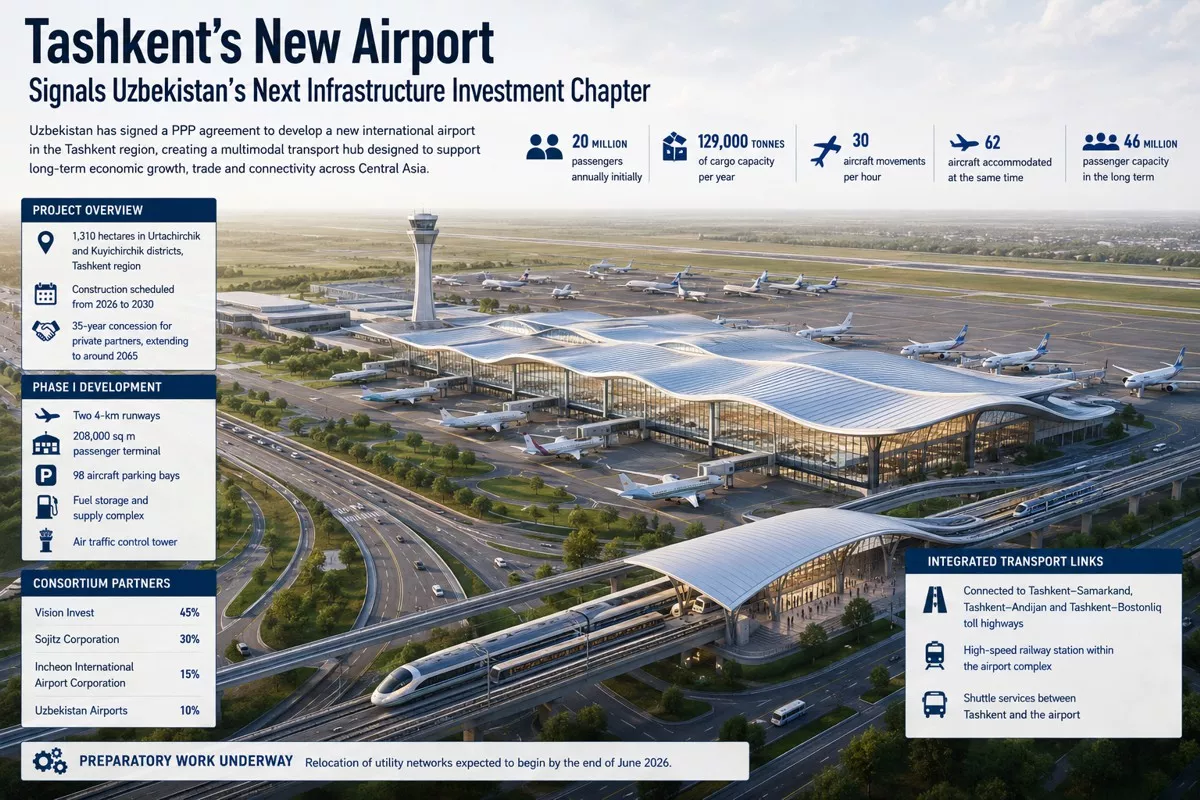
The project comes as passenger demand continues to outpace earlier forecasts. Islam Karimov Tashkent International Airport handled around 10 million passengers in 2025, already approaching the previously projected 2030 capacity of 11 million passengers.
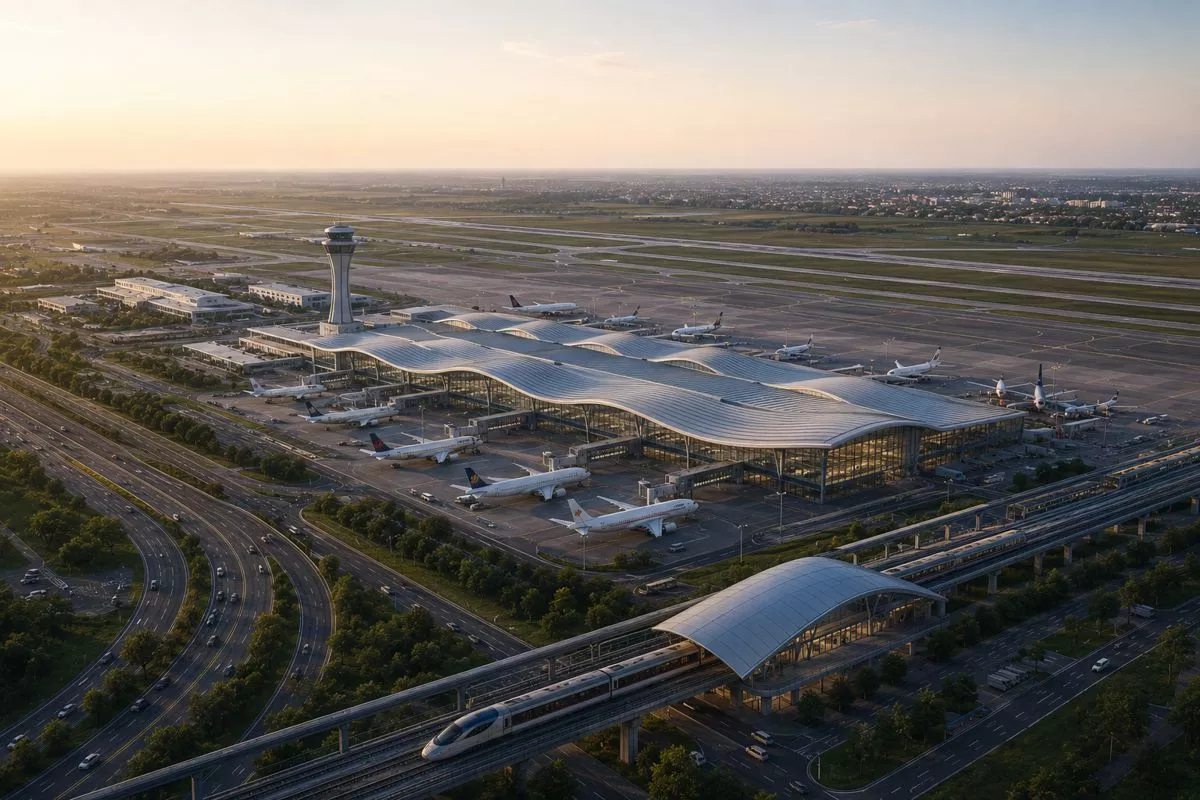
The new airport, located about 24 kilometers from central Tashkent, is initially designed to accommodate 20 million passengers annually.
"We massively underestimated," Vision Invest Senior Vice President Kazbek Bassiev said at the investment forum last month, referring to earlier passenger projections. "That is what makes us convinced of the demand."
Reflecting the country's growing importance, IATA announced in April that it would open a permanent office in Tashkent, describing Uzbekistan as a regional leader. The organization said the office would help airlines and airports implement international safety and operational standards.
One of the office's first priorities will be establishing a Billing and Settlement Plan (BSP) by the end of the year, enabling Uzbek airlines to process global financial transactions more efficiently and expand international ticket sales.
Rising interest in Central Asian region
Industry stakeholders are also banking on continued tourism growth. According to the national statistics office, international arrivals rose 27.5% year-on-year during the first five months of 2026.
Visitors are increasingly combining trips to Tashkent with the historic cities of Samarkand and Bukhara as part of wider Central Asia itineraries. Particularly strong growth has been recorded among tourists from China, Malaysia, Japan and the United States, according to the presidential administration.
Despite the surge in demand, Uzbekistan Airways has struggled to keep pace, currently accounting for 86% of the domestic market.
President Shavkat Mirziyoyev said in June that the airline's fleet expansion had failed to match growing passenger demand. To address the shortfall, Uzbekistan Airways has ordered 36 aircraft from Airbus and Boeing, with plans to more than double its fleet by 2030 while launching new routes to Southeast Asia, India and Pakistan.
The government also plans to float between 15% and 20% of the airline through an initial public offering as part of Uzbekistan's broader privatization program, following the May IPO of state investment fund UzNIF, which currently holds a significant stake in the carrier.
The airline's reform program comprises 115 measures, including the adoption of international accounting standards. Asset manager Franklin Templeton, which serves as trustee and manager of UzNIF and is expected to oversee the IPO, estimates the reforms could increase Uzbekistan Airways' valuation from $1.6 billion to approximately $2.3 billion.
Uzbekistan is not the only one in the neighbourhood that is preparing for growing passenger and tourist traffic. Across Central Asia and the South Caucasus, Kazakhstan is expanding Almaty International Airport, while Azerbaijan is enlarging Heydar Aliyev International Airport in Baku, with both seeking to capture a greater share of Europe–Asia transit traffic.
By Nazrin Sadigova







 editor@caliber.az
 +994 55 444-88-98
 Азербайджан, Баку, ул. Низами, 203, Af Business House, 5-й этаж