










Astronomers warn mass satellite constellations will disrupt telescopes, observatories
The rapid expansion of satellite megaconstellations could make the night sky up to three times brighter than it is today, severely disrupting astronomical observations and imaging systems.
According to a new study that was uploaded to the preprint server arXiv but not yet peer-reviewed,satellite operators may need to comply with strict brightness and size limits to avoid worsening light pollution in space observation, as LiveScience highlights.
Thousands of satellites already orbit Earth in sprawling constellations, with many more expected to launch in the coming years. Astronomers say these satellites increasingly interfere with observations by streaking across telescope images and contaminating data.
In 2021, researchers recommended that satellites operating in Low Earth Orbit at around 550 kilometers altitude should have an apparent magnitude of at least 7 — a measure of brightness where higher numbers indicate dimmer objects.
Olivier Hainaut, an astronomer at the European Southern Observatory in Garching and author of the new study, told Live Science by email that this threshold is “completely coincidentally, [that's] the faintest satellite visible by the naked eye.”
Hainaut explained that bright satellite streaks can trigger additional imaging distortions in sensitive astronomical cameras.
“For some cameras … this causes a secondary effect (‘saturation cross-talk’) that multiplies the effect of the bright streak,” he said. “This could zap whole images.”
He also warned that satellites contribute to broader atmospheric light pollution. “The light from the bright satellites is scattered by the atmosphere, illuminating the whole sky,” Hainaut said. “This constitutes light pollution.”
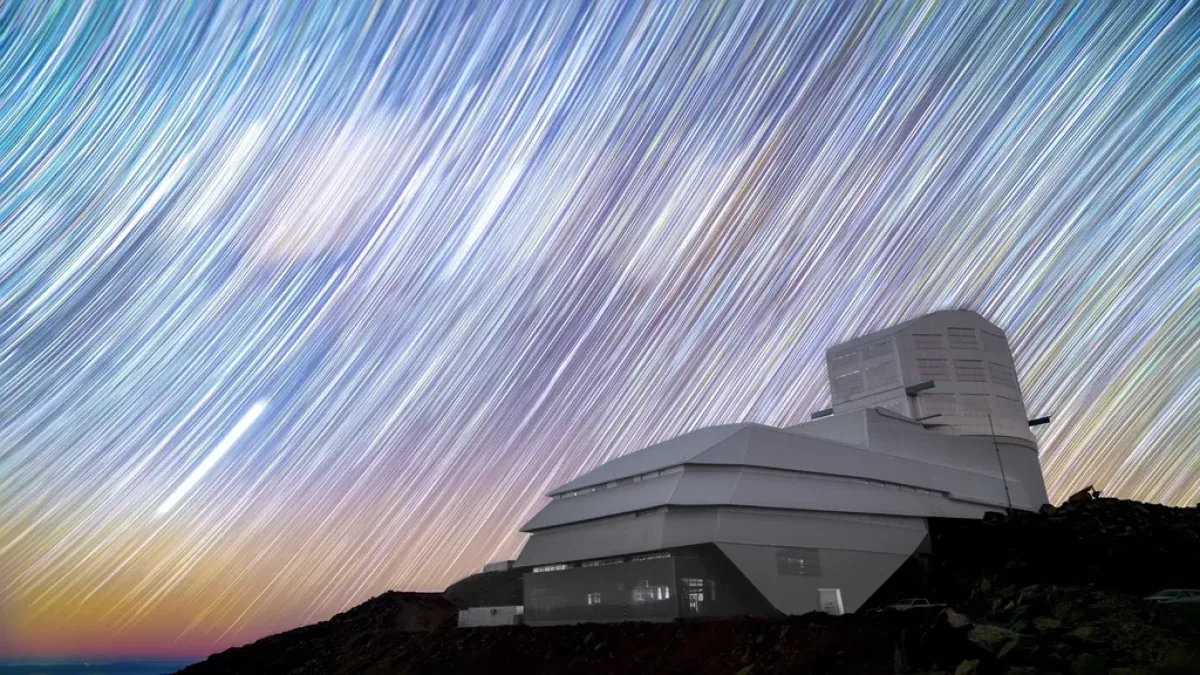
Study’s customized model
To better understand the scale of the problem, Hainaut developed a computer model simulating how visible light from satellites is scattered through Earth’s atmosphere.
The model incorporated two separate physical scattering processes, allowing researchers to estimate how the night sky would appear from different Earth-based observatories.
According to the study, a megaconstellation consisting of 60,000 satellites — even if all were dimmer than magnitude 7 — would increase the natural brightness of the night sky by only about 0.1%.
However, the satellites’ trails across telescope images would still create major issues. Hainaut found they could saturate between 6% and 15% of the field of view of the LSST Camera, potentially wiping out large numbers of astronomical observations.
By Nazrin Sadigova







 editor@caliber.az
 +994 55 444-88-98
 Азербайджан, Баку, ул. Низами, 203, Af Business House, 5-й этаж