










Dormant dispute risks erupting as Putin sets foot in Kuril islands
When Russian President Vladimir Putin embarked this week on his first-ever visit to the Southern Kuril Islands, known in Japan as the Northern Territories, a dormant diplomatic volcano that has remained unresolved since the end of the Second World War erupted once again in Tokyo.
The visit prompted an immediate and sharp protest from Japan. Prime Minister Sanae Takaichi called the move “absolutely unacceptable,” saying Putin's visit “wounds the feelings of the Japanese people,” as reported by Japanese media outlets.
Japan's Foreign Minister Toshimitsu Motegi issued a similarly forceful response, declaring that the islands are “an inherent part of Japan’s territory both historically and under international law,” and that the government “strongly protests this visit.”
The territorial dispute over the Southern Kuril Islands remains one of the biggest sticking points in Russia-Japan relations. It has prevented Moscow and Tokyo from signing a post-World War II peace treaty, while Japan's sanctions against Russia over the Ukraine crisis have brought bilateral negotiations over the islands to a halt.
While attending military drills in Yuzhno-Sakhalinsk, Putin recalled that Russia had once maintained constructive engagement with Japanese leaders, including former Prime Minister Shinzo Abe, before Tokyo changed its policy towards Moscow.
Under Abe's administration, the two countries sought to set aside their territorial differences in order to advance trade and economic cooperation. Abe also attended multiple sessions of the Eastern Economic Forum in Vladivostok.
Those days now appear distant. One of the clearest signs of the deterioration in relations is Japan's newly published Defence White Paper, which classified Russia as a major threat for the first time. Putin, for his part, has repeatedly sought to downplay the possibility of a direct confrontation, saying in various speeches that "we do not pose a threat to Japan. We have absolutely no claims against it."
Inheritance from World War II
At the heart of the dispute lies the Kuril Islands, a chain of islands stretching between Japan's northernmost main island, Hokkaido, and Russia's Kamchatka Peninsula. The strategically important volcanic archipelago has been under Russian administration since the Soviet Union seized it during the final days of World War II in 1945.
The territorial dispute has remained unresolved for more than 80 years and continues to represent the primary obstacle to Russia and Japan signing a formal peace treaty.
The modern dispute dates back to the shifting borders of the 19th century.
In 1855, the Treaty of Shimoda established a border between Iturup and Urup, leaving the four southern islands — Kunashir, Habomai, Shikotan and Iturup — under Japanese control. In 1875, the two empires exchanged their territorial claims: Russia gained control of Sakhalin, while Japan took possession of the entire Kuril chain.
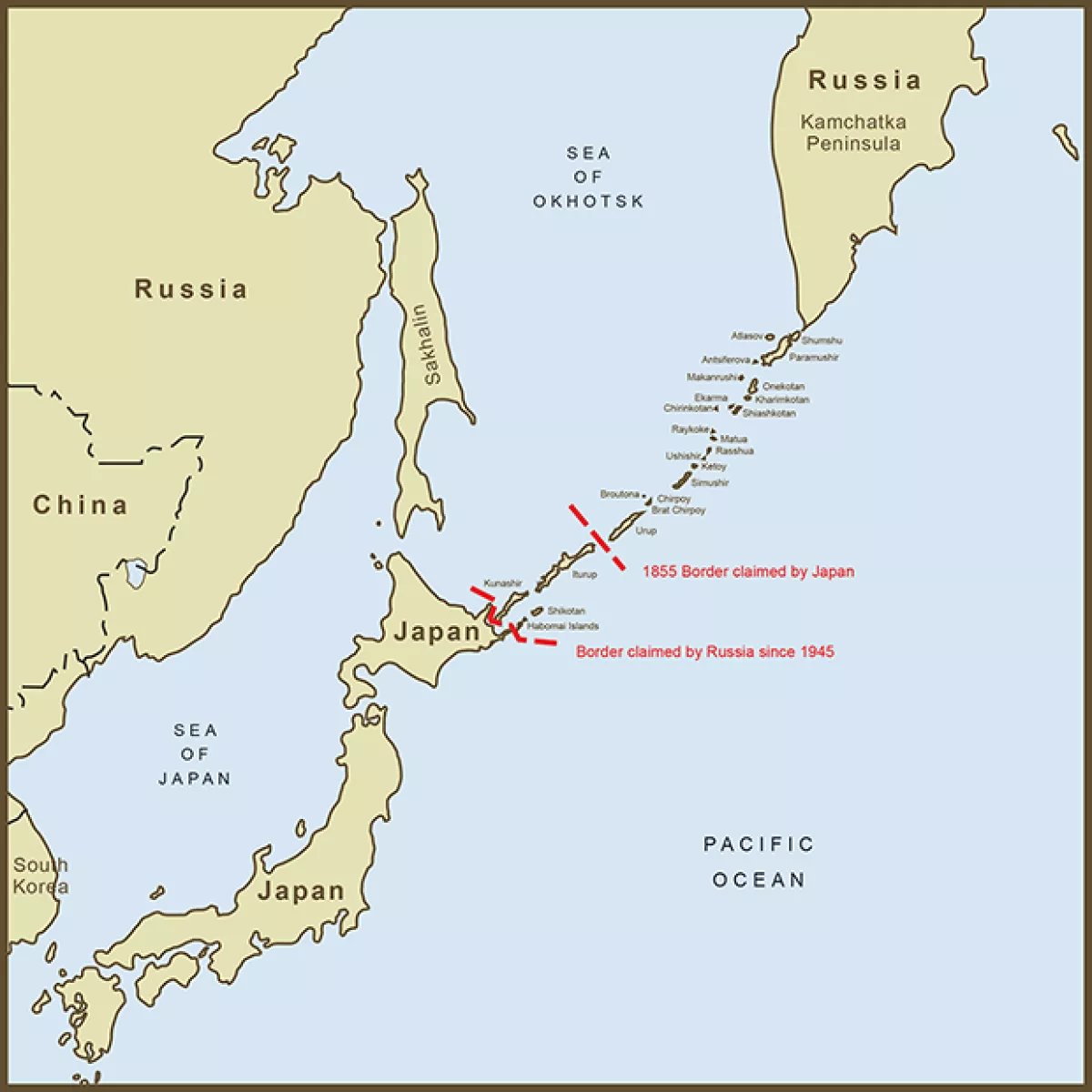
That arrangement held, with interruptions, until the final days of the Second World War. On August 8, 1945, the Soviet Union declared war on Japan, two days after the atomic bombing of Hiroshima and roughly a week before Tokyo announced its surrender. Soviet forces subsequently moved into the Kuril Islands and southern Sakhalin.
The legal picture is similarly complicated. Japan renounced its claims to the Kuril Islands under the 1951 San Francisco Peace Treaty, but the Soviet Union did not sign the agreement, and the treaty did not specify which country would assume sovereignty over the disputed territory.
In 1956, Moscow and Tokyo restored diplomatic relations. Soviet leader Nikita Khrushchev subsequently indicated that Shikotan and Habomai could potentially be handed over to Japan following the conclusion of a formal peace treaty. Japan, however, continued to demand the return of all four islands.
The islands have significance far beyond their symbolic value and serve as a strategic point for defence purposes.
The archipelago stretches in an arc from Kamchatka south towards Hokkaido and has long served as a forward military position for Moscow. The islands help Russia control access to the Sea of Okhotsk, which serves as a strategic sanctuary for its nuclear-armed submarines.
That logic survived the collapse of the Soviet Union. In recent years, Russia has reinforced its military presence on the islands with coastal missile systems, upgraded runways and new barracks. Moscow has also introduced tax incentives aimed at attracting settlers and investors.
The surrounding waters are rich fishing grounds, while the islands themselves contain deposits of gold, silver and rhenium, a rare metal used in jet engines. Around 20,000 Russian citizens currently live across the disputed territory.
Ukraine factor
Russia-Japan relations have deteriorated sharply since 2022 when Japan joined the sanctions regime and imposed its own sweeping restrictions on Russia over the Ukraine crisis, while direct air links were severed and bilateral trade and investment contracted sharply.
Moscow has repeatedly protested Japan's provision of economic assistance and geospatial intelligence to Kyiv, its support for using frozen Russian sovereign assets held by Western states to aid Ukraine, and its cooperation with Ukraine on drones.
In 2022, Russia suspended peace treaty talks with Japan "because it is impossible to discuss this fundamental document on bilateral relations with a state that holds an explicitly unfriendly position and seeks to harm the interests of our country."
Moscow also suspended visa-free travel for former Japanese residents of the Southern Kuril Islands wishing to visit their former places of residence.
Since taking office, the Takaichi administration's push for greater remilitarisation has further heightened Russian security concerns.
In late July, Russian Deputy Foreign Minister Andrey Rudenko argued that what he described as the belligerent stance of the Japanese authorities was negatively affecting stability in the Asia-Pacific region and directly undermining the security interests of neighbouring countries.
Regarding Russia-Japan relations, the diplomat said that only if Japan takes concrete steps to abandon its anti-Russian stance can the two countries resume dialogue and cooperation.
For now, experts believe there appears to be little prospect of a breakthrough as neither side has much room for compromise over the territorial dispute, while Japan's alignment with the West over the Ukraine crisis makes any significant easing of sanctions against Russia unlikely.
By Nazrin Sadigova







 editor@caliber.az
 +994 55 444-88-98
 Азербайджан, Баку, ул. Низами, 203, Af Business House, 5-й этаж