










Berlin looks to Kyiv as Europe’s new defence innovation hub
Europe’s approach to security and defence in relation to Ukraine appears to be undergoing a major shift, reflected in a new defence partnership between Kyiv and Germany announced this week.
While Western governments initially viewed Ukraine primarily as a recipient of military aid and financial support, a growing number of European capitals now see the country as one of the world’s leading laboratories for modern warfare technology.
Although the initiative may appear at first glance to be another bilateral defence-industrial agreement, analysts say it represents something far more consequential: Berlin is effectively acknowledging that much of the innovation shaping 21st-century warfare is now emerging from eastern Europe.
The launch of the “Brave Germany” initiative was announced in Kyiv on May 11 by German Defence Minister Boris Pistorius and Ukrainian Deputy Prime Minister Mykhailo Fedorov.
The project will serve as Germany’s partnership branch within Brave1, Ukraine’s state-backed defence innovation platform focused on supporting military technology development and defence startups.
According to an analysis by the Hungarian Conservative outlet, the signing of the letter of intent by Pistorius during his visit to Ukraine marks a significant evolution in German strategic thinking.
Evolving German defence outlook
For decades after the Cold War, Germany’s security policy was shaped by limited military engagement, relatively modest defence spending and heavy reliance on multilateral institutions. But the war in Ukraine exposed how slowly many traditional European defence systems adapt to the realities of modern conflict.
Ukraine, by contrast, has developed a wartime innovation model built around rapid production cycles, low-cost technological adaptation and real-time battlefield testing. Ukrainian developers have often managed to move drone systems and electronic warfare technologies from prototype to deployment within months — a pace that many European defence companies previously considered unrealistic.
Pistorius has openly acknowledged this shift. According to the German defence minister, Berlin is no longer seeking only to support Ukraine militarily, but also to learn from the country’s battlefield experience and defence-industrial innovation.
The change signals a broader transformation in German-Ukrainian relations, which are increasingly evolving from a traditional donor-recipient dynamic into a strategic technology partnership.
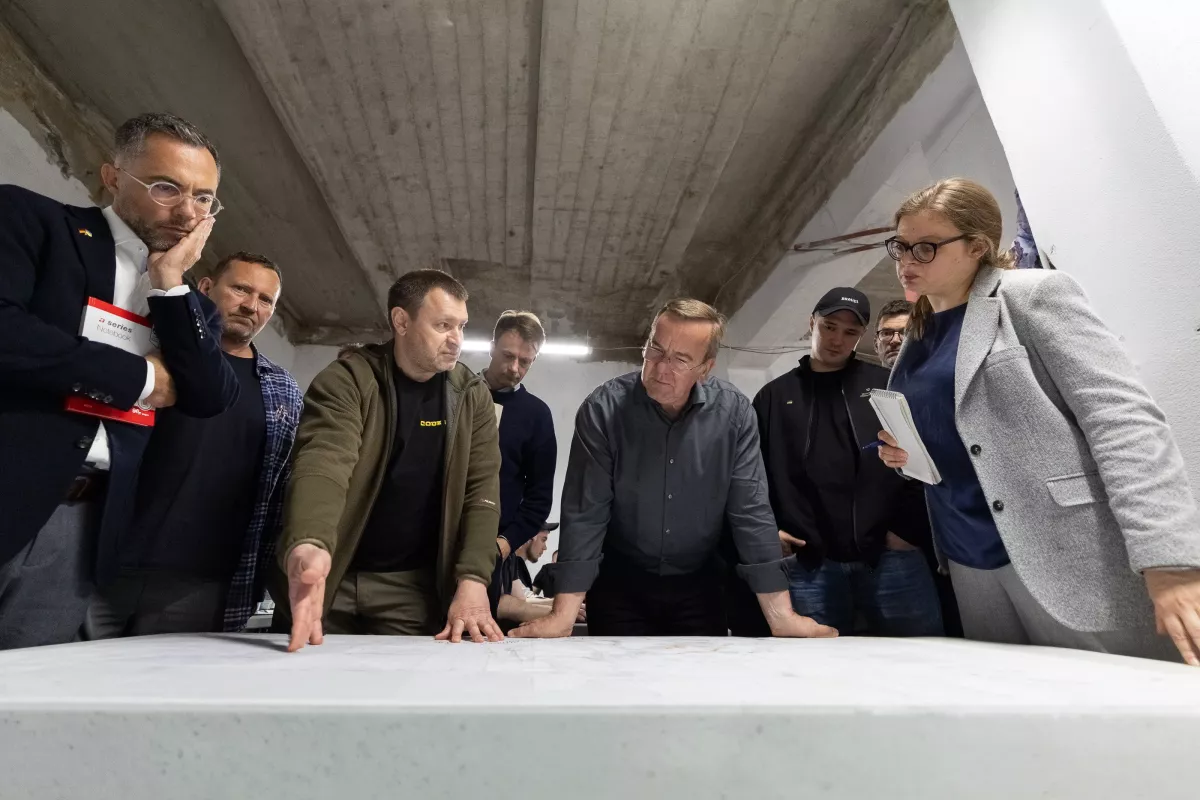
At the core of the Brave Germany initiative will be a joint financing mechanism designed to support Ukrainian and German firms developing strategically important military technologies. The "Brave Germany" initiative is intended to help Kyiv address technological gaps on the front line by integrating innovations developed in cooperation with partner countries.
The cooperation will focus on unmanned systems, artificial intelligence, advanced communications, high-powered laser weapons and missile-related technologies.
Drone development has emerged as one of the partnership’s most important components. German and Ukrainian companies are already cooperating on several short-, medium- and long-range unmanned systems projects. According to reports, some of the planned platforms could eventually strike targets at distances of up to 1,500 kilometres.
Ukraine leads West into new era of warfare
As the article highlights, this initiative reflects more than technological cooperation alone, as it is a broader transformation like warfare itself.
One of the clearest lessons from the war in Ukraine is that low-cost, rapidly manufactured and mass-deployable unmanned systems are increasingly capable of replacing — at least partially — some traditionally expensive weapons platforms. Drones are no longer viewed merely as supporting tools, but as central infrastructure in modern combat operations.
For Germany, this carries major strategic implications. For decades, Berlin built its defence model around heavy conventional weapons systems and large-scale industrial manufacturing. Ukraine’s wartime experience suggests future conflicts may place equal importance on software development, autonomous systems and electronic warfare alongside tanks and artillery.
German military planners are therefore paying close attention to Ukraine’s battlefield coordination systems. During the war, Ukraine developed decentralised digital command structures capable of processing battlefield data in real time and adapting rapidly to changing tactical conditions.
Such systems could prove particularly valuable for the Bundeswehr, which has long faced criticism over bureaucracy and slow digital modernisation.
The Brave Germany initiative also extends beyond weapons development. The program is expected to include joint hackathons, startup accelerators and innovation competitions aimed at creating an integrated German-Ukrainian defence technology ecosystem.
The first phase of funding is expected to begin by the end of 2026.
By Nazrin Sadigova







 editor@caliber.az
 +994 55 444-88-98
 Азербайджан, Баку, ул. Низами, 203, Af Business House, 5-й этаж