










Christian Solidarity International: Financial misconduct under the guise of charity PHOTO
A special report by the European-Sudanese Public Affairs Council (ESPAC) presents evidence of serious irregularities in the financial reporting of Christian Solidarity International (CSI), an organisation that presents itself as a Christian human rights group.
According to the report, CSI claimed that payments to Sudan were made in the local currency (Sudanese pounds) and did not affect the arms market. In practice, however, the transactions and financial records were conducted in U.S. dollars. It was established that, through CSI, intermediaries earned net profits amounting to three to four times the actual value of the transactions, according to Faktyoxla.az. International reports clearly demonstrate that, by exploiting religious sentiments, CSI created a large-scale "victim industry" in the West (Christian Solidarity International's "Slave Rescue" Efforts Face Scrutiny – MinistryWatch).
Growth in regional spending and Armenia (2020–2025)
According to CSI headquarters in Switzerland, whereas the bulk of the organisation's budget was allocated to Sudan and Syria prior to 2020, following the Second Karabakh War, programmes related to Armenia and Karabakh became one of its priority areas. CSI allocated a significant portion of its revenues to specialised lobbying groups in the United States and Europe to conduct campaigns under the slogans of the "blockade of Nagorno-Karabakh" and the "genocide of Christians."
Funds received from private Armenian donors were distributed by CSI in Armenia through church-affiliated local foundations under the guise of "humanitarian assistance" for Armenians who had voluntarily left Karabakh. These projects were subsequently used as promotional material in the West to expand the organisation's donor base in the following years.
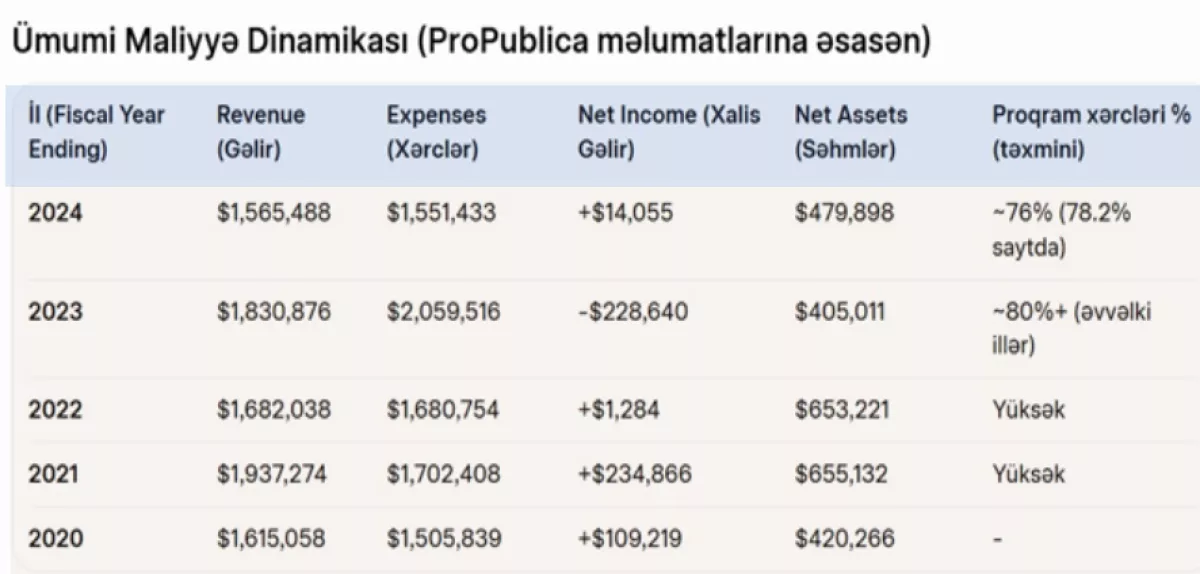
The official annual revenue of CSI's U.S. branch is approximately $1.57 million, while its annual expenditures amount to around $1.55 million. According to its official reports, 78.2 per cent of expenditures are allocated to programme activities, with the remainder spent on administrative costs and fundraising.
It appears that financial transfers between CSI's headquarters in Zurich and its U.S. branch lack transparency. A significant portion of the funds raised in the United States is transferred directly to Switzerland under the designation of "foreign grants" and subsequently routed to third parties. This chain of transactions enables the organisation to obscure the ultimate purpose of the funds during internal audits.
An analysis of CSI's official tax filings submitted to the U.S. Internal Revenue Service (IRS) reveals significant discrepancies that raise questions about the relationship between executive compensation and the share of administrative expenses for a non-governmental organisation of such limited size. Although CSI presents itself as an exclusively charitable organisation, its internal financial management practices suggest a different picture.
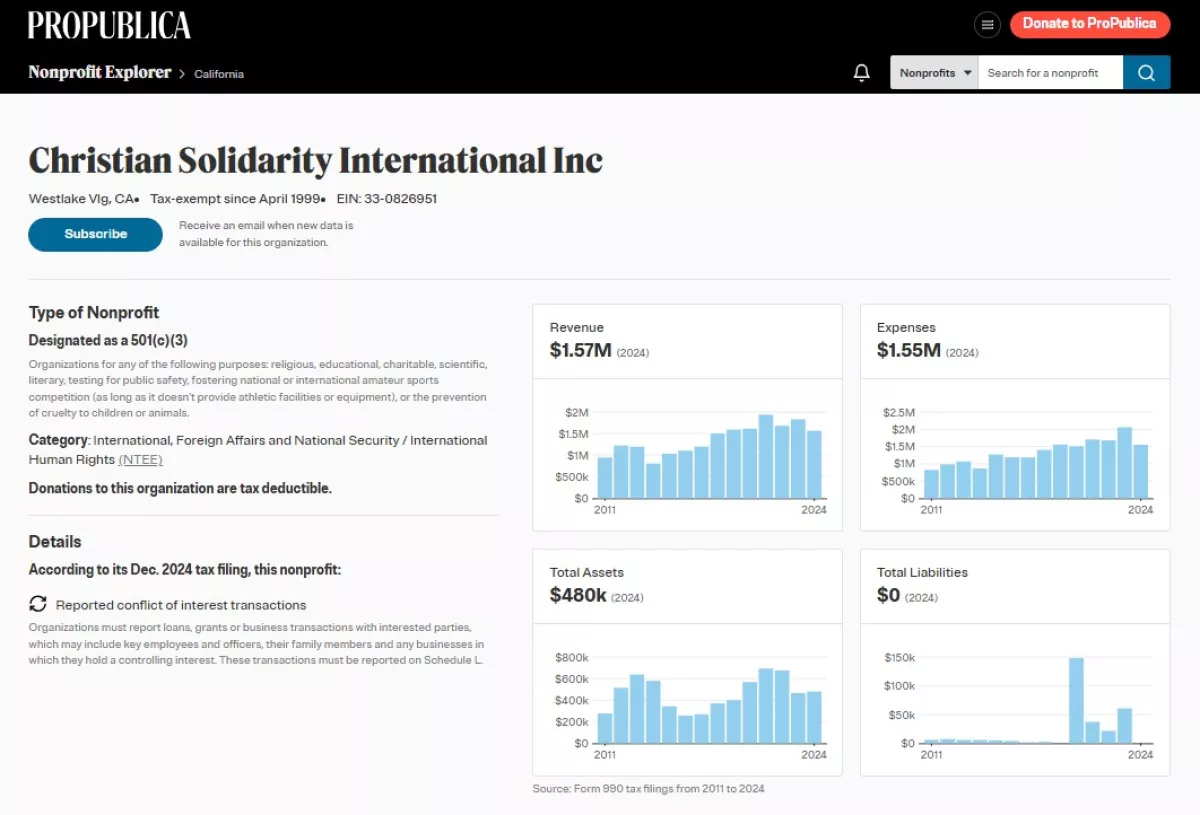
One of the most notable aspects of the tax filings, which independent auditors describe as a red flag, is the organisation's mechanism for transferring funds. A significant portion of donations collected in the United States under the guise of humanitarian assistance from religious communities is not spent within the country. Instead, these funds are reported in tax filings as grants to foreign partner organisations and transferred to the organisation's headquarters in Switzerland. Once the funds leave the United States, it becomes virtually impossible to trace which local foundations, church-affiliated organisations, their representatives, or other recipients ultimately receive them, whether through cash or non-cash transactions. This lack of traceability has been identified as the primary reason why CSI's international financial transparency rating was downgraded to "C."
CSI financial data on Karabakh in the Jahresbericht 2024 annual report
The report presents the overall volume of funding by country in the form of a map and a table. These figures cover expenditures related to programme implementation, including humanitarian assistance, medical support, housing, economic initiatives, advocacy activities, and other projects. However, detailed information on individual disbursements and the internal allocation of funds is not disclosed.
According to the report, $230,000 was allocated to Karabakh and Armenia. The document states that the principal areas of funding included housing assistance, medical and psychological support for individuals who left the Karabakh Economic Region of Azerbaijan in 2023 and are currently residing in Armenia, the restoration of the Lady Cox Rehabilitation Centre building near Yerevan, monthly medical assistance for 150–200 beneficiaries, livelihood and income-generation programmes, and international advocacy activities related to protecting the rights of displaced persons. However, even in these documents, the financial data are presented only in aggregated form, without a detailed breakdown of expenditures.
A similar pattern can be observed with CSI-USA. The organisation holds a status that allows it to receive charitable donations and benefit from tax exemptions. Members of the Armenian diaspora—as well as other donors—who contribute to CSI are eligible to claim tax deductions in the United States, while the organisation subsequently channels these funds into its projects, including those in Armenia, under the guise of humanitarian assistance. On the surface, this mechanism appears lawful and transparent; in practice, however, the situation is more complex.
To elaborate, CSI is required to publish annual financial statements audited by independent auditors. The organisation's Annual Reports provide official statistics on the volume of funds raised and spent worldwide, including financing for projects in Syria, Nigeria, Armenia, and other countries. According to data from the ProPublica registry, CSI-USA does not maintain substantial capital reserves, as the funds it raises are generally disbursed relatively quickly. As of the end of 2024, the organisation's net assets (reserve fund) stood at approximately $480,000, and no outstanding debts or other financial liabilities were reported.
The official figures indicate that CSI manages an annual budget of approximately $1.5–2 million, with a significant portion of these funds directed toward political and religious campaigns, including activities supporting Armenia's interests. The organisation's budget is financed almost entirely—nearly 100 per cent—through donations and grants.
In other words, CSI has no other significant sources of income, such as investment returns or commercial activities. In 2024, the organisation reported total revenue of approximately $265,000, representing a decline of about 14 per cent compared with 2023. At the same time, total expenditures decreased by approximately $508,000. The 2024 financial statements also once again included an expense category labelled "fundraising expenses," amounting to approximately $30,630.
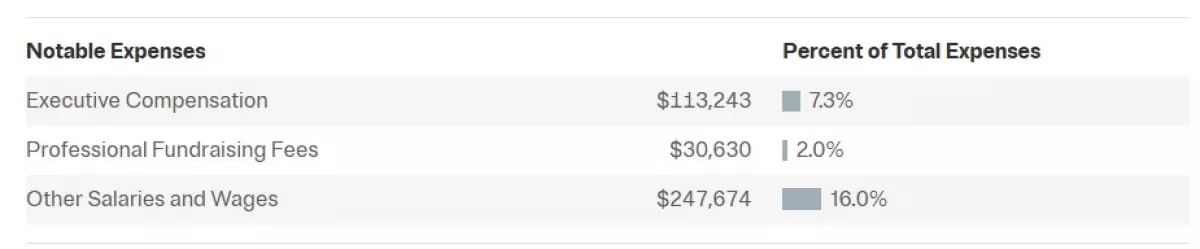
In 2020 and 2021, fundraising expenses were minimal, while in 2022 and 2023 they were reported as zero. This indicates ineffective organisational management. According to ProPublica data, a comparison of CSI's 2024 tax return with its filings from previous years—particularly those for 2020–2023—reveals significant changes in the organisation's financial indicators, as well as a number of circumstances that are considered suspicious and fall into the category of red flags.
Conflict of interest transactions
In the organisation's 2024 filings, the statuses "Reported conflict of interest transactions" and "Schedule L" appeared for the first time.

Under U.S. law, this section is triggered when an organisation provides grants, extends loans to its officers, members of the executive director's family, or external companies and foundations under the concealed control of its leadership, or enters into questionable business transactions with such related parties.
Where is the "conflict of interest" here?
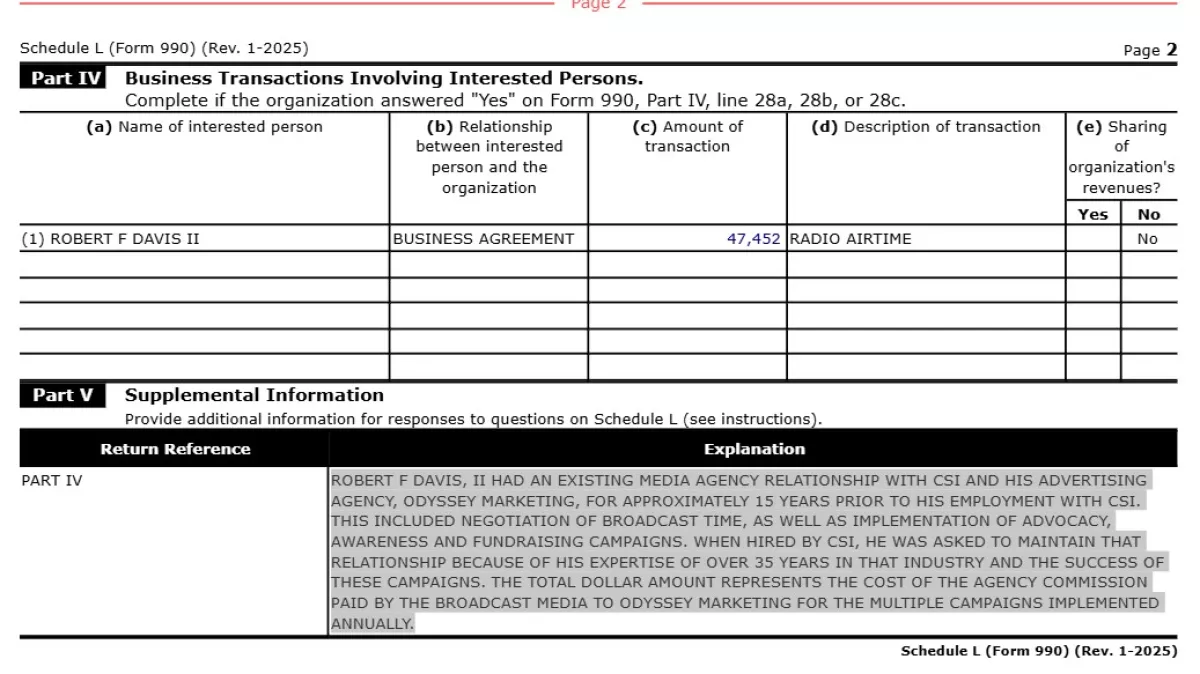
Before joining CSI as its Chief Executive Officer, Robert F. Davis had worked with the organisation for 15 years through his advertising agency, Odyssey Marketing, which he owned. After he became CEO, that business relationship continued.
According to this document, the $47,452 represents a commission payment made to Odyssey Marketing. These funds are paid to Odyssey Marketing by radio stations. In other words, CSI pays media companies for radio advertising, and the media companies then pass a portion of those payments (as a commission) to Odyssey Marketing. This arrangement is presented as evidence of a large-scale money laundering scheme.
"Financial mobilisation"
In 2021, 2022, and 2023, CSI did not pay any Professional Fundraising Fees, indicating that it did not use the services of professional fundraising companies. However, in 2024, the organisation suddenly paid $30,630 to third-party fundraising intermediaries. This suggests that, in an effort to address an internal crisis or a decline in donations, the organisation abruptly launched aggressive, paid fundraising campaigns.
100 per cent dependence on donors (Zero investment income)
In 2024, 100 per cent of CSI's revenue came exclusively from external voluntary donations. Investment income, bank interest, and all other sources of revenue were reported as zero dollars. Organisations of this type typically generate at least some investment returns or interest income to preserve their assets. For example, CSI reported $4,629 in investment income in 2019. In contrast, the organisation's current financial model appears to operate entirely on a "receive funds and pass them on" basis.
The “sudden” concealment of major losses from previous years
The foundation ended 2023 with a loss of $228,640. In 2024, despite a further decline in revenue, expenses were artificially adjusted so that the report showed a net profit of $14,055. This usually happens when, in order to avoid tax audits, certain programme expenses are concealed or carried over to the following year.
The 2024 report proves that CSI is currently facing internal financial difficulties and a transparency crisis. While revenues declined sharply, the management’s increase in its own salaries, the hiring of professional fundraising managers, and, most importantly, the inclusion of the "conflict of interest" (Schedule L) section in the report create serious suspicions that funds are being directed to benefit individuals within the organisation or used for concealed transactions.
Financial flows across Europe and Eurasia (Projects in Armenia)
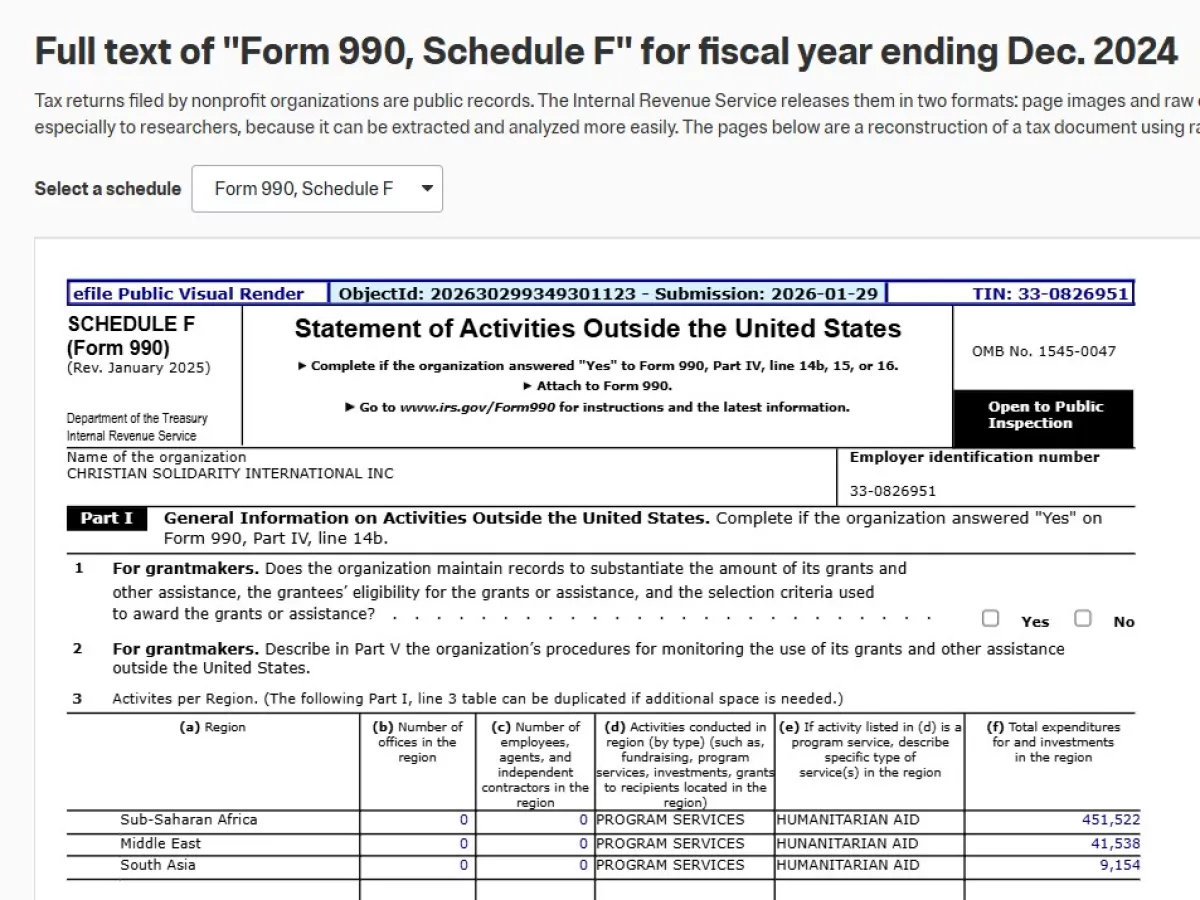
In its 2024 expenditures, the organisation reported a significant amount of direct grants and programme expenses under the category "Humanitarian aid and advocacy." CSI's headquarters in Switzerland states that it conducts large-scale annual campaigns related to activities in Armenia and Armenians who voluntarily left Karabakh. However, the U.S. branch transfers most of the funds it raises not directly to local organisations in Armenia, but to its headquarters in Switzerland. This is a classic method used to circumvent transparency requirements and oversight of funds in the United States.
The organisation's ideological direction and programme implementation are managed by its president, John Eibner. Schedule F contains information on programmes, grants, assistance, and activities conducted outside the United States. It separately reports expenditures for "Program Services" and "Advocacy" (propaganda/lobbying activities). John Eibner's activities are recorded under "Advocacy."
John Eibner is not merely the head of the foundation but one of CSI's key figures. He has close ties with the Armenian lobby (including ANCA), serves as a speaker at its events, and issues joint statements. During the reporting period, he participated as a "witness" at hearings in the U.S. Congress organised against Azerbaijan and allocated funds to finance lobbying activities. In Schedule F, these activities are recorded not as humanitarian assistance but as "Advocacy" (lobbying/propaganda) expenses.
The combination with "Schedule L" (Concealed transactions)
The first Schedule L (conflict of interest) entry for 2024 overlaps with Schedule F (foreign activities). When CSI's U.S. management (Robert F. Davis or John Eibner) allocated grants to foreign entities, the boards of those foreign foundations included either themselves or their close associates. In other words, donations collected in the United States were, upon being transferred abroad, directed through another foreign channel or to an entity under the personal control of the organisation's leadership.
Schedule F shows that this organisation is not a transparent humanitarian foundation but a mechanism for transferring funds for political and lobbying purposes. Funds collected in the United States and exempt from taxation are officially reported as "humanitarian support for Armenia," but in practice they serve to finance lobbying activities against Azerbaijan in the West.
The intensive campaigns against Azerbaijan conducted in the Western media, the U.S. Congress, and the United Nations require significant financial resources. The fundraising companies hired were engaged in raising money from the Armenian lobby to finance these political campaigns. Christian Solidarity International and the organisation's leadership, particularly Joel Veldkamp, constitute the centre that, by abusing tax exemptions in the United States, wages an information war against Azerbaijan together with the Armenian lobby.
The internal financial transfers concealed in the reports and revealed through the "conflict of interest" section also constitute the behind-the-scenes financial mechanism of these political activities
Why are donor names not disclosed?
According to Western legislation, the names of individuals and certain private Christian family foundations making donations to organisations such as CSI are not directly disclosed in publicly available documents due to the right to "anonymity and security." Tax filings only reflect the general amounts of contributions, as well as the amounts officially provided in the form of grants from other major charitable foundations (for example, Armenian diaspora foundations).
In most cases, donor information is anonymous or partially redacted (especially regarding smaller donors). Major donors ($5,000+) are sometimes disclosed; however, full donor lists available to the public are limited. The 2024 document does not provide a detailed, complete list of donors. It only indicates the total amount of donor assistance — $1,565,488. No major donor (for example, one accounting for 50 per cent or more of contributions) is identified. According to U.S. legislation, this is a normal practice, as donors may include private foundations or individuals.
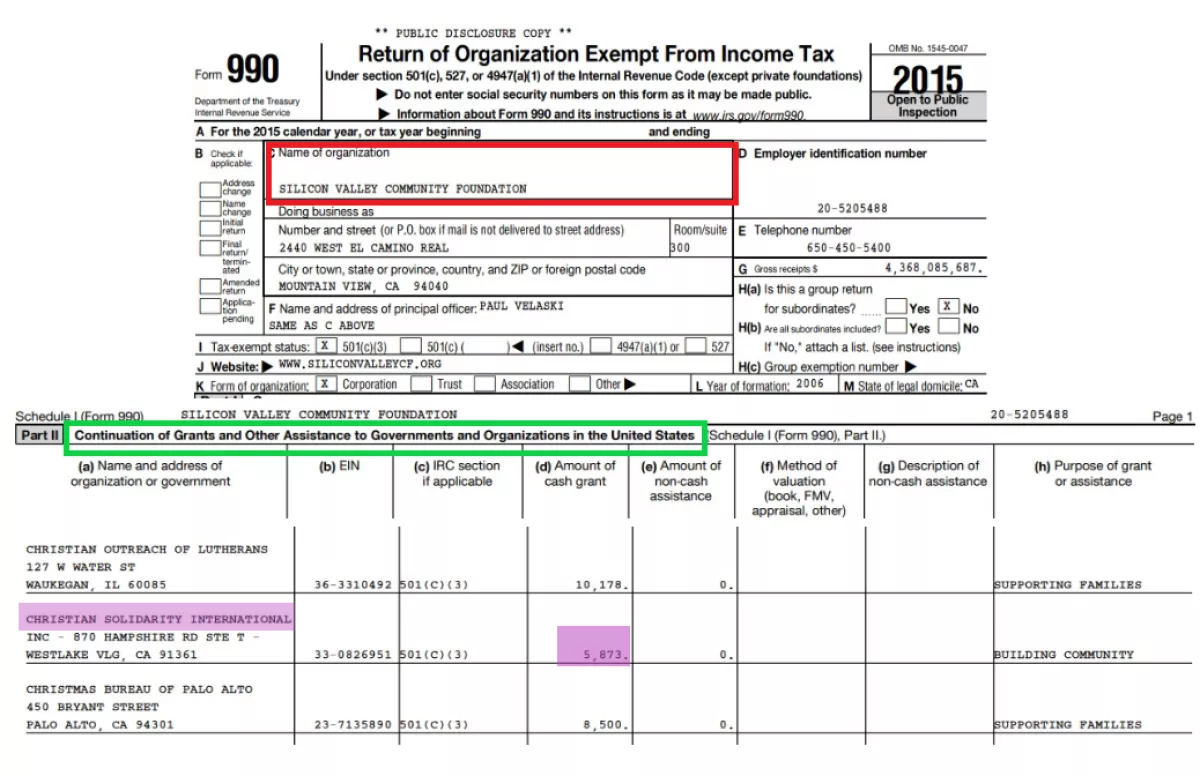
However, it was still possible to identify several organisations that made donations to CSI. One of them is the Silicon Valley Community Foundation (SVCF). It is one of the largest regional charitable foundations in the United States and the world. The foundation’s 2015 annual report indicates that it provided a grant to CSI.
SVCF is located in California and primarily manages assets belonging to technology billionaires from Silicon Valley (for example, Mark Zuckerberg, Jan Koum, and others). This foundation is also a typical Donor-Advised Fund (DAF), meaning a donor-oriented intermediary platform. Billionaires transfer their shares to such funds for tax planning purposes or charitable giving, and the foundation distributes the funds to the final recipients.
The current CEO and president of the foundation is Nicole Taylor. Its board of directors includes various corporate executives (for example, OpenAI Vice President Ann O’Leary and others).
Financial connection with Armenia
Although SVCF legally appears to be a neutral organisation, it is actively used to transfer funds from wealthy Armenian-origin investors in Silicon Valley to Armenia. According to official tax reports, SVCF has provided direct grants to the organisation Friends of Teach for Armenia, which operates within the framework of educational programmes in Armenia. Silicon Valley Community Foundation is listed in the official donor lists of several major projects in Armenia.
CSI financial flows
Among CSI’s donors are the Silicon Valley Community Foundation, National Christian Foundation (which financed humanitarian projects in Armenia), Morgan Stanley Global Impact Funding Trust (which acts as an intermediary platform when wealthy Armenian-origin Morgan Stanley clients transfer funds from their personal accounts to Armenian foundations or Armenia-related assistance programmes), Raymond James Charitable Endowment Fund, American Online Giving Foundation (a digital foundation that allows employees of any company in the United States, for example, a programmer of Armenian origin, to make online donations from their salaries to Armenian lobbying organizations), Salt of the Earth, The Silseth Foundation, Manna International, and The Robertson-Finley Foundation.
A detailed study of CSI’s official tax filings, international audit documents, and hidden layers of internal reports reveals the organisation’s behind-the-scenes activities carried out under the guise of a "spiritual mission" and "humanitarian aid."
What we see is not a transparent charitable foundation defending the rights of Christian minorities around the world, but a transnational network built on the exploitation of donors’ religious sentiments and opaque financial flows. The fundamental facts identified during the research demonstrate that CSI’s activities are built on two closely interconnected pillars: internal financial manipulations and commissioned political lobbying.
Christian Solidarity International is a corrupt network that has transformed universal human values and religious solidarity into a commercial project and a political weapon.
The organisation’s figures, financial manipulations, and legal disputes demonstrate that it has long suffered a moral collapse and should become the subject of a serious international investigation. Exposing the chain of manipulations behind the smear campaign against Azerbaijan is necessary not only to protect the truth, but also represents a requirement of international humanitarian principles.







 editor@caliber.az
 +994 55 444-88-98
 Азербайджан, Баку, ул. Низами, 203, Af Business House, 5-й этаж