










Inside US start-up developing America's first humanoid robot for military missions
While most companies developing humanoid robots are targeting factories, warehouses and households, a young American start-up is pursuing a different ambition: building autonomous humanoids specifically for military operations.
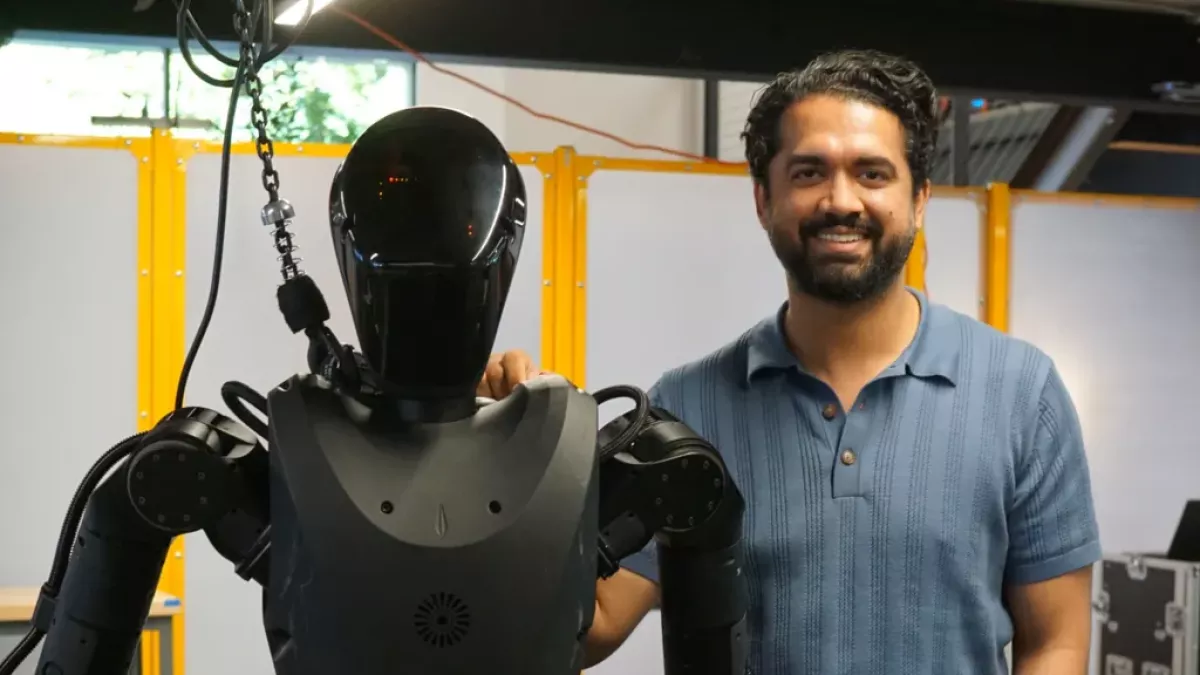
Just two years after its founding, Foundation Robotics says it is developing what could become the first US-built humanoid robot designed for a broad range of defence missions. During a visit to the company's facility, the BBC was given a look at its prototype, Phantom, as executives outlined a vision of AI-powered robots operating alongside—or in place of—soldiers on future battlefields.
The company says Phantom is being designed to carry out support missions such as transporting supplies, reconnaissance, inspecting hazardous environments, and recovering equipment or casualties. But its long-term roadmap extends well beyond logistics.
The robot is also intended for combat operations, including what co-founder and CEO Sankaet Pathak describes as "frontline weaponisation."
Pathak argues that deploying humanoid robots in dangerous environments could reduce risks to soldiers by allowing machines to clear buildings or navigate other high-risk areas where human troops are especially vulnerable.
He also contends that ground-based autonomous systems could reduce collateral damage compared with autonomous aerial strikes by engaging targets with greater precision.
A long road ahead
Despite the ambitious vision, Foundation Robotics acknowledges its technology remains in the early stages.
The first-generation Phantom MK-1 still lacks many capabilities expected of an operational military platform. It has no onboard battery, is neither dustproof nor waterproof, cannot stand back up after falling, and still lacks sufficiently capable hands and wrists—features considered among the greatest technical challenges in humanoid robotics.
A second-generation model, Phantom MK-2, is already under development in another section of the company's facility.
According to Pathak, the upgraded version will feature weather-resistant construction, a battery providing around six hours of operating time, the ability to recover from falls, and a stronger frame capable of withstanding greater physical forces.
Its redesigned hands will also offer far greater dexterity, including articulated wrists that, according to Pathak, would enable the robot to operate firearms.
Foundation Robotics says it aims to manufacture at least 40,000 humanoid robots annually by the end of 2027, while eventually reducing production costs to below $20,000 per unit.
The company has already secured $24 million in research contracts with the US military and says two Phantom units are currently undergoing testing with the Ukrainian military.
According to Pathak, the US military trials are limited to logistics and handling tasks rather than weapon use, while testing in Ukraine includes evaluating combat-related capabilities.
Foundation Robotics also drew public attention earlier this year after Eric Trump, son of US President Donald Trump, joined the company as an investor and adviser.
Opinions divide on AI use in battlefield
Perhaps the greatest technical hurdle facing Foundation Robotics—and the broader humanoid robotics industry—is creating artificial intelligence capable of functioning reliably in unpredictable real-world environments.
Phantom is powered by an AI system known as Cortex, with a more advanced version currently under development.
The system is designed to receive a mission objective—such as delivering supplies or mapping the interior of a building—and determine how to accomplish it using training based on videos, images and text.
According to Pathak, Cortex combines two distinct AI models.
A "reasoning model," trained on task-specific examples, interprets objectives and develops an action plan, while a broader "world model," trained on internet videos and data gathered through the robot's interactions with the physical world, predicts how the surrounding environment will respond, allowing Phantom to move safely and complete assigned tasks.
The growing role of artificial intelligence in combat remains one of the most contentious issues in modern defence technology.
Pathak argues that humans should generally remain "in the loop," approving any use of lethal force before the robot acts. However, he also says exceptions may exist where autonomous engagement is necessary to prevent catastrophic outcomes and believes there are scenarios in which prior human authorization would be less critical.
By Nazrin Sadigova







 editor@caliber.az
 +994 55 444-88-98
 Азербайджан, Баку, ул. Низами, 203, Af Business House, 5-й этаж