










Türkiye unveils Bayraktar TB3 with ASELBUOY POD module for first time PHOTO
The Bayraktar TB3 strike unmanned aerial vehicle (UAV) has been unveiled for the first time equipped with the ASELBUOY POD module for deploying sonobuoys, developed by Turkish defence company ASELSAN.
The demonstration is taking place as part of TEKNOFEST Mavi Vatan, Caliber.Az reports, citing SavunmaSanayiST.
ASELBUOY POD is a modular deployment system that allows sonobuoys to be placed in designated areas according to specific mission requirements. With the module, the Bayraktar TB3 will be able to detect submarines using acoustic sensors in areas of potential interest.
ASELSAN developed ASELBUOY POD to integrate sonobuoys with unmanned aerial vehicles. The system can be adapted to various aerial platforms and enables the safe and controlled deployment of different types of buoys according to the requirements of a particular operation.
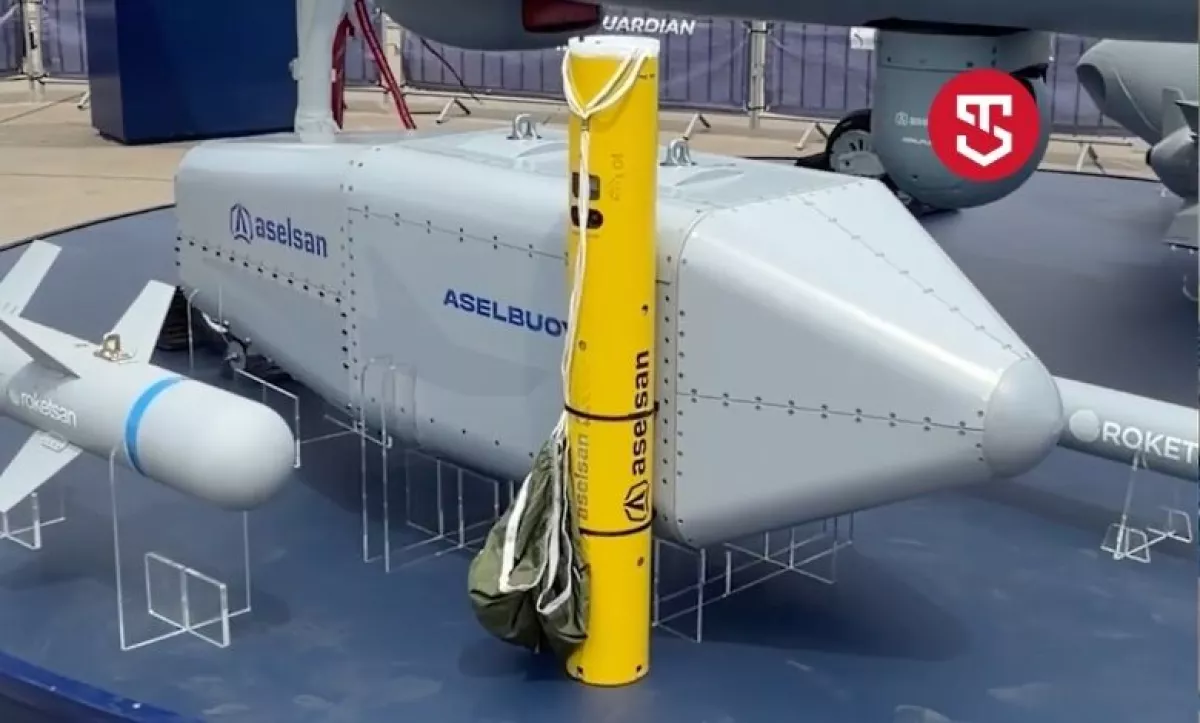
ASELSAN’s anti-submarine warfare solutions also include the ASELBUOY P passive sonobuoy. It can be deployed from various platforms, including maritime patrol aircraft, helicopters and UAVs.
Once deployed in a designated area, the ASELBUOY P monitors the acoustic environment using a highly sensitive underwater sensor. Data collected for real-time submarine detection is transmitted to relevant platforms through a communications system located in the buoy’s surface section.
The Bayraktar TB3 is 8.35 metres long, has a wingspan of 14 metres and a maximum takeoff weight of 1,600 kilograms. The UAV can carry up to 280 kilograms of payload.
The Bayraktar TB3 is powered by a turbodiesel engine developed by Turkish company TEI and can remain airborne for more than 24 hours under standard operating conditions. The UAV features folding wings and can autonomously take off from and land on ships equipped with short runways.
On November 19, 2024, the Bayraktar TB3 took off from the short deck of the TCG ANADOLU amphibious assault ship, which is equipped with a ramp angled at 12 degrees, and successfully landed back on the same deck without using any landing assistance systems.
By Bakhtiyar Abbasov







 editor@caliber.az
 +994 55 444-88-98
 Азербайджан, Баку, ул. Низами, 203, Af Business House, 5-й этаж