










Aliyev–Costa summit 2026: redefining EU–Azerbaijan ties Fifteen points of a new reality
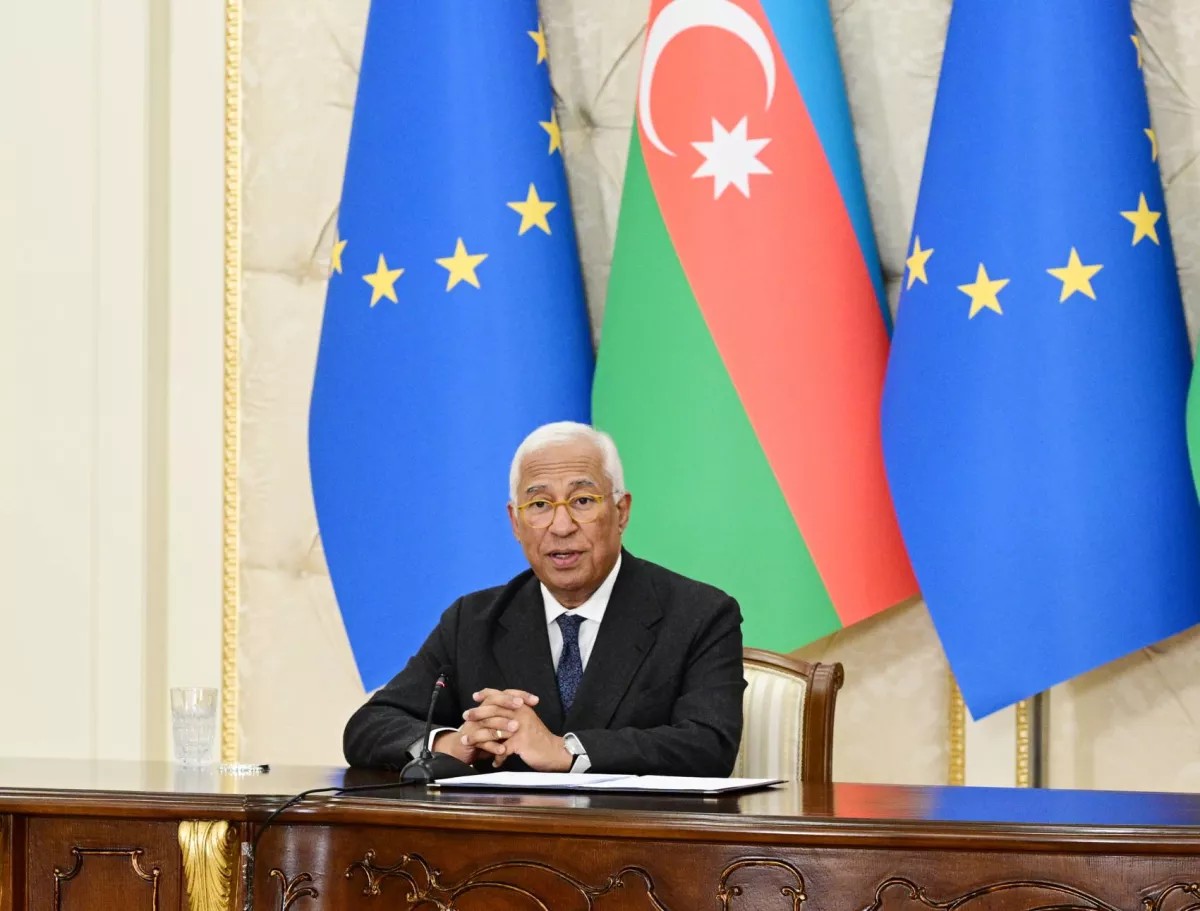
The official visit of the President of the European Council, António Costa, to Baku on March 11, 2026, and the joint press statement delivered with the President of Azerbaijan, Ilham Aliyev, mark a qualitative shift in relations between Baku and Brussels.
This shift had been maturing for a long time, prepared consistently and methodically, but it occurred precisely now — at a moment when geopolitical turbulence in the Middle East and around it has reached such a level of intensity that Europe’s usual strategic calculations have stopped working.
The war in the Middle East, the blockade of the Strait of Hormuz, and the collapse of the global energy market have all created a context in which the joint statement by Ilham Aliyev and António Costa reads very differently than it would have even six months ago.
To grasp the scale of what has occurred, it is necessary to recall where this journey began. Relations between Azerbaijan and the European Union have formally been based on the 1999 Partnership and Cooperation Agreement — a document from an era when Baku was, for Brussels, a distant post-Soviet capital on the shores of the Caspian Sea.
Since then, the world has changed beyond recognition, while the agreement has remained the same. Negotiations on a new comprehensive bilateral agreement have dragged on for years and are still not concluded. Yet, alongside this formal legal process, a de facto process has been unfolding — and it is this process that defines today’s reality.
Energy partnerships, the Southern Gas Corridor, the 2022 Memorandum, COP29 in Baku, and meetings on the margins of the European Political Community summits in Tirana and Copenhagen — each of these elements has added a new layer to relations that, de facto, have long since outgrown the framework of the outdated agreement.
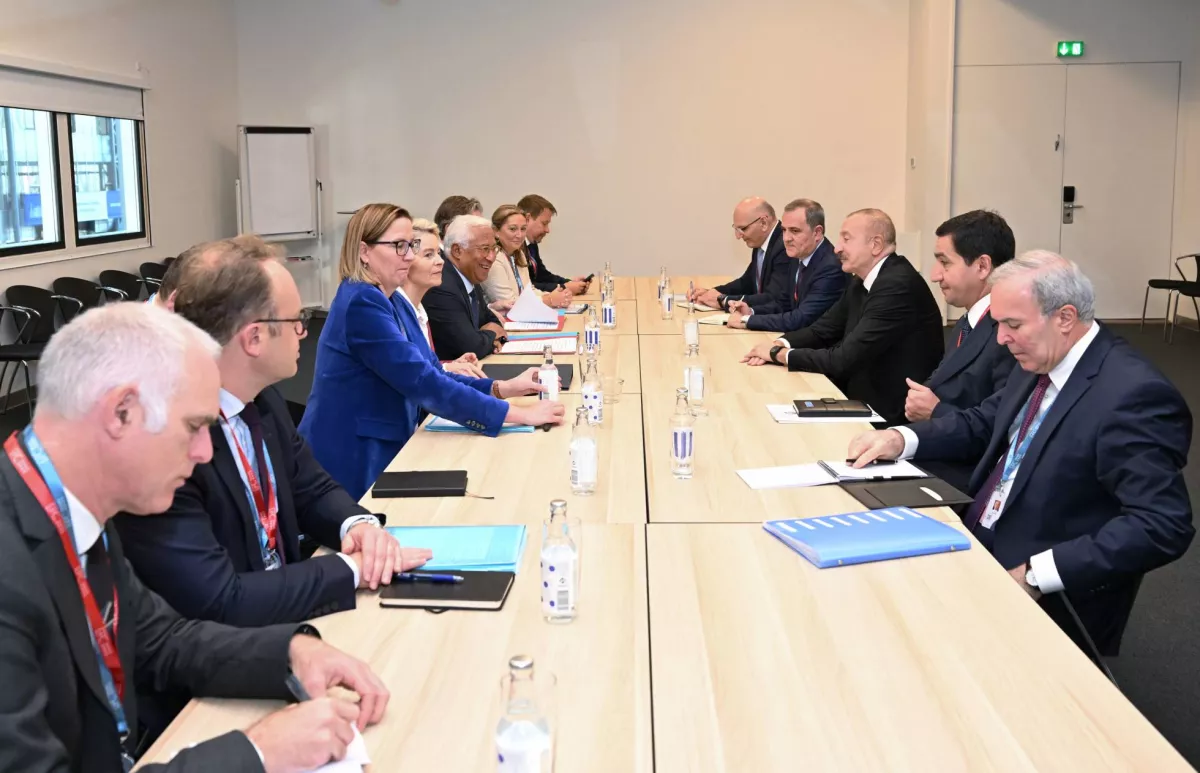
The meetings of Ilham Aliyev with António Costa and Ursula von der Leyen at the European Political Community summits in May 2025 in Tirana and October of the same year in Copenhagen effectively became a turning point.
In the Danish capital, António Costa and Ursula von der Leyen congratulated Aliyev on the successes achieved in Washington regarding the peace agenda between Armenia and Azerbaijan, expressing hope that this would contribute to lasting peace in the region.
The President of the European Council and the head of the European Commission emphasised that they would continue their efforts to support peace. They also noted that the development of transport communications in the region is an important priority for the European Union.
It was at this moment that the direction was set, which ultimately led to the visit to Azerbaijan.
The joint statement of March 11, 2026 — a document consisting of fifteen points — carries a specific political signal in each one. The first detail that stands out is the wording of the third point, where the parties reaffirm that their relations are based on mutual respect, equality, and reciprocal benefit, with full compliance with the United Nations Charter and international law, including the principles of sovereignty and territorial integrity.
For Azerbaijan, this formulation is fundamental. It signifies that the European Union, represented by the President of its Council, recognises precisely the framework on which Baku has built its position throughout the post-conflict period. There are no caveats, no references to “the right of peoples to self-determination” as a counterbalance — it is a clear and unambiguous affirmation of sovereignty and territorial integrity as a foundational principle.
The fifth point of the statement, focused on the peace process, deserves particular attention. The presidents welcome the “historic momentum” in the Azerbaijan–Armenia peace process, noting the outcomes of the Washington summit and the subsequent steps towards normalisation. António Costa affirms full support for the efforts of both sides.
Here, the tone is important: the European Union does not position itself as a mediator, does not claim the role of arbitrator, and does not attempt to impose its own agenda. Instead, Brussels assumes the role of a supportive partner that recognises what has been achieved. This marks a significant contrast with the EU’s approach three to four years ago, when Emmanuel Macron and his allies sought to seize the mediating initiative and impose a process logic that was far removed from Baku’s interests.
The sixth point highlights another principle of critical importance for Azerbaijan — the recognition of extensive reconstruction work in Karabakh and East Zangezur. The European Union does not merely “take note” of these efforts — it acknowledges the seriousness of the challenges, especially the problem of landmine contamination, and calls for increased international support. At the same time, it emphasises that the EU is a leading international donor in humanitarian demining.
For Baku, this means that Europe is, in effect, embedding itself within Azerbaijan’s post-conflict reality — and doing so on terms defined by Baku. This is, de facto, a high-level recognition of the new realities.
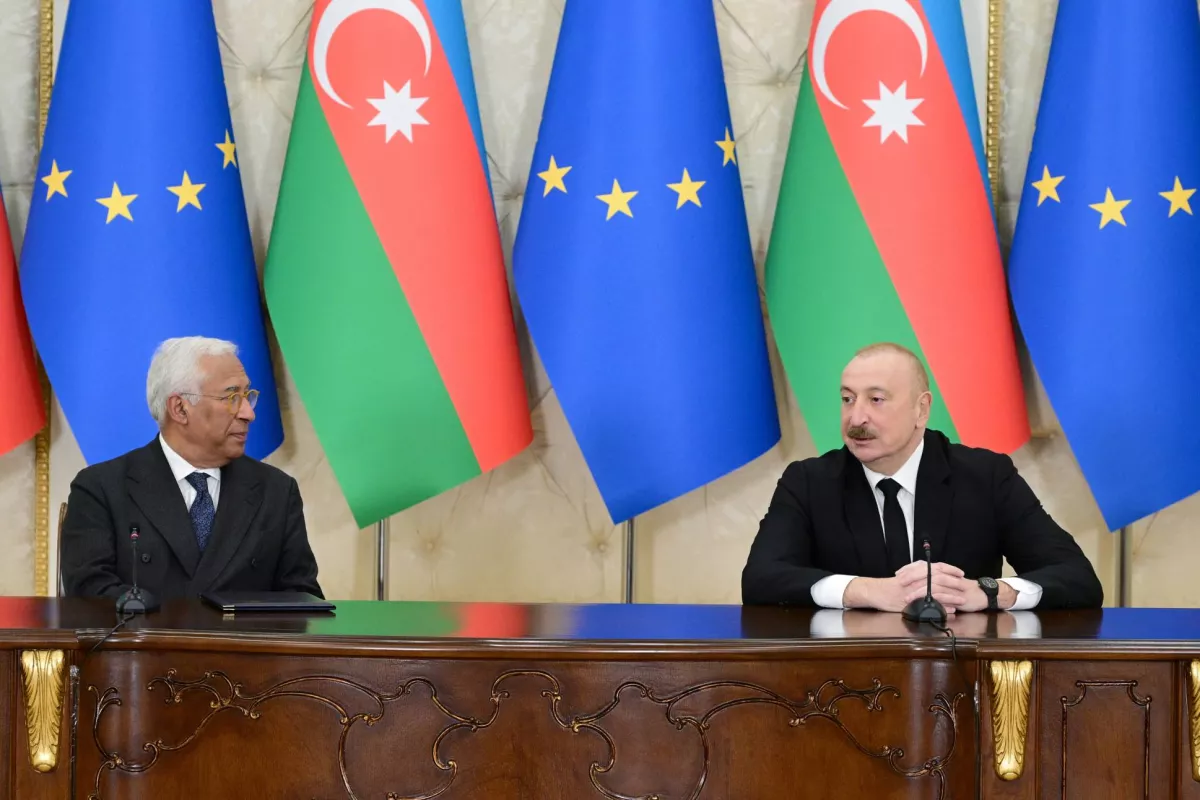
The energy section of the statement is perhaps the most concrete and pragmatic part of the document. Here, the numbers speak for themselves. In 2025, Azerbaijan exported 25.2 billion cubic metres of gas, of which around 12.8 billion cubic metres went to European Union countries. Azerbaijani gas is now supplied to ten EU member states, while the total number of recipient countries has reached sixteen.
The capacity of the Trans-Adriatic Pipeline has been expanded by 1.2 billion cubic metres per year since the beginning of 2026, and contracts have been signed for deliveries to Austria and Germany. In his press statement, Ilham Aliyev announced plans to bring a new gas field online, capable of producing an additional ten billion cubic metres annually over the next two to three years.
All of this is happening against the backdrop of the Middle East war, which is shaking global energy markets and forcing Europe to take the diversification of supplies even more seriously.
António Costa delivered a statement in Baku that deserves to be quoted: “Our energy partnership is more important than ever.” This acknowledgement came in the context of the European Council’s 2022 decision — the famous Versailles decision — on diversifying sources of gas, oil, and coal.
Four years later, the Southern Gas Corridor has become one of the main instruments for implementing this decision. Initially, Brussels officials approached Baku’s ambitions with some scepticism — the target of 20 billion cubic metres by 2027 seemed overly optimistic — but the Middle East crisis has radically changed the situation.
The EU has now expressed readiness to mobilise private investment to support Azerbaijan’s energy transition and to involve European companies in the clean technology sector in Baku’s ambitious plans: six to eight gigawatts of renewable generation over five to six years, an underwater electric cable across the Black Sea with a capacity of over one thousand megawatts, and “green” energy corridors connecting the Caspian Sea with Southeast Europe.
Transport connectivity is another axis around which the new architecture of relations is being built. The eighth point of the statement recognises the key role of Azerbaijan in the Middle Corridor — a transport route linking Europe and Asia through the South Caucasus.
António Costa explicitly described its development as a “strategic opportunity” and emphasised the critical importance of completing the Baku–Nakhchivan railway connection. This project, barely feasible before the Washington summit, is now taking tangible shape — the peace settlement with Armenia removes transit barriers and opens prospects that until recently could only be discussed theoretically.
Ilham Aliyev highlighted this with characteristic directness: shortly after the signing of the peace agreement, Azerbaijan lifted all restrictions on the transit of goods from third countries through its territory to Armenia and began supplying petroleum products to Yerevan. In this way, peace is translated into economic reality.
The creation of a High-Level Working Group on economic cooperation within the framework of the Global Gateway initiative — also recorded in the eighth point — moves the discussion from the realm of declarations into the realm of institutions.
For the European Union, Global Gateway is a response to China’s Belt and Road Initiative, a global infrastructure strategy designed to demonstrate that Europe can compete with Beijing in building transport, digital, and energy corridors. The fact that Azerbaijan is integrated into this strategy as a key link is highly significant. Baku is transformed from merely an energy supplier into a transit and infrastructure hub, without which European connectivity to Central Asia would be virtually impossible.
The TRIPP project, enshrined in the Washington agreement, now acquires a European dimension: the modernisation of railways in Nakhchivan with EU support complements the American initiative and turns the region into a crossroads of the two largest global infrastructure projects.
The twelfth point addresses defence and security, countering terrorism and extremism, combating the illicit arms and drug trade, human trafficking, and irregular migration. The thirteenth focuses on digital transformation and artificial intelligence. The fourteenth covers education, culture, youth policy, and visa facilitation.
Together, these points demonstrate that the partnership is advancing toward comprehensive strategic engagement, where energy remains a cornerstone but is by no means the only supporting pillar. Europe is beginning to view Azerbaijan as a full-fledged security partner — a logical stance considering that Baku assisted in the evacuation of around 1,800 people from Iran, including EU citizens, after the outbreak of hostilities. António Costa expressed his “sincere gratitude” for this assistance.
The fifteenth and final point of the statement is concise, yet eloquent: “The leaders discussed the main current geopolitical issues, including the latest developments in Iran and Ukraine.” This line places the entire preceding content of the document firmly within its true geopolitical context. The war, which began as a US–Israeli operation against Iran and quickly expanded beyond the region, has become a systemic shock for the entire area.
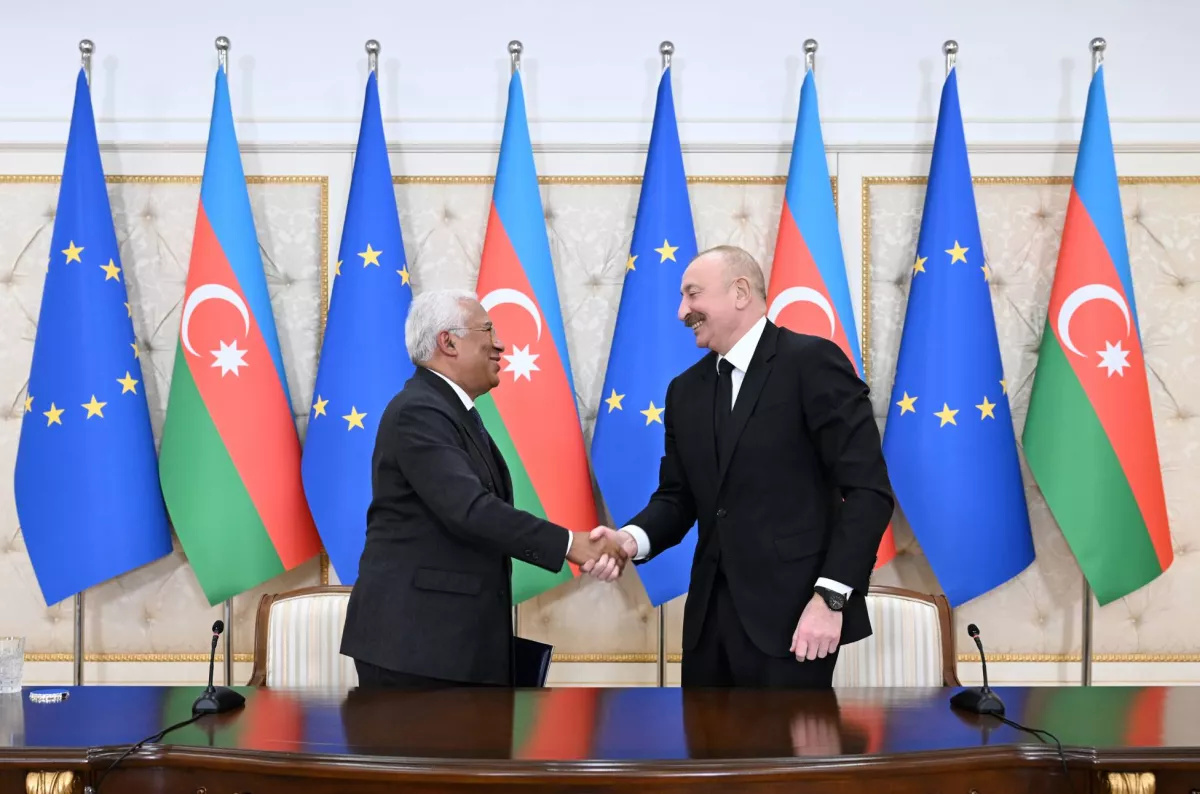
The joint statement of March 11, 2026, is a document in which the European Union formally acknowledges the important role of Azerbaijan in terms that Baku has long sought. Ahead lies the endorsement of updated partnership priorities, the resumption of the Cooperation Council, and the completion of negotiations on a new comprehensive agreement. Each of these steps will give legal substance to the political reality already established in the Baku statement.
The South Caucasus, until recently a peripheral region for Brussels with “frozen conflicts,” is now becoming an area on which the continent’s energy security and transport connectivity depend. Within this space, Azerbaijan is the key player.







 editor@caliber.az
 +994 55 444-88-98
 Азербайджан, Баку, ул. Низами, 203, Af Business House, 5-й этаж