










Right to oil The main lesson of Baku’s history
More than thirty years ago, delegations came to Baku to assess its prospects. A country with more than a million refugees and internally displaced persons, with one-fifth of its territory under occupation and an economy in crisis, was entering the international market not as a full-fledged partner, but rather as a supplicant — offering fields that still had to be proven to investors willing to risk their money in a state facing a range of problems at the time.
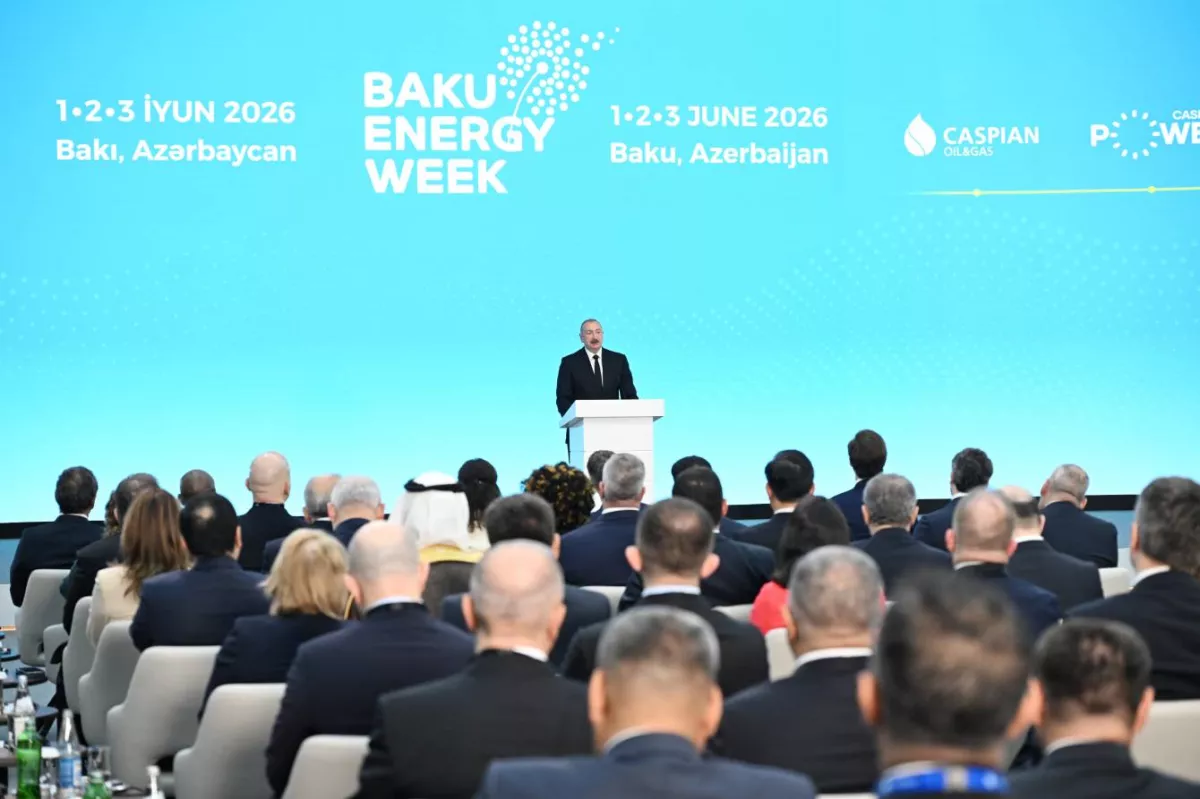
The Caspian Oil and Gas Exhibition, launched in the mid-1990s, became a kind of showcase: Western companies were sizing up the asset. Today, the same platform, under a new name — “Baku Energy Week” — receives letters from Trump and Starmer, while President Ilham Aliyev, at its opening, speaks not about how to attract capital, but about where Azerbaijan is investing its own capital.
In the span of a single generation, the roles have shifted so dramatically that Baku’s story has become an argument in a global debate that has been ongoing for the past decade: whether there is a future for states living on oil and gas revenues. And the side that answered “no” now appears to be losing.
The climate agenda of the 2010s turned oil and gas into something morally questionable: producing countries were portrayed as backward, investment in exploration was considered irresponsible, and talk of new fields was treated almost as improper. The logic was simple to the point of naïveté: the faster fossil fuels were abandoned, the sooner the “green future” would arrive.
In Baku, President Aliyev articulates a counterargument without ambiguity — the world cannot do without fossil fuels, and attempts to convince itself otherwise have not accelerated the transition, but instead led to energy crises, price shocks, and a dependency that Europe has experienced in full measure.
The President of Azerbaijan thanks the US administration for bringing the energy issue back to a more normal, pragmatic track. Behind this diplomatic formulation lies a concrete reality: the recognition that pragmatism proved more far-sighted than ideology.
Baku never abandoned its oil for the sake of others’ notions of propriety — and it now turns out that it was right.
This form of “rightness” is not abstract. It can be measured in the same figures used to assess a state’s economic resilience. Azerbaijan’s external debt stands at around 6 per cent of GDP — a level that most European economies can only aspire to — while state reserves exceed that debt by 18 times.
Poverty, which affected more than half the population in the mid-1990s, has fallen to around five per cent. Unemployment remains minimal. Behind these percentages lies a simple strategic idea embedded in the 1994 “Contract of the Century”: a natural resource in itself does not make a country either wealthy or strong — it only provides a foundation for decisions that still have to be made.
Venezuela, sitting on some of the world’s largest oil reserves, descended into economic catastrophe. Norway transformed the same resource into a sovereign wealth fund securing prosperity for generations. Azerbaijan chose its own path — directing oil revenues into infrastructure, education, healthcare and, crucially given its circumstances, into the armed forces, which was not a luxury but a condition of survival.
This is precisely why Azerbaijan’s energy story ceases to be merely economic and becomes political in the most direct sense.
The victory in the Patriotic War of autumn 2020 was not achieved solely on the battlefield — it was paid for by two decades of oil revenues, transformed into a modern army, drones, combat readiness, and a state capable of conducting and financing a large-scale military campaign without undermining its own economy.
The link between the pipeline and Baku’s victory is stated openly, and there is no triumphalism in it — only a logic that any resource-rich country aspiring to sovereignty would do well to study. A strong economy and a powerful military turned out to be two sides of the same coin, minted from Caspian energy resources.
A country that three decades ago was seen as unviable regained its lands through force, built on revenues that it was repeatedly urged to doubt.
From a donor of other people’s development models, Azerbaijan has transformed into a subject that defines its own agenda, and this shift is most clearly visible in the change of roles.
Thirty years ago, investors were invited to Baku — today, the country itself is an investor: SOCAR operates fields and projects far beyond the Caspian, from the Middle East to Africa and Central Asia. A state that once had to prove its creditworthiness is now assessing that of others.
And precisely at the moment when it might have been expected to settle into the comfort of oil rents, Baku makes a move that disrupts the conventional image of hydrocarbon-producing states as prisoners of a single resource.
The new deep-gas project at Azeri–Chirag–Gunashli promises output sufficient for both the country and its partners for a century ahead. At the same time, Azerbaijan is investing in renewable energy on a scale that many self-proclaimed champions of the “green transition” do not match. By the end of next year, total solar and wind capacity is expected to reach two gigawatts, and by 2032 — eight.
This is the pragmatism President Aliyev refers to: not a choice between oil and the sun, but a rejection of the very dilemma imposed from outside.
Gas has long ceased to be merely an export item for Baku — it has become an instrument that turns geography into political capital.
A landlocked country, situated between major regional powers, Azerbaijan has managed to build a network of pipelines that delivers its resources to the European market while bypassing those who would prefer to keep the valve in their own hands.
Azerbaijani gas today flows to 16 countries, and the list continues to expand as Europe, burned by dependence on a single supplier, searches for alternatives. For a continent thrown into a frantic search for replacement supplies after 2022, the Southern Gas Corridor proved not to be a backup option, but precisely the infrastructure that Baku had been patiently building for a decade — while others were explaining that the future belonged to a post-pipeline world.
History has had a sharp way of mocking such advice.
Today, Azerbaijan is offering its neighbours on the eastern shore of the Caspian what it once used first itself — an outlet.
Central Asia, with its vast potential for solar and wind power generation and significant gas reserves, faces the same barrier Baku faced in the 1990s: resources exist, but access to markets is limited.
The Trans-Caspian Green Energy Corridor, which Azerbaijan is developing together with Kazakhstan and Uzbekistan, and the subsea cable that is expected from 2032 to carry Caspian electricity westward, are a continuation of the same logic that once underpinned the Baku–Tbilisi–Ceyhan pipeline. The idea is to connect the resource to the consumer, to become an indispensable link, and to turn geography into a source of influence.
President Aliyev characterises Azerbaijan’s contribution to global energy security as something that will inevitably grow — and this is not merely a figure of speech.
The final piece in this architecture is the Zangezur Corridor, which President Aliyev in Baku describes as inevitable, referring to the document signed at the White House on August 8, 2025.
Azerbaijan’s energy strategy has gone furthest precisely where it no longer concerns hydrocarbons alone. The Zangezur Corridor, which would connect mainland Azerbaijan with Nakhchivan via Armenia, is no longer about what flows through it — but about control over the routes themselves.
The East–West Corridor thus gains a new branch, Baku acquires another lever of influence, grown from the same oil foundation laid thirty years ago.
And in this, perhaps, lies the main lesson of Baku’s history — one that those accustomed to telling resource-rich states how to live would do well to absorb. Natural wealth is neither a curse nor a blessing in itself; it is a test of whether a state has the will to use it according to its own judgment rather than external prescriptions.
Thirty years ago, people came to Baku to see whether there was anything worth buying. Today, they come to understand how it is done.







 editor@caliber.az
 +994 55 444-88-98
 Азербайджан, Баку, ул. Низами, 203, Af Business House, 5-й этаж