










How Chabahar Port crisis is testing New Delhi's policy on strategic autonomy
India's decade-long investment in Iran's Chabahar Port — once the cornerstone of its strategy to reach Afghanistan and Central Asia while bypassing Pakistan — is facing its gravest challenge yet. A combination of the ongoing Iran war, renewed US sanctions and the Indian government's decision to allocate no funding for the project in its 2026 budget has left the future of one of New Delhi's flagship infrastructure investments increasingly uncertain.
The crisis has also exposed the limits of India's long-standing foreign policy doctrine of "strategic autonomy", which was the modern evolution of its Cold War-era non-alignment policy, as an analysis by Modern Diplomacy highlights.
India's inability to play a mediating role despite maintaining ties with the United States, Iran and Israel highlighted the dilemma. Pakistan, by contrast, went to position itself as a mediator between Washington and Tehran, prompting Congress leader Rahul Gandhi to dismiss Prime Minister Narendra Modi's foreign policy as a "joke."
Chabahar port
India signed a landmark 10-year agreement with Iran in May 2024 to equip and operate the Shahid Beheshti Terminal at Chabahar Port. The deal included a $120 million investment in port equipment alongside a $250 million credit line for related infrastructure.
India’s Prime Minister Narendra Modi visited Tehran back in 2016 where he already announced a plan to build and operate the key Chabahar port after meeting then-President Hassan Rouhani, and pledged to invest $500 million into its development.
Located in Iran's Sistan-Balochistan province, Chabahar was intended to become India's gateway to Afghanistan and Central Asia, providing direct access without relying on routes through Pakistan.
For years, New Delhi consistently allocated Rs 100 crore annually to the project. That changed in February 2026, when the Union Budget contained no funding for Chabahar. The move was widely viewed as a response to the Trump administration's decision to restore sweeping sanctions on Iran in September 2025 after allowing a previous waiver granted to the project, meant for India to get time to "wind down" their involvement, to expire in April 2026.
By April, reports indicated India was considering temporarily transferring its stake in the Chabahar Free Zone entity (IPGCFZ) to an Iranian partner until sanctions are eventually lifted. Indian officials described the move as a tactical adjustment rather than a permanent exit from the project.
Iran war reshapes India's calculations
The project's future became even more uncertain after the outbreak of the 2026 Iran war.
When the United States and Israel launched military strikes against Iran in late February, New Delhi limited itself to general calls for restraint and diplomacy, avoiding direct criticism of either country. The cautious response drew criticism both at home and abroad.
The conflict quickly demonstrated how vulnerable India remains to instability in the region. Iran's near-total blockade of the Strait of Hormuz disrupted an estimated 46–50% of India's crude oil imports and around 90% of its LPG imports, directly affecting energy supplies across the country.
India's position also attracted attention within BRICS, where it holds the 2026 chairmanship. While China, Russia and South Africa openly backed fellow member Iran, India's more restrained stance was widely seen as reflecting its increasingly close ties with Washington and Tel Aviv.
Opposition politicians accused the government of sacrificing India's historically strong relationship with Iran in pursuit of deeper strategic partnerships with the United States and Israel.
Strategic route for the wider region at risk
The stakes extend far beyond a single port. Chabahar represents India's only practical trade corridor to Afghanistan and Central Asia that avoids Pakistani territory. It has already facilitated deliveries of 2.5 million tonnes of wheat and 2,000 tonnes of pulses to Afghanistan as humanitarian aid and serves as a key link in the International North-South Transport Corridor (INSTC), connecting India with Central Asia, Russia and Europe.
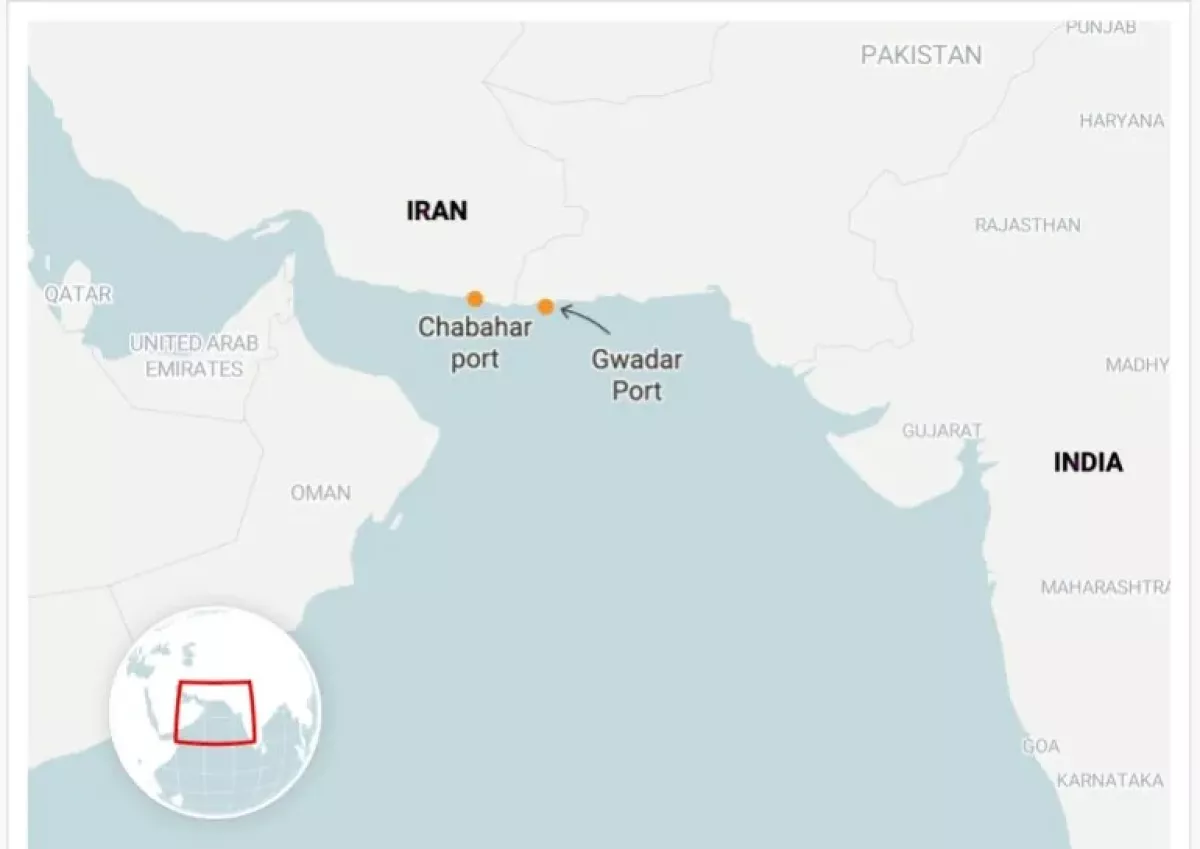
Analysts warn that any prolonged freeze or withdrawal could hand a strategic advantage to China, which already operates Pakistan's nearby Gwadar Port, located just 170 kilometres from Chabahar.
The outlet cites expert opinions, which argue that after India's budget announcement, abandoning Chabahar would directly strengthen Beijing's regional connectivity ambitions.
"India's Chabahar predicament illustrates a broader truth about the current international order: strategic autonomy is easier to declare than to practise when great powers demand alignment. New Delhi's challenge is not that it lacks strategic vision: the Chabahar investment itself was a bold and forward-looking move, but that external pressures are forcing trade-offs between partners and principles at an accelerating pace," the article concludes.
By Nazrin Sadigova







 editor@caliber.az
 +994 55 444-88-98
 Азербайджан, Баку, ул. Низами, 203, Af Business House, 5-й этаж