










How is Washington repeating its oldest mistakes in Iran?
Nearly half a century after the Iranian Revolution upended the Middle East and locked the United States into a cycle of confrontation with Tehran, the lessons of 1978–79 remain disturbingly unresolved. In King of Kings, journalist Scott Anderson revisits the fall of the Pahlavi monarchy not merely as a dramatic historical episode, but as a case study in how great powers misread political change—and then become trapped by their own inertia. The result, as a recent Foreign Policy analysis suggests, is an unsettling mirror for today’s stalled U.S. approach to Iran.
Anderson’s central contribution lies less in re-litigating the causes of the revolution than in capturing its chaos. Rather than a clean, ideologically driven rupture, the Iranian Revolution appears in his telling as a whirlwind of miscalculations, pauses, and sudden explosions—an environment in which neither Tehran nor Washington truly understood the forces they had unleashed. This framing challenges the comforting illusion that revolutions are predictable or manageable, especially by external actors.
At the heart of Anderson’s narrative is a dual failure. The first is personal: Mohammed Reza Shah Pahlavi, elevated and sustained by U.S. power after the 1953 coup against Mohammed Mosaddeq, proved incapable of decisive leadership once crisis struck. Anderson portrays him as a tragic figure—aware of his fragility, yet paralysed by it. His inability to either reform meaningfully or repress effectively left the state hollow at the moment it needed authority most.
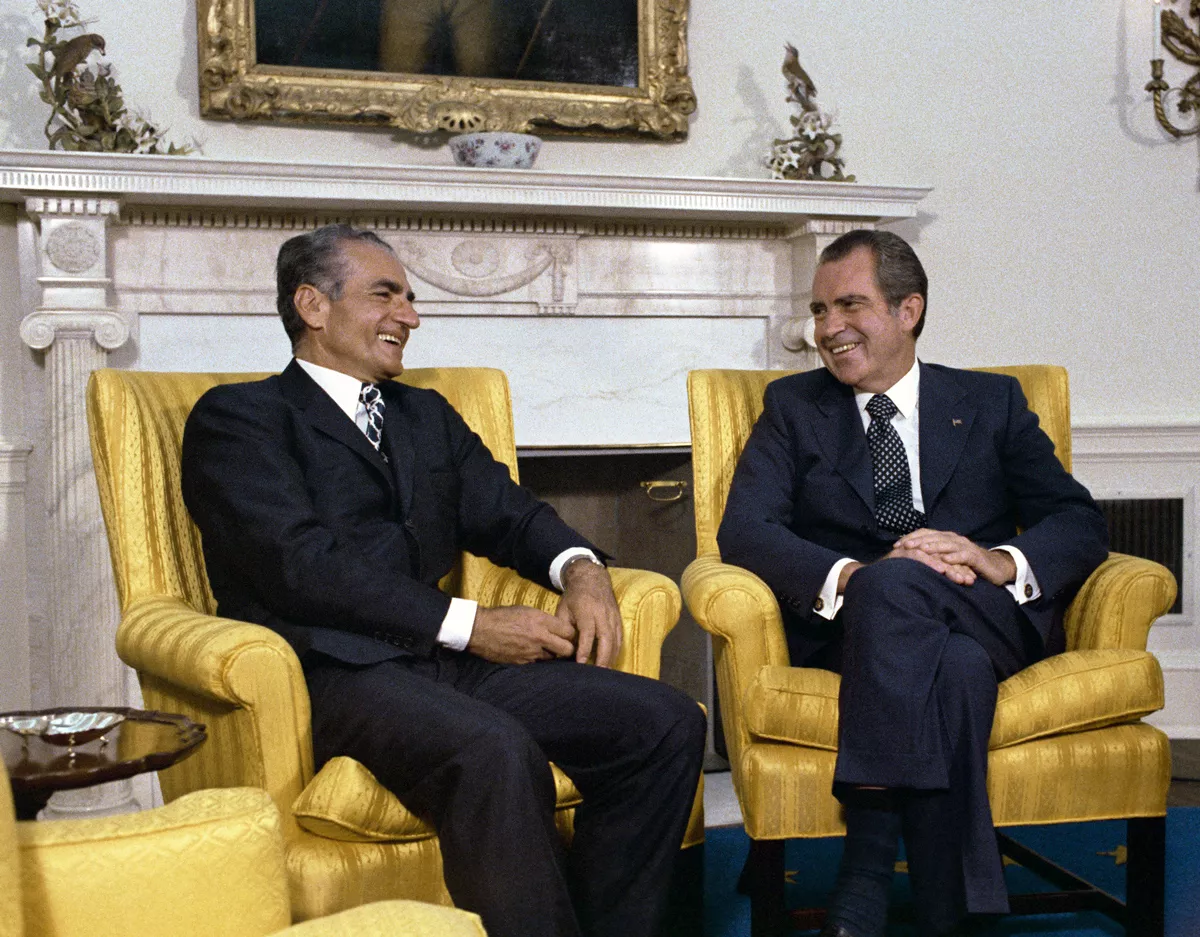
The second failure is structural and far more damning for Washington. By eliminating political alternatives in 1953, the United States bound its Iran policy to the survival of a single man. Over time, the shah became too big to fail—an indispensable ally, oil supplier, and arms client. Acknowledging the decay of his regime was treated as strategically unacceptable, and intelligence that contradicted official optimism was sidelined. U.S. policy did not simply fail; it calcified.
This is where Anderson’s history bleeds into the present. As Foreign Policy notes, today’s Iran policy risks repeating the same errors. U.S. strikes may have damaged Iran’s nuclear infrastructure, but they have not destroyed it. More importantly, Washington has shown little appetite to convert military pressure into diplomatic leverage. Iran, once again, is being treated as a static problem rather than a dynamic society on the brink of change.
That complacency is especially dangerous given Iran’s internal trajectory. Supreme Leader Ali Khamenei, like the shah before him, is nearing the end of a long reign. His eventual departure could trigger fierce power struggles within the Islamic Republic—or even more profound transformation under the weight of economic crisis, war fatigue, and public disillusionment. These are precisely the moments when misreading reality carries the highest cost.
The warning from Anderson’s account is clear: foreign policy driven by habit, hubris, and institutional inertia is a recipe for strategic shock. Without deep expertise, sustained attention, and a willingness to adapt, Washington risks once again discovering—too late—that the ground has shifted beneath its feet.
By Vugar Khalilov







 editor@caliber.az
 +994 55 444-88-98
 Азербайджан, Баку, ул. Низами, 203, Af Business House, 5-й этаж