










Macron's role in rise of "Merzoni" Europe’s new political power couple
For months, a pragmatic alliance between German Chancellor Friedrich Merz and Italy's Prime Minister Giorgia Meloni has been steadily taking shape. Despite at first glance appearing, in many respects, to be unlikely partners, the two leaders have quietly begun reshaping Europe’s internal balance of power.
The most recent sign of this shift came ahead of the European Union’s informal summit on February 12, 2026, when a joint policy paper earlier drafted by Merz and Meloni within the framework of a January summit in Rome was circulated to EU counterparts with support from Belgian Prime Minister Bart De Wever, calling for reforms to strengthen the bloc’s competitiveness.
The joint German-Italian document proposes steps to support businesses, attract investment and reinforce the single market. Among its recommendations are regulatory simplification, a reassessment of the carbon tax and the Emission Trading System (ETS) that caps greenhouse gas emissions, and a stronger commitment to “technological neutrality.”
Historically, the center of gravity in post-war European politics has shifted before, though it has typically revolved around France and Germany, the EU’s two largest economies, as one European affairs scholar noted in an article for The Conversation.
The United Kingdom’s influence within the EU was always limited by its late and often hesitant engagement with the “European project.” That influence ended decisively following the 2016 referendum that led to Britain’s departure from the bloc.
For nearly a decade after Brexit, European politics revolved around the partnership between Germany’s Angela Merkel and France’s Emmanuel Macron. Dubbed “Merkron,” their alliance combined Merkel’s cautious pragmatism with Macron’s charismatic and ambitious European vision. Together, they guided the EU through several hardships, including Brexit, the first presidency of Donald Trump and the Covid-19 pandemic.
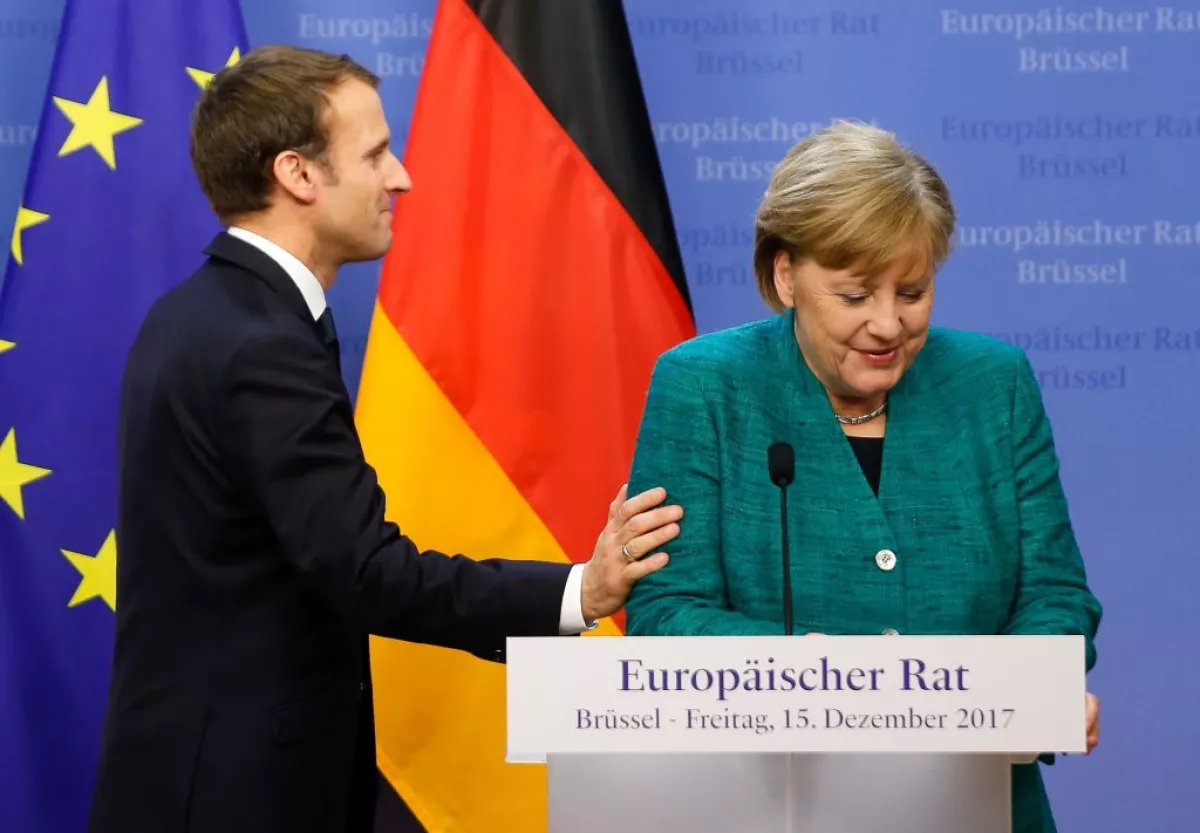
However, circumstances have shifted significantly. Merkel left office in December 2021, and Macron now faces mounting political difficulties at home. According to the article, his political position "increasingly resembles what diplomats and journalists describe as a European 'Cassandra': right in his warnings about global instability, yet less able to mobilize support domestically or across the continent to confront the issues."
The close of the “Merkron” era coincided with a wave of crises across Europe: Russia’s continuing war in Ukraine, uncertainty in US foreign policy, intensifying climate pressures, persistent migration tensions and the breakdown of arms-control agreements. The long-held post-Cold War belief in permanent peace on the continent has largely faded.
Common denominator for "Merzoni"
Into the space left by “Merkron” have stepped Merz and Meloni, though an unlikely pairing on the surface.
Merz is a conservative Atlanticist and outspoken economic liberal. His 2008 book, “Dare More Capitalism,” signaled his support for a more assertive pro-market agenda after years of centrist caution under Merkel. He argues that Germany must rebuild its military capabilities, marking a clear departure from decades of German and EU-wide reluctance to assume a stronger defence posture.
Meloni, by contrast, rose to prominence from Italy’s nationalist right. Her party, Brothers of Italy (Fratelli d’Italia), traces its roots to the remnants of Mussolini-era fascism. Yet since taking office, she has demonstrated political adaptability, repositioning herself as a responsible and effective European leader. As prime minister, she has maintained firm support for Ukraine and close cooperation with the EU, easing earlier concerns. As the article argues, she has also cultivated strong relationships in Washington, including with Trump’s political circle, showing what the article describes as strategic flexibility. Critics label her opportunistic, while supporters see pragmatism; in either case, Meloni has become a bridge between nationalist currents and mainstream European politics.
What binds Merz and Meloni is less shared ideology than shared necessity. Germany remains Europe’s economic powerhouse but requires partners to advance stronger defence capabilities and economic reform. Italy, meanwhile, seeks greater influence at the heart of European decision-making.
Both leaders now emphasize strategic autonomy — the idea that Europe must be capable of defending itself and safeguarding its interests even if US reliability wanes. As their joint paper states: “Continuing on the current path is not an option. Europe must act now.”
Historically, European unity has often strengthened in moments of crisis. Brexit bolstered pro-EU sentiment across the continent, and Russia’s invasion of Ukraine reinvigorated cooperation within both NATO and the EU. Today, as Washington signals possible shifts in its NATO commitments, contemplates tariffs and questions territorial arrangements in areas such as Greenland, Europe faces another political jolt. Recent surveys suggest strong public support across the continent for deeper EU defence cooperation and unity in confronting global challenges.
Rise of new policies
For leaders such as Merz and Meloni, these conditions open political space for initiatives that would have seemed unlikely a decade ago: expanded military spending, deeper defence integration, industrial policy measures and stricter migration controls.
Germany is experiencing perhaps the most significant transformation. For decades, Berlin avoided assuming military leadership, constrained by its historical legacy and protected by US security guarantees. That period appears to be ending, as German officials increasingly discuss rearmament, European defence preparedness and sustained strategic competition.
A whole string of bilateral agreements have been signed between the two leaders during a Rome summit in January moving beyond coordination toward a structured strategic partnership, signing deals on competitiveness, defence and resilience. The new German-Italian action plan underscores enhanced cooperation in defence, cybersecurity and strategic industries. While reaffirming commitment to NATO, both governments advocate for stronger European military capacity.
Concepts such as a future European defence force — once dismissed as unrealistic — are now gaining serious traction in policy debates. Italy is reportedly preparing a major procurement agreement with German defence manufacturer Rheinmetall worth up to €20 billion. The deal, which could include hundreds of armored vehicles and next-generation tanks, would rank among Europe’s largest joint defence initiatives.
What both parties stand to gain
For Meloni, closer ties with Berlin provide added legitimacy. Italy has historically alternated between periods of central influence and peripheral frustration within the EU. By aligning with Germany, Rome strengthens its position within Europe’s decision-making core. At the same time, Meloni can present herself domestically as a nationalist leader while remaining indispensable at the European level. Her political positioning allows her to maintain relationships in Washington while staying within EU consensus — a delicate balance few European leaders achieve.
Germany, in turn, gains flexibility and a partner whose priorities align more closely with pragmatic EU politics. Macron’s ambitious federalist vision has sometimes unsettled more cautious member states. Italy offers Merz a practical counterweight, focused on competitiveness, migration management and industrial policy rather than sweeping institutional reform.
By Nazrin Sadigova







 editor@caliber.az
 +994 55 444-88-98
 Азербайджан, Баку, ул. Низами, 203, Af Business House, 5-й этаж