










Royal Danish air force bids farewell to F-16 as F-35 takes over
After more than four decades at the core of Denmark’s combat airpower, the Royal Danish Air Force has formally retired the F-16 Fighting Falcon, marking the end of an era even as the aircraft continues to play an active role in global security.
The final Danish-operated F-16 flight took place on January 18 at Skrydstrup Air Base, coinciding with the service’s transition to the F-35A and the redistribution of its veteran Vipers to frontline operators including Ukraine and Argentina, The War Zone writes.
Earlier that day, three additional aircraft departed Skrydstrup in full afterburner for a final formation flight, symbolically ending the type’s frontline role.
The ceremony underscored the historic significance of the F-16 to Denmark’s air force, particularly at Skrydstrup, where 727 Squadron served as the RDAF’s final F-16 unit. Speaking at the event, former Danish Chief of Defence Gen. Christian Hvidt reflected on the aircraft’s longevity and performance.
“We never talk about the age of the F-16 because it has been maintained by probably the world’s best aircraft technicians and is flown by some of the world’s best pilots," he said. “Congratulations to 727. What exciting and enormous challenges lie ahead.”
Hvidt, callsign “VIT,” has a personal connection to the platform, having landed the first Danish F-16 at Skrydstrup in January 1980. Denmark acquired the aircraft through what became known as the “Sale of the Century,” a multinational European procurement effort with Belgium, the Netherlands, and Norway. In RDAF service, the F-16 replaced a diverse fleet that included the F-100 Super Sabre, F-104G Starfighter, and Saab Draken.
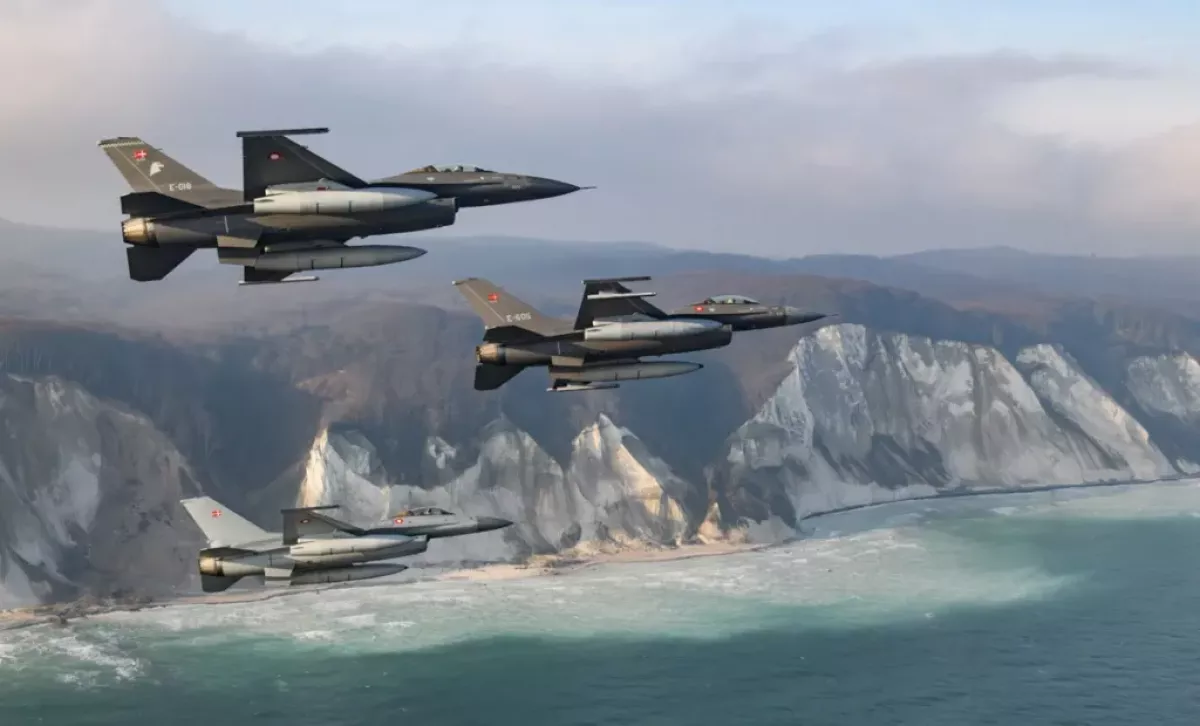
Denmark ultimately operated 77 F-16A/B aircraft across several blocks, later upgrading 61 of them under the Mid-Life Update (MLU) programme to the F-16AM/BM standard.
These jets incorporated uniquely Danish features, including Terma’s Pylon Integrated Dispenser Stations (PIDS), which integrated electronic warfare systems, countermeasures, and approach warning sensors into underwing pylons. Danish F-16s also employed the Terma Modular Reconnaissance Pod, enhancing tactical ISR capabilities.
Operationally, the RDAF’s F-16s were deeply embedded in NATO combat and air policing missions, from Allied Force over the Balkans to operations over Afghanistan, Libya, and the Middle East, as well as Baltic and Icelandic air policing. Despite this extensive operational history, the aircraft remain structurally sound, enabling their transfer to new operators.
Denmark’s transition to the F-35A Lightning II reflects broader changes in warfare. As Steen Hartov of the Air Force Command explained, “In the future, we will see a completely different type of warfare… battles on land, in the air, at sea, in space, and not least digitally will take place at the same time and directly influence each other.”
The RDAF highlights the F-35’s ability to fuse, process, and distribute battlefield data as a decisive advantage over fourth-generation fighters.
While retired at home, Denmark’s F-16s continue to shape global security. Aircraft have been sold to Argentina and donated to Ukraine, where former RDAF jets—still equipped with distinctive Terma self-protection pylons—are already seeing high-intensity combat.
As TWZ notes, the aircraft’s most demanding operational chapter may ultimately be unfolding far from Danish airspace, long after its formal retirement ceremony.
By Sabina Mammadli







 editor@caliber.az
 +994 55 444-88-98
 Азербайджан, Баку, ул. Низами, 203, Af Business House, 5-й этаж