










Russian state TV loses viewers as trust in television declines
Trust in television among Russians has fallen to its lowest level in years, while audiences for major state television talk shows have also declined, according to surveys by the Levada Centre and data from Mediascope.
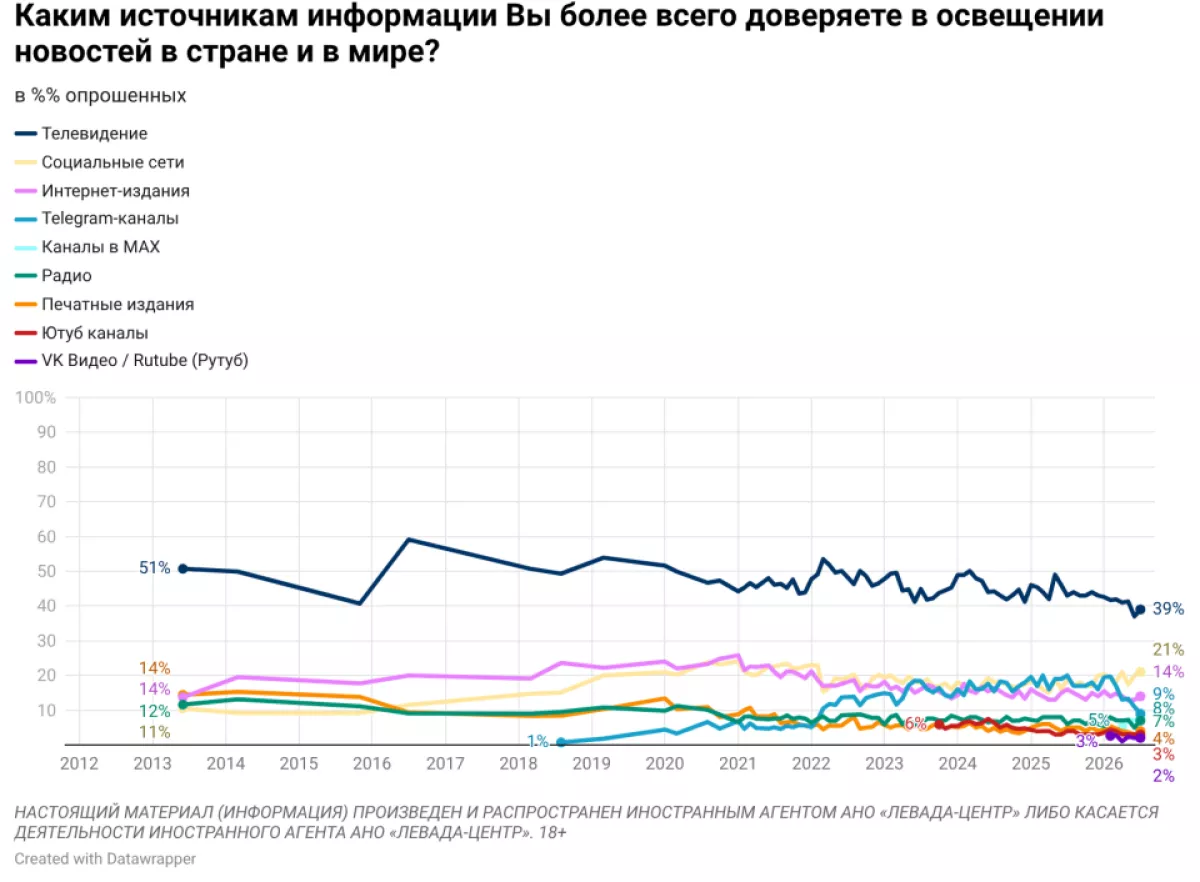
Levada Centre data showed that 37% of respondents in June and 39% in July said they trusted television as a source of information. This compares with 51% in 2013 and 60% in 2016. During the first year of Russia’s war against Ukraine, about half of respondents considered television trustworthy, while the figure was slightly above 40% last year, The Moscow Times reports.
The proportion of Russians who said they trusted social media, the internet and Telegram channels more than television reached a combined 44%, exceeding television’s core audience for the first time. Another 19% said they did not trust any source of information.
Political analyst Abbas Gallyamov attributed the decline to growing public fatigue with state propaganda, citing its tone, perceived inappropriateness and the continued presence of the same television personalities.
Mediascope data also showed declining audiences for major political talk shows. Olga Skabeeva’s 60 Minutes had an audience share of 3% in the week of July 20–26, 2026, down from 4% during the same period in 2024.
Channel One’s Vremya Pokazhet saw its audience share fall from 2.3% to 1.9%, while Vladimir Solovyov’s Sunday Evening recorded the sharpest decline, dropping from 2.9% to 1.7%.
Vremya Pokazhet and Sunday Evening have consequently fallen out of Mediascope’s top 100 most-watched television programmes. 60 Minutes remained in the ranking at 79th place.
Gallyamov described the declining interest in state television propaganda as a significant indication of Russia’s potential for public discontent. Meanwhile, Levada Centre data showed that 29% of Russians in July believed the country was moving in the “wrong direction”, nearly twice the level recorded at the beginning of 2024.
The share of respondents who described the political situation in Russia as “explosive” reached 13%, the highest level recorded since the 2022 mobilisation.
By Sabina Mammadli







 editor@caliber.az
 +994 55 444-88-98
 Азербайджан, Баку, ул. Низами, 203, Af Business House, 5-й этаж