










Bosnia's turbulent journey 30 years following Dayton peace accords
On November 21, 1995, the leaders of Bosnia-Herzegovina, Serbia and Croatia initialed an agreement that ended the three-and-a-half-year war in Bosnia in a hotel room at an American Air Force Base in Dayton, Ohio. Three weeks later, the General Framework Agreement – known as the Dayton Peace Accords – was formally signed.
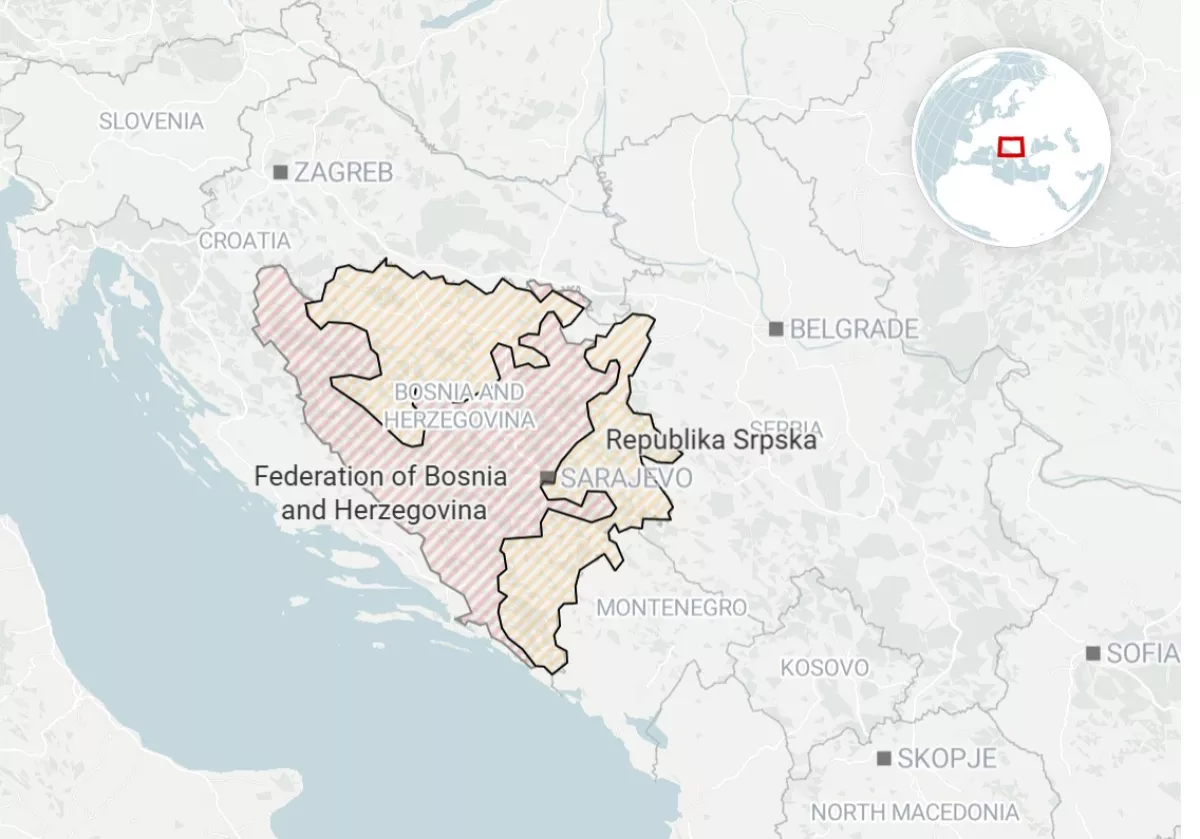
The Dayton agreement preserved Bosnia and Herzegovina – the country's full formal name – as a single state but divided it into two entities: Republika Srpska, proclaimed by ethnonationalist Serbs in January 1992, and the Bosnian Federation.
An international military force was deployed to maintain the peace following the war which tragically evolved into the most brutal and destructive of the conflicts triggered by the breakup of Yugoslavia. Half of its 4.4 million people were forcibly displaced, and more than 100,000 were killed, as an article by The Conversation recalls.
Analysing the journey that the country embarked upon 25 years following the peace accords, the paper argues that Bosnia’s post-Dayton trajectory can be divided into three rough decades: reconstruction, stalemate and crisis.
Hopeful beginnings
The first decade was the hardest but also the most promising. With peace enforced by an international force that included US and Russian troops, Bosnians began returning to their shattered homeland. But repairing the country’s social fabric proved daunting, the article notes. While the international community sought to reverse ethnic cleansing, the barriers to doing so were enormous.
A once proudly multicultural country was left fragmented into ethno-territorial divisions. Under the Dayton Accords, Bosnians were guaranteed the right to return to their homes, but this was complicated by the destruction of many houses and the occupation of others by those who had forcibly displaced their owners.
By the summer of 2004, the UNHCR announced it had facilitated 1 million returns. Yet it soon became clear that “minority returns” — people returning to areas where they would be an ethnic minority — were limited.
Many who reclaimed their former property did so only after prolonged struggle, and then quickly sold it to start new lives in areas dominated by their own ethnic group, as cross-ethnic trust had been largely shattered by the war.
Stalemate
The first decade marked the height of liberal international statebuilding. The international high representative, tasked with “civilian implementation” of the Dayton Accords, consolidated military and intelligence powers at the state level. Several central institutions were established, including a state court, border service and financial bodies.
However, Bosnia’s progress stalled in 2006 when the high representative pulled back from statebuilding and a package of constitutional reforms aimed at streamlining Dayton by strengthening central institutions fell two votes short in Parliament.
Unexpectedly, the package was blocked not by parties from Republika Srpska — historically the chief obstructionists — but by former Prime Minister Haris Silajdžić’s Bosniak-dominated party, which advocated unifying the two entities. This in turn prompted Republika Srpska’s leading politician, Milorad Dodik, to float the prohibited idea of an entity-level independence referendum.
With the high representative largely inactive, the publication notes that Bosnia became trapped between incompatible political visions, each side strong enough to obstruct but too weak to prevail.
Crumbling unity
In November 2015, Bosnia’s Constitutional Court ruled that marking January 9 as “Republika Srpska Day” — commemorating a symbolic declaration of independence — was discriminatory and unlawful under human rights law.
Dodik, the de facto leader of Republika Srpska, responded by holding an extralegal referendum affirming public support for retaining the date.
According to the article, a decade of stalemate gradually shifted into a state of permanent crisis.
This defiance escalated into open subversion of Bosnia’s constitutional order and key parts of the Dayton settlement. The Republika Srpska assembly passed laws that directly challenged central state institutions built during the first postwar decade. With limited enforcement capacity, the Bosnian state struggled to compel compliance.
When former German agriculture minister Christian Schmidt was appointed high representative in 2021 over objections from Russia, Dodik rejected his authority outright, claiming Schmidt lacked necessary UN Security Council approval due to Russian and Chinese vetoes.
Within months, Schmidt warned the Security Council that Bosnia faced “the greatest existential threat of the post-war era.”
After the outbreak of war in Ukraine, Dodik aligned firmly with Moscow, making multiple trips to the Kremlin. Meanwhile, most people and institutions in the Bosnian Federation sided with Ukraine and the West. A deep geopolitical divide cleaved the country: two entities, two divergent realities.
In April 2022, Schmidt suspended a law that would have allowed Republika Srpska to seize state assets on its territory, which encompasses more than half the country.
More than a year later, he annulled RS laws permitting the entity to ignore his decisions and rulings of Bosnia’s Constitutional Court. Schmidt then made it a criminal offense to disregard his decisions, punishable by up to five years in prison and disqualification from public office.
For defying these rulings, Dodik was indicted in August 2023. After a lengthy court process he said was aimed at “eliminating him from the political arena,” he was sentenced in February to one year in prison and barred from office for six years.
In February 2025, tensions peaked when Bosnia’s Constitutional Court barred Dodik from public life. He predictably rejected the court’s authority, prompting another standoff. According to the article, Dodik hired figures close to the Trump administration, including Rudy Giuliani, to lobby on his behalf. By late October, they had succeeded in securing the removal of US sanctions in exchange for his departure from the Republika Srpska presidency.
To distant observers, Bosnia may seem like a success story simply because it has not relapsed into war. However, as the article puts it, the peace forged at Dayton placed the country in a straitjacket that has kept it divided ever since. While widely regarded as flawed and unpopular, the accords nonetheless preserved Bosnia and prevented renewed conflict — an imperfect success, but a success nonetheless.
By Nazrin Sadigova







 editor@caliber.az
 +994 55 444-88-98
 Азербайджан, Баку, ул. Низами, 203, Af Business House, 5-й этаж