










Gulf rivalry risks Yemen becoming world's latest hotspot for conflict
A sharp escalation in southern Yemen has brought Saudi Arabia and the United Arab Emirates into an unprecedented direct confrontation, exposing deep fractures within the alliance that once backed the internationally recognised government in Sanaa. In recent weeks, the two Gulf powers have found themselves supporting rival factions on the ground, with a formal declaration of “war” by one rebel group and its challenge to Yemen’s territorial integrity raising fears that the conflict could spill into a new regional battlefield.
The deteriorating power balance has seen Riyadh and Abu Dhabi accuse one another of attacking forces aligned with their respective allies. This marks a dramatic departure from the early years of the war, when both countries intervened together in support of Yemen’s government, as noted in a recent BBC report into the situation.
Saudi Arabia’s foreign ministry has now called on Yemen’s southern factions to attend a “dialogue” in Riyadh aimed “to bring together all southern factions to discuss just solutions to the southern cause.”
The appeal follows accusations by the UAE that Saudi-backed ground forces, supported by Saudi air strikes, attacked a military camp in Hadramawt belonging to the UAE-backed Southern Transitional Council (STC).
Yemen’s civil war erupted in 2014, plunging one of the Arab world’s poorest countries into years of violence and triggering one of the world’s worst hunger crises. At the outset, the Iran-backed Houthi movement seized much of northern Yemen, including the capital, Sanaa. The conflict escalated in 2015 when a Saudi- and UAE-led coalition launched a military campaign to restore the government.
A ceasefire in recent years has largely frozen front lines with the Houthis, but divisions have deepened within the Saudi-backed ruling coalition. The Presidential Leadership Council (PLC), formed in 2022 to unite anti-Houthi factions, has steadily weakened, while the STC has consolidated control over most of southern Yemen, despite formally being part of the coalition.
Infighting intensified on December 2, when the STC — which seeks an independent southern state — launched a major offensive in eastern Yemen, rapidly seizing territory from government forces. The advance included the oil-rich Hadramawt province, which borders Saudi Arabia. The STC said the operation was needed to “restore stability,” but PLC head Rashad al-Alimi condemned it as a “rebellion,” warning it could fracture Yemen and destabilise the region.
Tensions escalated further with Saudi-led coalition air strikes on an STC military camp in Hadramawt on January 2, which an STC official said killed seven people. Earlier strikes this week already hit the southern port city of Mukalla, after the coalition accused the UAE of delivering two ships carrying military equipment to the separatists. While no casualties were reported, the article notes that images of burnt-out vehicles circulating online suggested the strikes targeted UAE hardware.
The UAE denied the accusations, saying the shipment contained no weapons and that the vehicles were intended for Emirati forces. Nevertheless, following the strikes, the head of Yemen’s Presidential Council announced the cancellation of a joint defence treaty with the UAE and ordered all Emirati forces to leave Yemen within 24 hours.
Saudi Arabia backed the demand, accusing the UAE of pressuring the STC to launch its eastern offensive and warning that Saudi national security was a “red line.” Abu Dhabi denied directing the campaign but, in a surprise move, later agreed to withdraw its forces from Yemen.
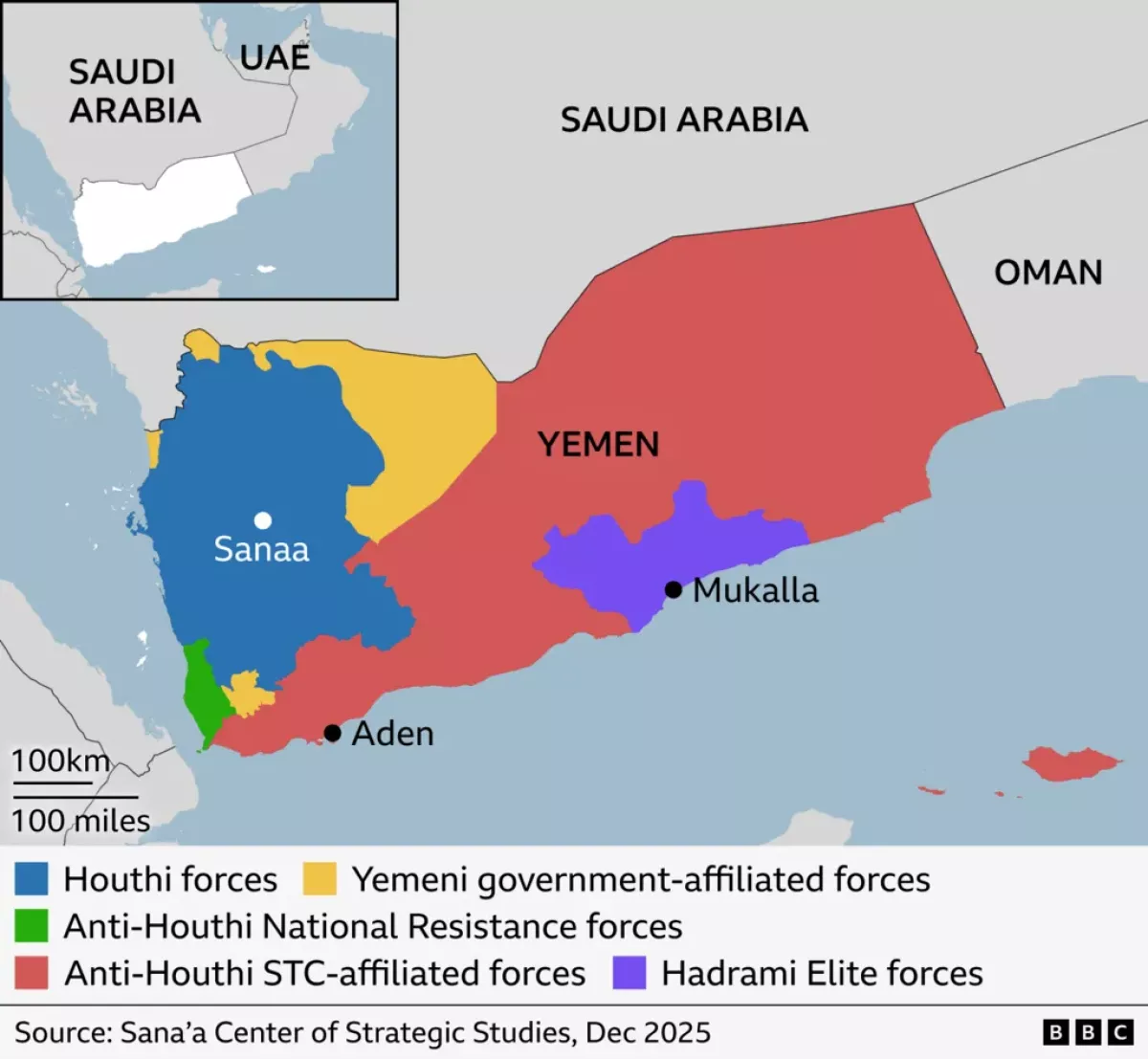
While the conflict is increasingly portrayed as a proxy struggle between the Gulf rivals, analysts say the STC’s actions have been years in the making. Observers note that the UAE’s backing of the STC aligns with its interest in securing Red Sea ports and countering Islamist groups within Yemen’s government, the article states.
The STC’s ambitions have grown alongside its territorial gains, Yemeni affairs journalist Anwar al-Ansi told BBC Arabic.
“[STC chief Aidarous] Al-Zubaidi has been the most consistent person inside Yemen, consistently demanding independence for southern Yemen. So, no, I don't think he will give up,” said another analyst, Farea al-Muslimi from the Chatham House think tank.
STC spokesperson Anwar al-Tamimi confirmed the group’s goals to the BBC. “Our intentions have always been clear for years and that is to establish an independent state, we haven't tried to fool anyone,” he said. “It's the right of the people of the south to choose their fate, unfortunately many in the region have tried to stand in our way.”
He rejected claims that southern independence would threaten Saudi Arabia. “We will have stability and won't be a source of terrorism that threatens them,” he said.
Amid those competing ambitions by regional forces, Yemen’s population continues to bear the brunt of the cost. Nearly a decade of war has devastated the economy and left some 40 million people facing what aid agencies describe as the world’s third-worst hunger crisis. The BBC cites 2021 figures published by the UN, estimating that 377,000 people had died due to the conflict and its knock-on effects on hunger and healthcare, including 259,000 children under the age of five.
By Nazrin Sadigova







 editor@caliber.az
 +994 55 444-88-98
 Азербайджан, Баку, ул. Низами, 203, Af Business House, 5-й этаж