










Can these oil pipelines offset consequences from Iran’s waterway closure?
Two key oil pipelines that bypass the strategically vital Strait of Hormuz have come under renewed global attention as the regional war triggered by strikes from the United States and Israel against Iran continues to escalate.
The first is Saudi Aramco’s East-West pipeline network, also known as Petroline. Stretching roughly 1,200 kilometres across Saudi Arabia, the system transports crude oil from the eastern Gulf hub of Abqaiq to the Red Sea export terminal at Yanbu.
Following recent upgrades, the East-West pipeline is estimated to have a design capacity of around 7 million barrels per day. Saudi Aramco said earlier this week that the network is expected to reach full capacity in the coming days.
A second, smaller alternative route is the Abu Dhabi Crude Oil Pipeline. The roughly 400-kilometre pipeline links inland oil facilities at Habshan with the export port of Fujairah in the United Arab Emirates.
ADCOP is estimated to carry about 1.5 million barrels of crude per day, with a maximum capacity of close to 1.8 million barrels.
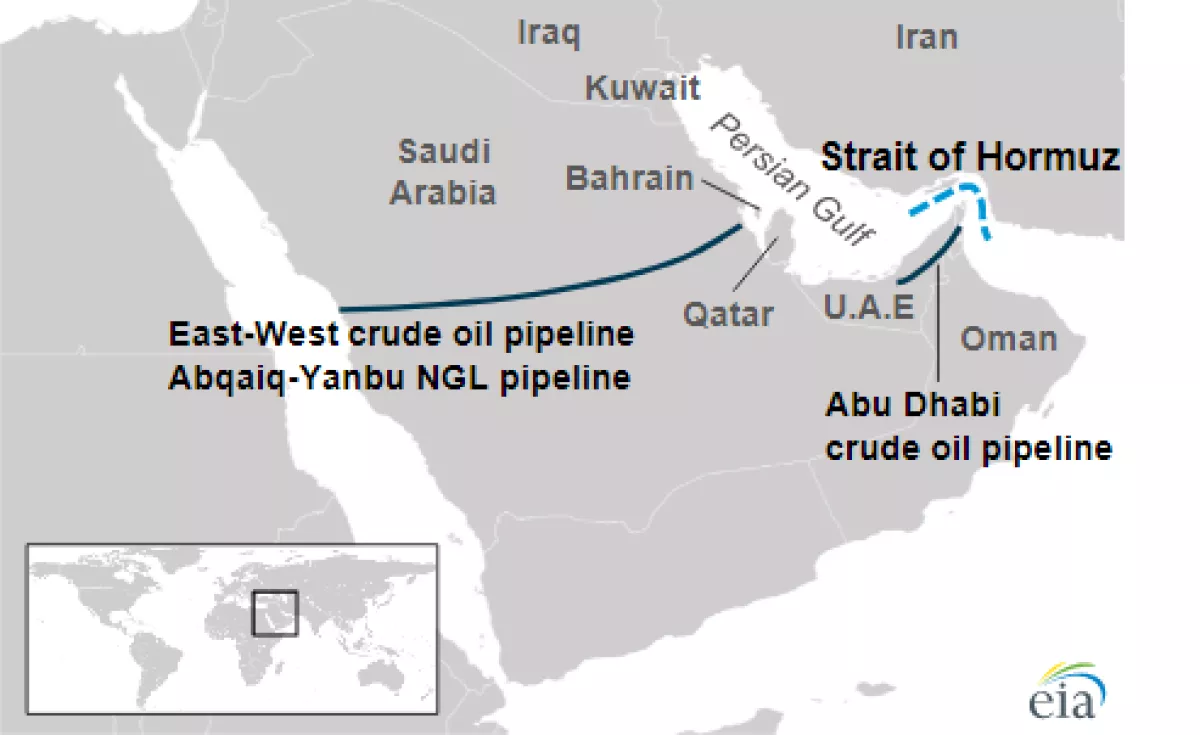
Crucially, both pieces of infrastructure bypass the Strait of Hormuz — a critical maritime chokepoint that has effectively been blocked by Iranian authorities following U.S. and Israeli strikes on the Islamic Republic.
Combined, the East-West pipeline and ADCOP could help offset part of the roughly 20 million barrels of oil per day that typically pass through the strait. However, energy analysts warn that the risk of attacks on energy infrastructure across the region remains a major concern.
“Saudi Arabia and the UAE are already increasing utilisation of pipelines that bypass the strait,” Naveen Das, senior oil analyst at the trade intelligence firm Kpler, told American outlet CNBC.
“In the UAE, we estimate the 1.5 mbd ADCOP pipeline is operating at 71% utilization, leaving around 440,000 [barrels per day] of spare capacity. ADNOC can temporarily raise throughput to 1.8 mbd if required,” Das said.
He cautioned, however, that the potential for attacks on energy facilities could limit how much additional capacity these routes can realistically handle. Abu Dhabi’s state oil company has reportedly shut down its large Ruwais refinery complex after a fire broke out at one of the facilities, according to multiple media reports. The Ruwais complex is capable of processing about 922,000 barrels of crude per day.
Oil markets have remained highly volatile since the conflict involving Iran escalated last month. Global benchmark Brent crude briefly surged to nearly $120 a barrel earlier this week before retreating. Futures were last trading near $100 a barrel on March 13 as additional attacks on ships were reported in the Persian Gulf.
By Nazrin Sadigova







 editor@caliber.az
 +994 55 444-88-98
 Азербайджан, Баку, ул. Низами, 203, Af Business House, 5-й этаж