










Vast whale “graveyard” discovered in Indian Ocean depths
A vast underwater graveyard of whales—stretching for more than 1,200 kilometers across the Indian Ocean—has been discovered on the seafloor, revealing one of the most extraordinary fossil sites ever documented in deep-sea science.
The newly identified “megasite,” formally named the Diamantina Zone necropolis, was identified by a research team from the Chinese Academy of Sciences’ Institute of Deep-sea Science and Engineering. They have published their data on this astonishing find in the esteemed Nature journal this week, as an article by LiveScience highlights.
The site contains hundreds of whale fossils and carcasses preserved at extreme ocean depths, some of which date back more than 5 million years. Scientists say the scale and density of the site make it the most extensive whale accumulation ever recorded.
Researchers identified 476 whale fossils and five relatively recent carcasses during 32 deep-sea dives using the Fendouzhe submersible. The exploration covered an area of about 0.64 square kilometers, but extrapolations suggest the broader region may contain up to 750 fossils per square kilometer.
The discovery was made in the Diamantina Zone, a remote region of ridges and fractures in the southeastern Indian Ocean, where whales appear to have been drawn repeatedly over geological time.
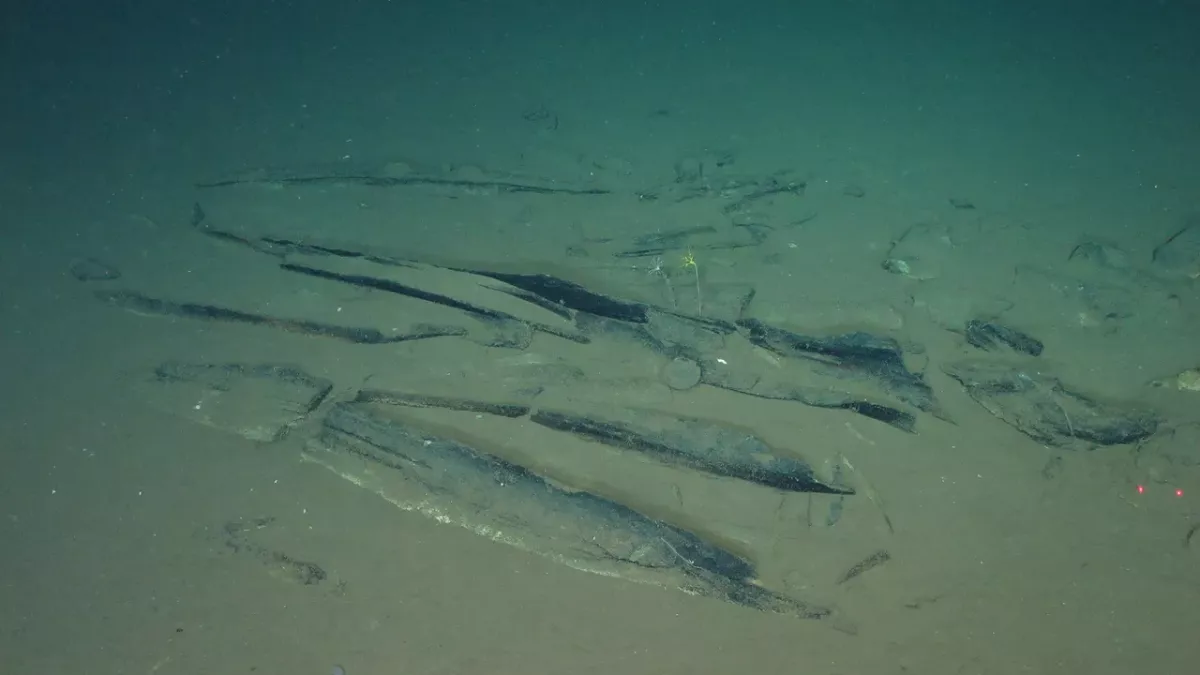
“These findings just defy belief,” said Nick Pyenson, a fossil marine mammal curator at the Smithsonian National Museum of Natural History, who was not involved in the study. He described the site as a “megasite,” adding that the scale suggests something “really special” has been uncovered.
Among the most striking discoveries is a 5 m-long skeleton of an Antarctic minke whale, one of the larger carcasses found at the site. However, most remains belong to beaked whales—deep-diving species that spend long periods in the open ocean and remain poorly understood.
"Many of the members of the whale-fall communities may also be newly discovered species, the authors wrote, because although most could be matched to the genus or family level using DNA data from samples, only one could be confidently assigned to a species: a clam known as Abyssogena southwardae," the article highlights.
The fossil record at the site also spans deep time. The oldest specimen belongs to an extinct beaked whale from the genus Pterocetus, dating back approximately 5.3 million years to the Early Pliocene. Researchers also identified a previously unknown species, now named Pterocetus diamantina.
One of the most surprising aspects of the discovery made by Xiaotong Peng, a deep-sea researcher at the Chinese Academy and his colleagues is that it represents the deepest whale-fall ecosystem ever recorded, with one site located at around 6,700 m depth—about 2,500 m deeper than any previously known comparable habitat.
Whale-fall ecosystems form when a whale dies and its body sinks to the seafloor, creating a sudden nutrient-rich environment that supports complex communities of scavengers and specialized deep-sea organisms. At the Diamantina Zone, scientists also observed squid and fish, suggesting the area may act as a major deep-water feeding ground that repeatedly attracts whales over time.
However, researchers also believe the same feeding behavior may carry hidden risks. Beaked whales may occasionally dive beyond their typical physiological limits of around 3,000 m, potentially exposing themselves to decompression sickness or lung collapse.
Taken together, the findings suggest that the Diamantina Zone is not just a resting place for whale remains, but a long-term ecological hotspot—one that has quietly recorded millions of years of deep-ocean life and death in extraordinary detail.
By Nazrin Sadigova







 editor@caliber.az
 +994 55 444-88-98
 Азербайджан, Баку, ул. Низами, 203, Af Business House, 5-й этаж