










What we know about sea mines in and around Strait of Hormuz?
The United States military says it is deploying warships to the Strait of Hormuz to clear suspected sea mines, amid heightened tensions over Iran’s partial disruption of one of the world’s most critical energy chokepoints.
US Central Command (CENTCOM), which oversees American military operations in the Middle East, said guided-missile destroyers USS Frank E Peterson and USS Michael Murphy would take part in an operation to establish a “safe pathway” for maritime traffic after what it described as Iran’s near-closure of the waterway, foreign media reports.
The mission follows reports of Iranian mine-laying activity and comes after the Islamic Revolutionary Guard Corps (IRGC) circulated navigation guidance indicating alternative shipping corridors. The IRGC warned of “the likelihood of the presence of various types of anti-ship mines in the main traffic zone”.

The Strait of Hormuz, through which around a fifth of global oil and liquefied natural gas exports pass, has seen shipping disruption since the escalation of hostilities between the United States, Israel and Iran earlier this year.
Iran has not confirmed deploying mines but has publicly warned that the strait is “closed” to hostile vessels while allowing selected traffic.
Analysts say even the threat of mines, rather than confirmed deployment, can severely disrupt maritime commerce by driving up insurance costs and forcing shipping companies to reroute or halt operations. Alexandru Cristian Hudisteanu, a retired Romanian naval officer, said the effect can be largely psychological: “The mined area does not have to be everywhere to be everywhere in the minds of those who must transit it,” he said.
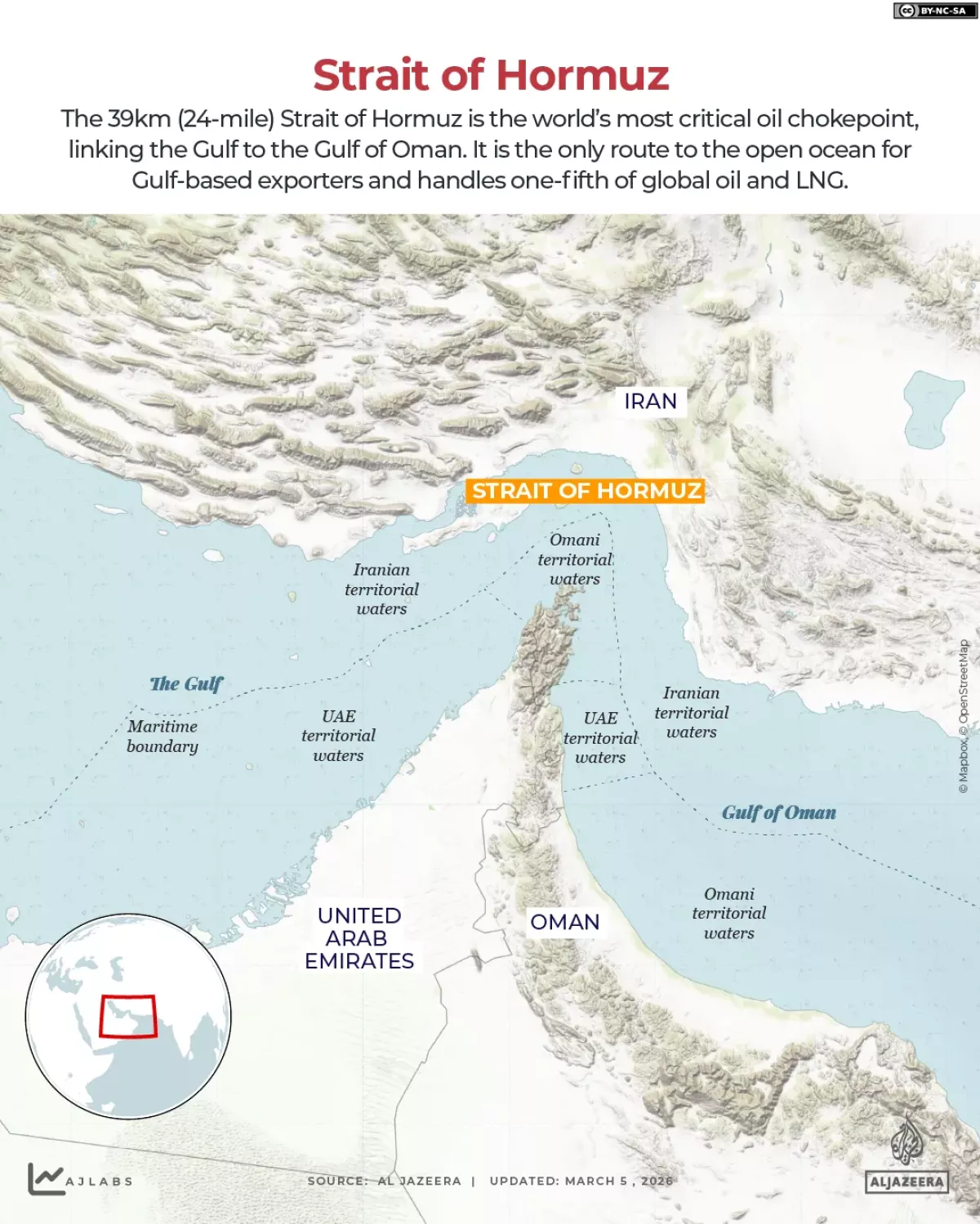
Sea mines remain among the most cost-effective naval weapons, with modern variants ranging from simple contact devices to advanced bottom and rocket-propelled systems that can target ships using acoustic, magnetic or pressure signatures.
Iran is estimated by maritime analysts to possess thousands of mines, many domestically produced. Experts say their deployment in a narrow strait would likely be designed to channel shipping into predictable lanes, increasing vulnerability.
US officials have said President Donald Trump believes American forces have destroyed “all” 28 Iranian mine-laying boats, though that claim has not been independently verified.
CENTCOM has confirmed strikes on Iranian vessels but has not provided evidence that the entire mine-laying capability has been eliminated.

Military analysts also warn that US mine countermeasure capacity has been reduced in recent years. A recent assessment described a US Navy “mine gap” following the retirement of dedicated mine-hunting ships and helicopters used for sweeping operations.
Hudisteanu said mine countermeasure units face significant risk during operations: “MCM units tend to be good at one single job and lousy at anything but minimal point defence,” he said, adding that such vessels are “virtually sitting ducks” without substantial protection.
The combination of limited clearance assets and the difficulty of detecting modern mines has raised concerns that restoring safe passage through the strait could be slow, even if no further escalation occurs.
By Aghakazim Guliyev







 editor@caliber.az
 +994 55 444-88-98
 Азербайджан, Баку, ул. Низами, 203, Af Business House, 5-й этаж