










Capital that is not looking for oilfields $30 trillion at the Baku Forum
The $30 trillion figure — the combined assets under management of institutions represented at the 2nd Azerbaijan International Investment Forum — is easy to turn into a headline and leave at that. That would miss the point. The figure matters not simply because of its size, but because of what that capital represents. And alongside it is another figure that may be even more revealing: $2.8 trillion held by sovereign wealth funds, state institutions and pension funds.
These figures describe different pools of capital, but taken together, they offer a clearer picture of what is being discussed in Baku.
Two types of capital
The oil and gas majors that came to Azerbaijan after the signing of the “Contract of the Century” invested primarily in specific assets: an oilfield, a pipeline, a platform. The logic was project-based. There were reserves to develop, a defined investment horizon and a production-sharing agreement. Risk was assessed largely around the performance of a particular asset, while the wider environment was treated as one of the variables shaping the investment.
Infrastructure funds and sovereign capital operate differently. They are not simply looking to acquire individual assets; they are looking for positions within broader value chains.
A data centre makes sense when there is reliable energy, strong connectivity and sufficient demand. An airport makes sense when there is passenger traffic and a wider transport network. A port makes sense when it is connected to a functioning trade corridor.
It is enough to look at the portfolios of the forum participants. GIP owns Gatwick, Edinburgh and Sydney airports; railway operators Pacific National in Australia and Italo in Italy; the Peel Ports and Port of Melbourne port operators; data-centre operator CyrusOne; and major energy assets held through Clearway, Vena, Atlas and Eolian.
Brookfield, with more than $1 trillion in assets under management, has an even broader footprint: 308,000 telecommunications sites, 77,000 kilometres of fibre-optic networks, 150 data centres, 36,000 kilometres of railways, 3,200 kilometres of toll roads, and utility infrastructure serving more than 10 million people.
The Canadian company traces its roots to a Brazilian utility firm founded in 1899 and operates on an “owner-operator” model. It does not simply finance infrastructure; it owns and directly manages the assets.
This is not a sectoral portfolio. It is a network of interconnected nodes. And the question being discussed in Baku was, in essence, whether Azerbaijan can become one of those nodes.
Composition, not just the sum
The $30 trillion figure consists primarily of private asset-management capital. BlackRock, with $15.3 trillion in assets under management at the end of June, oversees a pool of capital several times larger than Azerbaijan’s entire annual economic output. BNY manages $2.2 trillion and, as a custodian, provides services for $62.6 trillion in assets. PGIM has around $1.5 trillion under management. Franklin Templeton, KKR, Ares and Neuberger Berman, with $613 billion, are among the other major names represented.
But the $2.8 trillion in sovereign, government and pension capital represents a fundamentally different proposition. ADIA, Singapore’s Temasek, the Türkiye Wealth Fund, Saudi Arabia’s Hassana and Bahrain’s Mumtalakat are institutions with investment horizons measured in decades rather than quarters. This is capital that is not necessarily looking for short-term returns or inclined to exit at the first downturn in the market cycle. Its longer investment horizon places very different demands on the countries seeking to attract it.
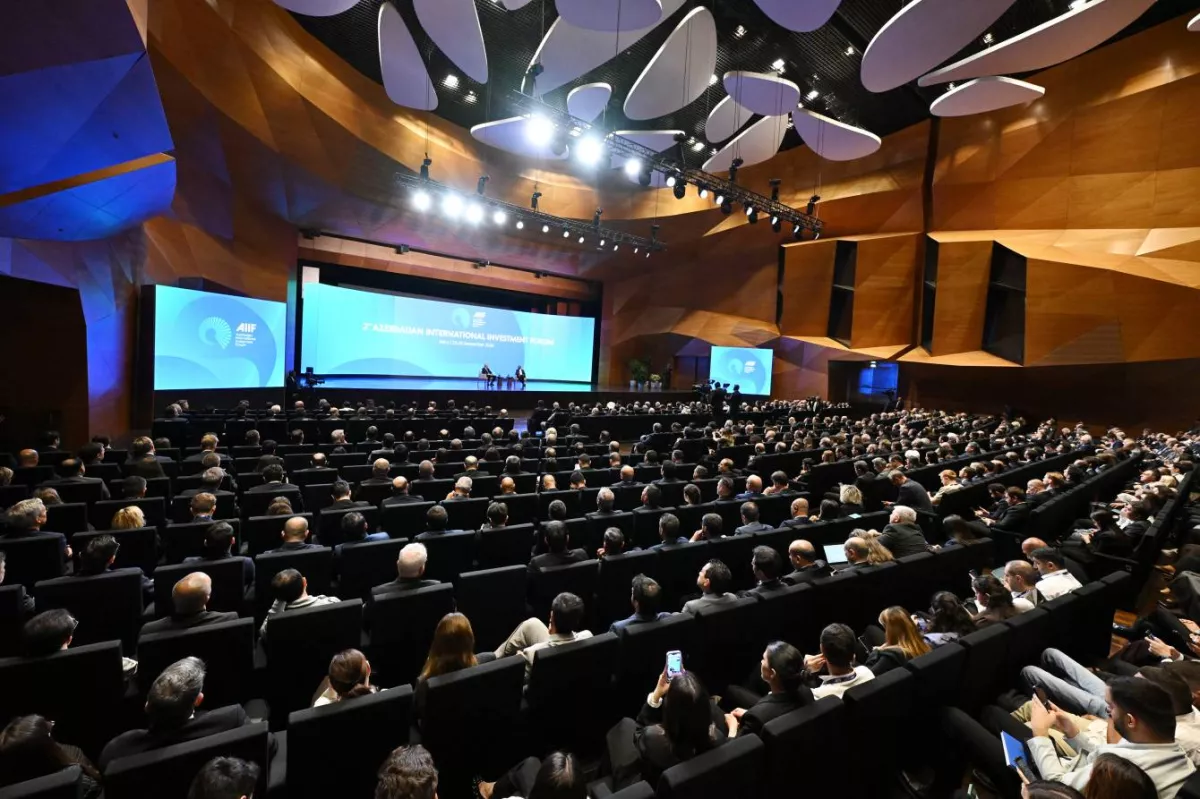
The scale of the gathering is verifiable: more than 3,000 registered participants, 803 foreign delegates from 70 countries, and around 100 representatives of 48 institutions and investment platforms listed for the Azerbaijan Infrastructure Investment Dialogue. On the first day alone, 11 documents were signed.
What exactly are they assessing?
The answer to whether Azerbaijan can become such a node is not found in a panel discussion. It emerges from the parameters an infrastructure investor examines before deciding whether a market is worth entering.
Horizon. Infrastructure investments typically take 15–25 years to generate returns. An investor is therefore assessing not the market environment of today, but whether the rules are likely to remain stable beyond the lifespan of any single political cycle.
Contractual certainty. President Ilham Aliyev’s point that agreements signed 30 years ago remain unchanged is aimed precisely at this audience. For a fund that may own an asset until 2045, the track record of honouring — or changing — contractual commitments can matter more than current returns.
Balance sheet. A statement that Azerbaijan could eliminate its external public debt in a single day sounds to foreign investors less like a conventional political statement than a line in a financial model. Ambrosetti presents the same picture in comparative terms: public debt stands at 20.1 per cent of GDP, placing Azerbaijan eighth globally among countries with the lowest debt burdens.
Momentum. The same logic applies to Azerbaijan’s position in the Global Attractiveness Index 2026: 60th out of 146, up four places in a year. But another indicator is arguably more revealing: in the Dynamism Index, Azerbaijan has risen from 145th to 15th over eight years. For an investor looking 20 years ahead, the pace of change can be more informative than a static snapshot.
Energy. An AI data centre is, first and foremost, a question of megawatts. A 96 per cent gasification rate, plans to expand renewable generation and the stated ambition to become a reliable electricity supplier are therefore not just energy-sector statistics. For a digital infrastructure investor, they go directly to the question of whether a project can physically operate at the required scale.
Demand. Not Azerbaijani demand. Regional demand.
On market size
This point needs to be stated plainly. Ten million people alone do not constitute a large enough domestic market for a fund managing $15 trillion to establish a separate investment vertical. Azerbaijan is viewed through a different lens: as a gateway and connectivity hub serving a much larger regional market.
Since November 2025, Azerbaijan has participated fully in the Consultative Meetings of the Heads of State of Central Asia, effectively expanding the C5 format into C6. For an infrastructure investor, this is not merely a diplomatic development. It potentially expands the geographic scale of projects and the markets they can serve.
BlackRock/GIP is planning to expand its operations in Kazakhstan and Uzbekistan. In Kazakhstan, the focus includes financing the modernisation of transport and logistics infrastructure. In Uzbekistan, the plans encompass petrochemicals, the privatisation of state assets, data centres, an anchor-investor role in the placement of shares in the National Investment Fund, and participation in shaping the concept of the Tashkent International Financial Centre, scheduled to launch in 2027.
In May 2026, BlackRock/GIP, together with Abu Dhabi-based L'IMAD, ADNOC and Temasek, announced a $30 billion infrastructure alliance focused on the Gulf countries and Central Asia.
Seen in this context, Azerbaijan is not simply another market on the list. It is a potential point of connection between them.
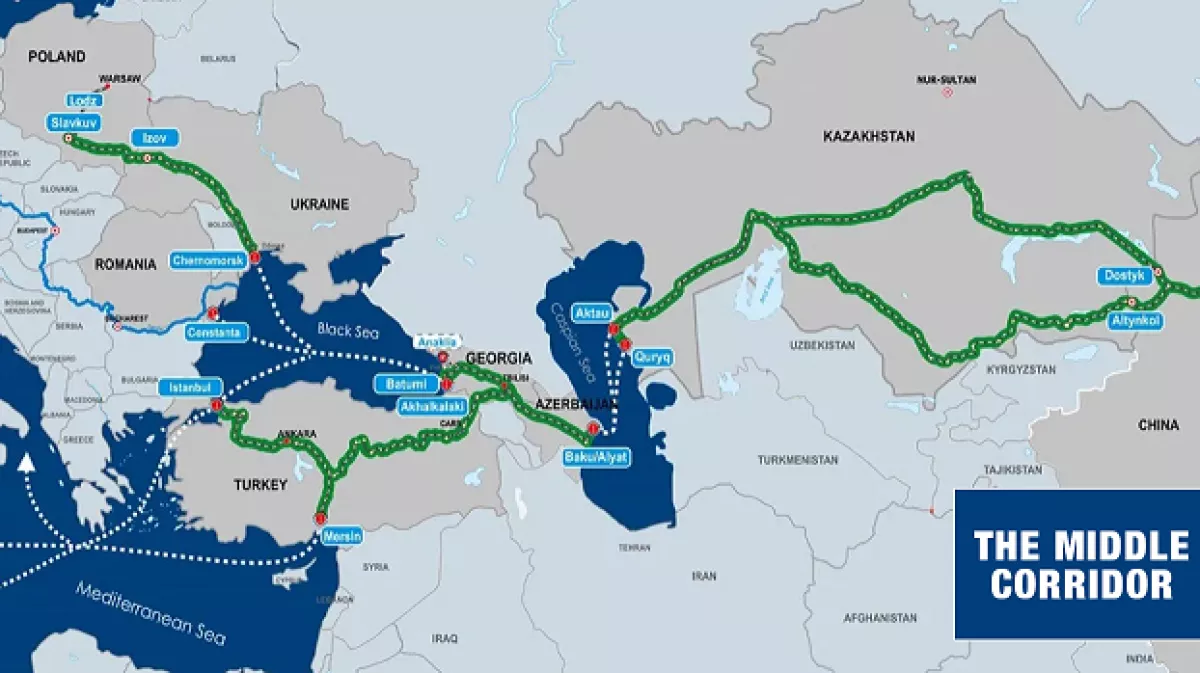
In the first eight months of the year, freight volumes along the Middle Corridor increased by 58 per cent, while annual transit is expected to exceed 16 million tonnes, with a target transit time of 10–12 days. The emerging TRIPP adds another link to this network.
The claim that Azerbaijan is the only country actively involved in both the East–West and North–South corridors therefore functions here less as rhetoric than as an infrastructure characteristic.
Who is sitting on which side of the table?
There is one detail that is often overlooked in coverage of the forum but changes the picture considerably.
The State Oil Fund of Azerbaijan (SOFAZ) is not simply being courted by these investors; it is also their partner. SOFAZ has worked with Neuberger Berman since 2015 and has committed a total of $775 million to instruments managed by the firm, including private equity, private debt, secondary-market investments and co-investments.
In February 2025, SOFAZ invested €34.5 million in Italian high-speed rail operator Italo. In October of the same year, it invested a further £50 million in London’s Gatwick Airport alongside GIP. Then, in January 2026 in Davos, a memorandum of understanding was signed at a meeting attended by Larry Fink, under which SOFAZ is considering investing up to $1.5 billion in infrastructure funds managed by GIP and in co-investment opportunities over the following three to four years. A separate protocol on long-term strategic cooperation was also signed with Brookfield.
This symmetry changes the nature of the negotiations. Azerbaijan’s sovereign wealth fund invests in a British airport alongside GIP, then sits down with the same group in Baku to discuss airport infrastructure, data centres and AI infrastructure at home. A country whose sovereign investor is itself a client and investment partner of major asset managers enters the conversation with a different set of credentials — and a different negotiating position.
What changed over the past year
A comparison with the first forum provides a more meaningful perspective than the absolute figures alone.
A year ago, investment agreements worth more than $10 billion were signed in Baku, with more than $7 billion directed towards the non-oil sector. That answered the first question: was investor interest translating into actual deals? The answer was yes.
The second forum is built on a different foundation and has a different agenda. Artificial intelligence and digital infrastructure, green energy, water management, critical raw materials and capital markets — areas that simply did not feature in Azerbaijan’s traditional investment profile. The memorandum between RINN, AZCON Holding and Microsoft Ireland Operations; UKEF’s statement that it is ready to consider financing projects in clean energy, the Middle Corridor and AI infrastructure within a £5 billion country limit; and the interest of the London Stock Exchange and Standard Chartered in helping Azerbaijani companies access international capital markets — all point to an investment agenda that extends well beyond oil and transit in the traditional sense.
Total investment in Azerbaijan’s economy over the past 20 years has reached $350 billion, half of it foreign. The non-oil sector now accounts for more than 70 per cent of GDP. Over the past six years, $25 billion has been invested in Karabakh and East Zangezur.
How to measure the result
This requires a sober approach. Otherwise, the analysis risks becoming a press release.
Attendance at a forum does not equal investment. Major funds travel extensively, and memoranda of understanding are signed even more frequently. Between an MoU and a completed deal lies due diligence, during which investors assess regulatory predictability, the quality of arbitration protections and — always — the exit strategy. An MoU is, by definition, non-binding; even the $1.5 billion SOFAZ–GIP figure is framed as consideration of potential investment opportunities.
The real indicators will be less exciting but more verifiable: completed deals, the first data-centre facilities with confirmed grid connections and capacity, specific terms of participation in airport infrastructure, and actual drawdowns from the potential $1.5 billion investment programme. Over the next year or two, these should become visible without much interpretation — just as the results of the first forum have.
The starting position, however, is supported by data rather than rhetoric. Investors can verify the numbers for themselves: debt levels, index performance, transport volumes and the changing composition of GDP. President Ilham Aliyev’s advice to investors not to believe fake news, in this context, can be read less as a political jab than as practical guidance. The information environment surrounding a country and the investment indicators describing it are two different sets of data, and professional investors are accustomed to distinguishing between them.
The $30 trillion came to Baku to examine the second set.







 editor@caliber.az
 +994 55 444-88-98
 Азербайджан, Баку, ул. Низами, 203, Af Business House, 5-й этаж