










Illusion or reality: what lies behind the US–Iran memorandum? Expert opinions on Caliber.Az
The United States and Iran have agreed on a memorandum of understanding that provides for a 60-day ceasefire on all fronts, including Lebanon, as well as the opening of the Strait of Hormuz for maritime navigation. The text of the document has not been published, and its exact terms also remain unknown.
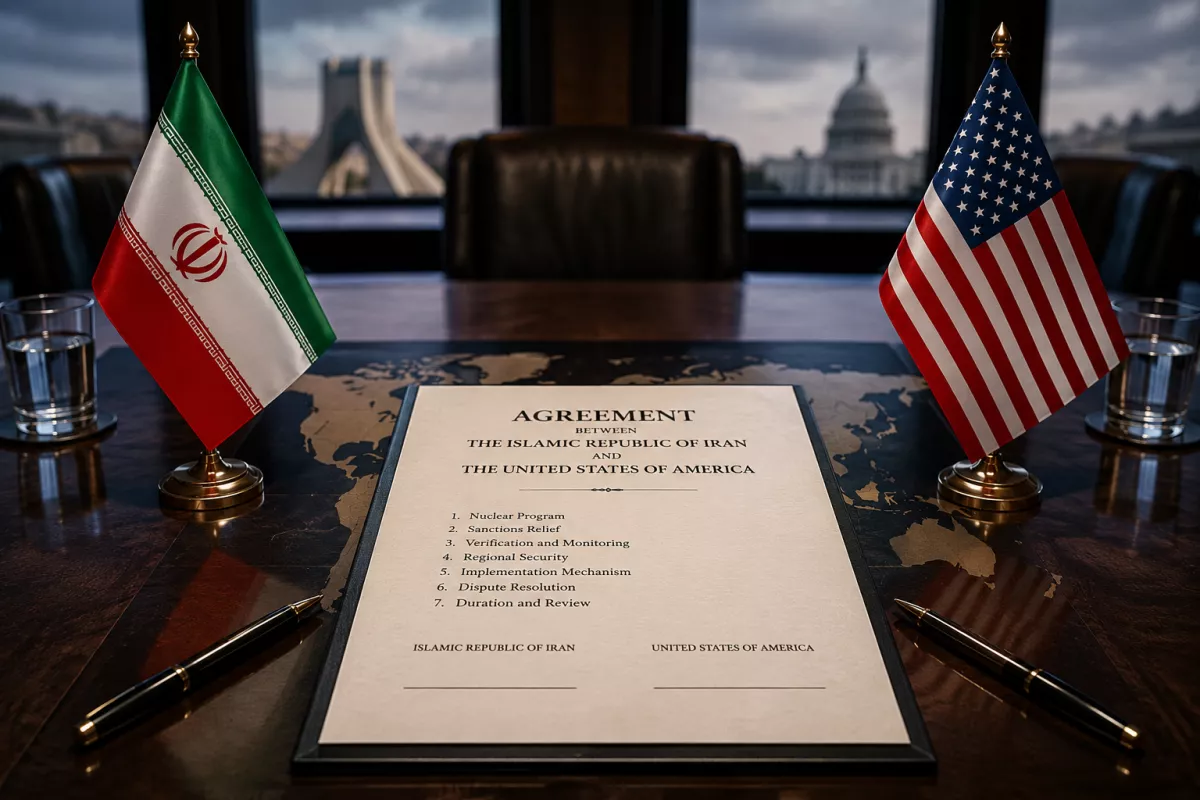
Iranian sources claim that the memorandum consists of 14 points, although the American side has not confirmed this information. The official signing of the document is scheduled for June 19 in Switzerland. It is expected that over the following 60 days, the parties will work on a final peace agreement and discuss contentious issues, including the future development of Iran’s nuclear program.
Israel does not consider itself a party to these agreements. It has no intention of withdrawing its troops from Lebanon and warns that it will continue to respond with strikes to attacks by Hezbollah.
The memorandum is certainly a positive development, but how long will it last? The overall situation remains extremely unstable. Tehran is demanding a complete cessation of hostilities in Lebanon, but if Hezbollah continues launching drones and missiles at northern Israel, it is unlikely that Israel will leave this unanswered. This could already threaten the implementation of the agreements reached. Other incidents are also possible in various parts of the Middle East, where the interests of Iran and the United States are closely intertwined. Does this mean that the conflict could flare up again with renewed force at almost any moment?
Prominent regional experts have tried to answer these questions for Caliber.Az.

Israeli journalist and historian Shimon Briman noted that in Israel, a wide range of assessments are being voiced regarding this unpublished memorandum — from “Trump has betrayed us and thrown us under the wheels of the Iranian bus!” to “This is a clever plan by Trump and Netanyahu to resume military strikes against Iran in a few months.”
“If the first version turns out to be true, it will be a devastating blow to Israel and its security from its main ally — the United States. It will also be a personal blow to Prime Minister Netanyahu, who will have nothing to show when he goes into the October Knesset elections.
But in reality, Israel does not consider itself a party to this agreement. Through the words of Defense Minister Israel Katz, it has already been stated that Israel will not withdraw its troops from Lebanon, but will continue to respond with strikes to Hezbollah attacks. This is a fundamental issue on which Israel cannot make any compromises. Because the newly established buffer zone under the control of the IDF in southern Lebanon serves as a guarantee of security and a peaceful life for Israel’s northern cities and communities,” the analyst emphasised.
In fact, he says, the signing of the memorandum on June 19 and the subsequent 60 days of negotiations on a comprehensive agreement will become a test of the strength of the U.S.–Israeli partnership and the personal political relationship between Donald Trump and Benjamin Netanyahu.
“Everyone in Israel understands that there will be no ‘peace’ with Iran as long as Tehran is ruled by the military-terrorist regime of the IRGC and the ayatollahs, who declare the destruction of Israel as their goal.
I hope that the new head of Mossad — the combat-tested and creative General Roman Gofman, a native of Mozyr, Belarus — will receive a significant increase in funding for ‘quiet operations’ aimed at destabilising and overthrowing the Islamic Republic’s regime,” Briman concluded.

Expert on international politics and the Middle East at the analytical centre Ukrainian Institute for the Future, Ilya Kusa, in turn, stated that, judging by media reports and the contents of the memorandum, this document was initially conceived as an interim compromise arrangement.
“This is not a final document that legally establishes the end of the war. Rather, it is a framework agreement containing compromise provisions on which the parties have managed to reach a mutual understanding. All key and most difficult issues have been postponed to the next stage of negotiations.
Essentially, today we are not talking about a final end to the war, but rather about a deeper form of freezing the conflict. This is another layer added to the ceasefire regime, which does not end the confrontation itself but creates conditions for consolidating the current positions. After that, the parties will be able either to continue the dialogue or return to military or political escalation.
Therefore, the memorandum certainly does not mean the end of the war. It could well collapse and periodically lead to new outbreaks of tension. However, through this document — especially if the naval blockade is fully lifted and the U.S. Navy leaves the conflict zone — the United States has gained an opportunity to distance itself from the crisis without directly harming its interests, in particular without risking the lives of American servicemen.
New escalations are entirely possible, but there will be fewer triggers for them. Most likely, they will be related to discussions of issues that were left outside the scope of the current agreements. These include the nuclear program, the fate of enriched uranium that remains on Iranian territory, Tehran’s regional policy, and its missile arsenal. It is precisely these issues that could become a source of new crises. However, this will happen later, when, according to the memorandum, negotiations on the key issues begin in two months,” the orientalist believes.
In this situation, one should not have expected a different kind of document, he continued.
“The probability that the United States and Iran would reach a final settlement was extremely low from the very beginning. Iran did not want to make concessions that could undermine the legitimacy of the political regime in Tehran, while the United States also could not offer terms that would appear to be a political concession on its part.
Essentially, the same scenario as with Gaza and Hamas has been repeated, when the United States failed to achieve anything beyond freezing a conflict that remains far from being resolved. However, the intensity of hostilities and the frequency of mutual strikes have significantly decreased, while Trump has gained the opportunity to speak about long-term peace, build a favourable political narrative around the Gaza situation, and launch a corresponding information campaign.
I think a similar scenario will be implemented with regard to Iran as well. However, it is unlikely to lead to a final settlement, since the fundamental contradictions underlying the U.S.–Iran conflict have not been eliminated. Most likely, their discussion will be moved into separate negotiation formats,” Kusa concluded.







 editor@caliber.az
 +994 55 444-88-98
 Азербайджан, Баку, ул. Низами, 203, Af Business House, 5-й этаж