










Turning point: How Washington 2025 changed the South Caucasus American experts speak to Caliber.Az
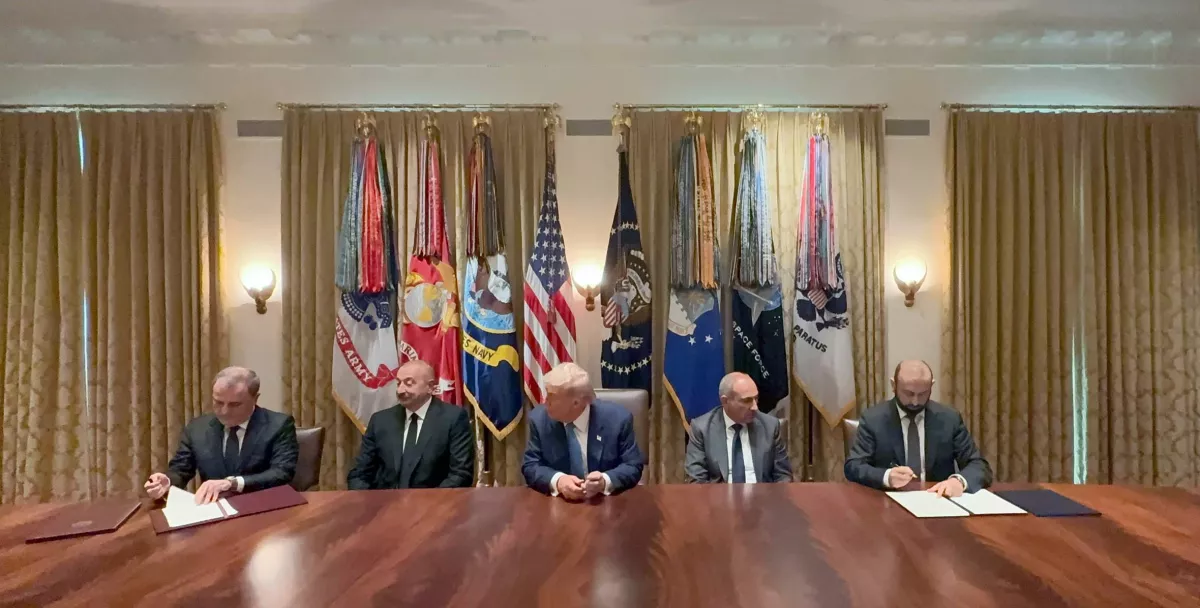
Today, August 8, marks exactly one year since the historic Washington summit, where, in the presence of Azerbaijani President Ilham Aliyev, Armenian Prime Minister Nikol Pashinyan, and U.S. President Donald Trump, the foreign ministers of the two countries initialled the text of the “Agreement on the Establishment of Peace and Inter-State Relations between the Republic of Azerbaijan and the Republic of Armenia.”
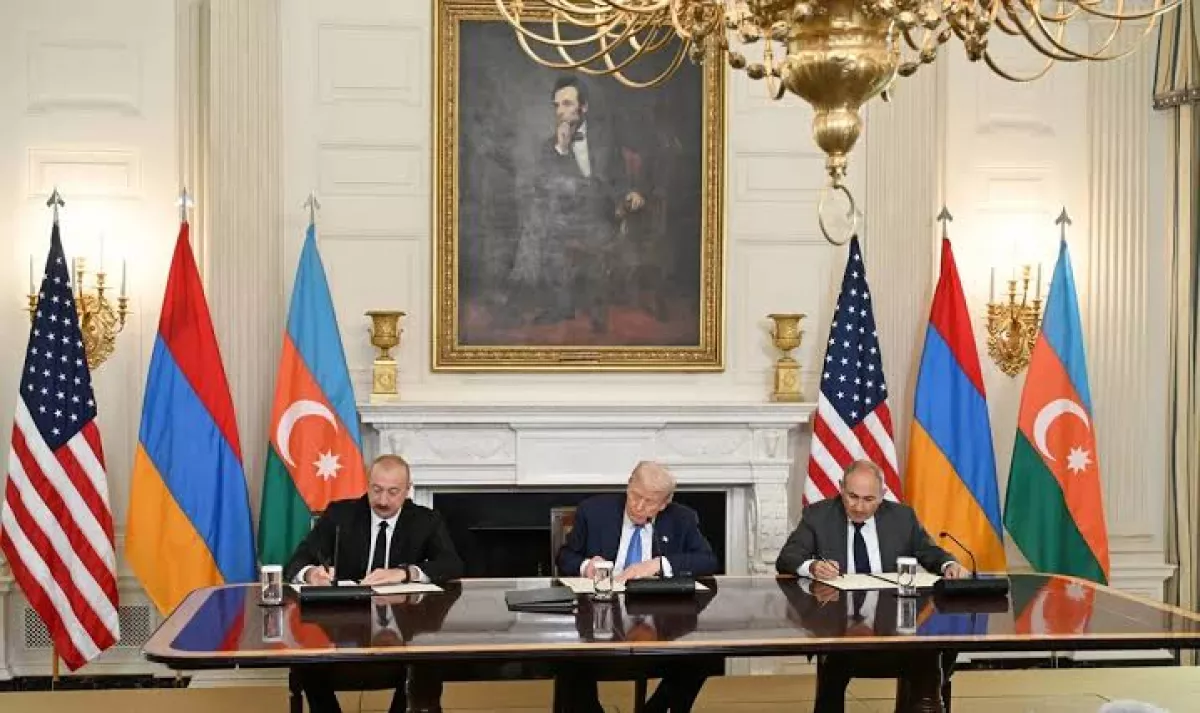
The leaders of the three countries cemented the initialling of the peace agreement by signing a Joint Declaration, which outlined a commitment to establishing peace in the South Caucasus and underscored the importance of unblocking regional communications. Against this backdrop, the launch of the “Trump Route for International Peace and Prosperity” (TRIPP) was announced.
The year since the meeting at the world’s most important office has, in effect, turned these agreements into reality on the ground. Today, the region is de facto living in peace.
American experts shared their views with Caliber.Az on the significance of Washington 2025 as a key factor shaping the future development of the South Caucasus.

Political scientist Andrew Korybko noted that the anniversary of the Washington summit between the leaders of the United States, Azerbaijan, and Armenia provides a timely opportunity to reflect on the significance of the initialled agreement, the Joint Declaration, and the TRIPP project.
“First and foremost, the agreement and the declaration have de facto established peace between the two countries, although Armenia has yet to fulfil Azerbaijan’s demand to amend its Constitution, which is a key condition for signing the final peace treaty. I believe Prime Minister Pashinyan’s party will need support from the opposition to introduce the relevant amendments to the country’s Basic Law, but it remains unclear whether he will be able to secure it.
Nevertheless, I believe a renewed escalation between the two states is unlikely, as both sides have clearly committed themselves to a path of peace. As for TRIPP, the project will contribute to greater integration of the countries of the region into the global economy and could become an important geopolitical factor. However, its implementation and development will take time, so its results will not be visible immediately,” Korybko said.

Meanwhile, Irina Tsukerman, a geopolitical and security expert and editor-in-chief of The Washington Outsider, said that the anniversary of the Washington summit is significant not merely as a commemorative date, but also as an opportunity to assess how fundamentally the nature of relations between Azerbaijan and Armenia has changed.
“History knows of many peace initiatives that made a strong impression on the day they were signed but quickly lost their significance due to a lack of political will or tangible results. In this case, what is particularly noteworthy is that over the past year, the parties have not only maintained their commitment to the agreements reached but have also continued moving forward, despite attempts by various external actors to return the region to its previous model of confrontation.
The Washington summit marked a turning point. It ultimately consolidated a departure from the logic whereby any disagreement would automatically escalate into military confrontation. The very fact that the leaders of Azerbaijan and Armenia were able to jointly sign a political statement, while their foreign ministers initialled a peace agreement, marked a transition from endless discussions about the possibility of peace to discussions about the mechanisms for implementing it. These are fundamentally different stages.
For decades, international mediators had sought to contain the conflict without addressing its underlying causes. The Washington process created the conditions for the emergence of a new political reality.

What is particularly important is that this process has not remained at the level of diplomatic declarations. Over the past year, there have been signs of gradual normalization that would have seemed almost impossible until recently, including the Bridge of Peace civil initiative and the supply of Azerbaijani fuel to Armenia.
Equally important is the fact that Baku and Yerevan are prepared to address contentious issues directly, outside the numerous mediation formats that often became part of the problem themselves. Direct dialogue means that both sides are gradually beginning to perceive each other as neighbours with whom they will have to build long-term relations. This approach is the foundation of any sustainable security system.
TRIPP deserves particular attention, as it goes far beyond the scope of an ordinary transport project. If the route is fully implemented, the South Caucasus could become a region of economic interconnectedness. History shows that countries are far less likely to engage in confrontation when their economies, logistics, investment, and trade are closely intertwined. Economic cooperation does not eliminate all risks, but it significantly raises the cost of any renewed conflict,” the expert said.
According to her, Azerbaijan has additional opportunities to strengthen its position as one of Eurasia’s key transportation and energy hubs, while Armenia has a chance to overcome years of isolation and become a full-fledged participant in major regional projects. As a result, the entire South Caucasus stands to benefit, emerging as a space for cooperation linking Europe, Central Asia, Türkiye, and the Middle East.
“The Washington process also changed the balance of international influence in the region. The United States demonstrated that it can act not merely as an external observer, but also as a country prepared to offer a concrete political platform for a settlement. This strengthened the U.S. position in the South Caucasus while also showing that the region is increasingly becoming an independent arena of global politics, where the interests of several major centres of power intersect.
In the broader international context, the anniversary of the Washington summit carries symbolic significance. Against the backdrop of numerous conflicts, ongoing wars, and growing geopolitical tensions, the meeting in the U.S. capital demonstrated that even after many decades of bitter confrontation, it is possible to shift towards a policy of pragmatism.
This does not mean that all problems have already been resolved. It means that a political model has emerged in which cooperation is gradually becoming more beneficial than confrontation,” Tsukerman concluded.







 editor@caliber.az
 +994 55 444-88-98
 Азербайджан, Баку, ул. Низами, 203, Af Business House, 5-й этаж