










Portugal revolutionises European maritime defence with drone carrier Joins ranks of China, Iran and Türkiye
A Romanian shipyard has launched Europe’s first purpose-built drone carrier for the Portuguese Navy, marking what experts describe as a “point of no return” in naval warfare’s shift toward unmanned systems.
The vessel entered the water on April 7 at a shipyard in the Black Sea port city of Galați, where Dutch shipbuilder Damen Group constructed it, as highlighted in a review by the Army Recognition outlet.
The 107-metre NRP “D. João II” is named after Portugal’s 15th-century monarch, John II of Portugal, who played a pivotal role in the country’s maritime expansion by supporting ocean exploration, advances in navigation, and the opening of new sea routes.
Unlike traditional warships, the vessel has been specifically designed to deploy aerial, surface, and underwater drones rather than crewed aircraft.
“Given Portugal’s extensive coastline, this ship represents a valuable addition both for the Portuguese Navy and for European maritime operations,” said Bram Langeveld, Damen’s Chief Commercial Officer.
The requirement for the NRP D. João II was defined by the Portuguese Navy to replace single-role ships with a multi-purpose platform capable of sustained operations across the Atlantic, including within Portugal’s exclusive economic zone.
“It will support maritime security, scientific research, and disaster response.”
Key features
The ship reflects lessons drawn from modern conflicts, including the war in Ukraine and increased Russian naval activity, where unmanned systems are being used more frequently for surveillance, reconnaissance, and strike missions at lower cost and risk.
Its concept emphasizes long-duration deployments, data collection, and operational flexibility. The vessel is designed to conduct a wide range of missions, including maritime surveillance, environmental monitoring, oceanographic research, seabed mapping, and support for unmanned systems. It is built for unrestricted deployment in both tropical and temperate climates, aligning with Portugal’s operational reach from the North Atlantic to African waters.
The program also incorporates dual-use objectives, linking defense operations with scientific research and maritime economic interests. This integrated approach reflects national priorities related to ocean governance and resource management.
The ship can accommodate up to 100 additional military personnel or more than 200 civilians in emergency situations such as evacuations or disaster response, enabling both operational and humanitarian missions.
Built at a cost of around €132 million using European Union recovery funds, the vessel is intended to function as a flexible drone hub, capable of rapidly switching mission profiles by exchanging modular payloads.
“MPV 10720 is the result of an innovative, forward-looking approach by the Portuguese Navy in adapting to modern naval requirements,” Langeveld said.
The concept was originally developed by former navy chief Henrique Gouveia e Melo, who described it during a 2024 contract signing as “a point of no return for modernity”.
The ship features a 94-metre flight deck capable of supporting both drones and helicopters, along with onboard systems for launching and recovering unmanned surface and underwater vehicles.
Hangars, a stern ramp, and dedicated mission bays allow multiple autonomous systems to operate simultaneously. The vessel can also carry containers, vehicles, or boats, and accommodate specialists such as drone operators and scientists. Additionally, it can be reconfigured to host a field hospital, laboratories, or humanitarian aid modules.
Sea trials are scheduled for later this year before the vessel enters service with the Portuguese fleet.
International precedent
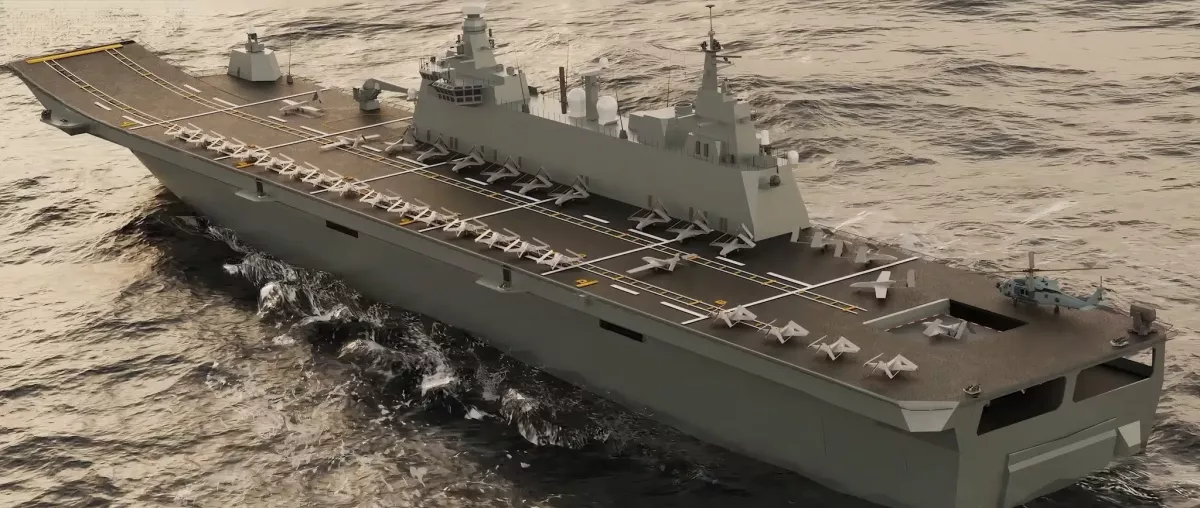
China launched the world’s largest amphibious assault ship in 2024, prompting speculation that it could serve as the first purpose-built drone carrier. Currently, only Türkiye (TCG Anadolu, pictured below) and Iran operate similar vessels, having adapted existing ships to deploy aerial drones.
By Nazrin Sadigova







 editor@caliber.az
 +994 55 444-88-98
 Азербайджан, Баку, ул. Низами, 203, Af Business House, 5-й этаж