










Quantum leap near Paris: French start-up bets on “winner-takes-all” future
On the western edge of Paris, in a laboratory near the River Seine, a technician adjusts a cryostat — a machine capable of reaching temperatures close to absolute zero — as France’s quantum ambitions quietly take shape.
The facility belongs to Alice & Bob, a fast-growing quantum computing start-up aiming to build one of the world’s first reliable large-scale quantum machines. Inside a maze of gold- and silver-coloured cylinders, chips are cooled to minus 273 degrees Celsius, creating conditions where quantum effects can be controlled.
At the heart of the technology lies a phenomenon first described by Albert Einstein and other pioneers — the quantum leap — where particles shift energy states in ways that defy classical physics, BBC reports.
Co-founder and chief executive Théau Peronnin says the field has moved beyond theory.
"Physicists used to doubt it was possible to leverage the weird behaviour of particles in the quantum. They don't anymore.
Now we know they work, and in a few years we will have reliable quantum computers that we can hook up to High Performance Computers (HPCs) in data centres to exponentially increase their computing power," he says.
"It's not about being faster. It's about being so dramatically faster that you change what is feasible. We will be able to solve problems that are absolutely intractable with classical computers," he says.
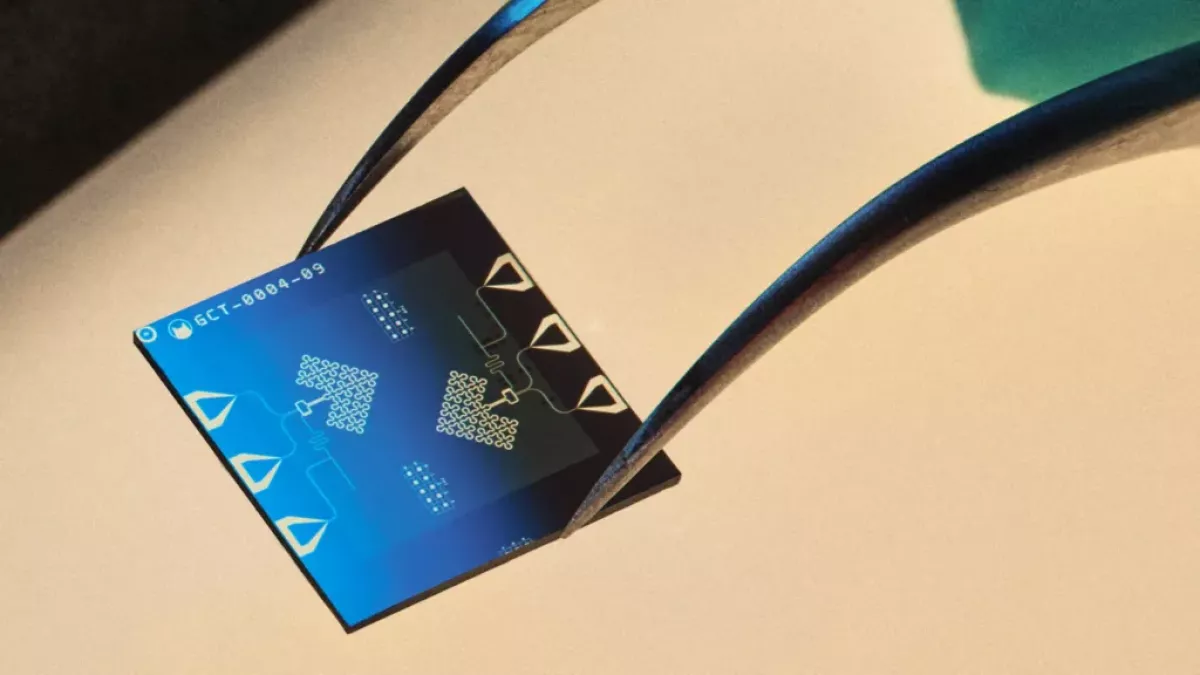
Alice & Bob has built a quantum computing chip called Boson
The company plans to open a larger €50m facility north of Paris in the coming months, featuring a clean room for chip manufacturing and expanded testing capabilities.
Quantum computing promises breakthroughs in fields such as medicine, where complex molecular interactions could be simulated with unprecedented precision.
"It will make medicine an exact science." He is only half joking. "At the moment, the development of new medicines is largely a question of trial and error."
However, significant technical challenges remain. Quantum bits, or qubits, are highly sensitive and prone to errors caused by environmental noise — a problem known as decoherence.
Most companies address this by building redundancy into their systems, requiring thousands of physical qubits to stabilise a single logical unit. Alice & Bob, however, is pursuing an alternative approach using so-called “cat qubits”, inspired by Schrödinger's cat, which are designed to correct certain errors automatically.
"It's built-in by design," Peronnin says. "We cracked a way to compensate for losses continuously."
The firm’s approach could significantly reduce the cost and complexity of quantum systems, positioning it alongside global competitors such as IBM and Google, which are also investing heavily in the technology.
France’s broader quantum ecosystem includes companies such as Pasqal, Quandela, Quobly and C12, reflecting a diverse range of technological approaches.
According to Olivier Ezratty, the country’s firms benefit from relatively lower energy and machine costs, while strong academic institutions such as École Polytechnique and École Normale Supérieure provide a steady pipeline of talent.
Despite progress, current machines remain limited.
"At the moment, the machine we have is no more powerful than your telephone," says Peronnin. "We're on the flat part of the exponential curve."
Still, the race to build a scalable quantum computer is widely seen as transformative, with vast economic and strategic implications.
The prize, Peronnin argues, could reshape the global technology landscape.
"It will be 'winner-takes-all', as it was for classical computers and IBM."
By Aghakazim Guliyev







 editor@caliber.az
 +994 55 444-88-98
 Азербайджан, Баку, ул. Низами, 203, Af Business House, 5-й этаж