










Strategic balance one year later: India stumbles, Pakistan consolidates success Article by Kashmir Media Service
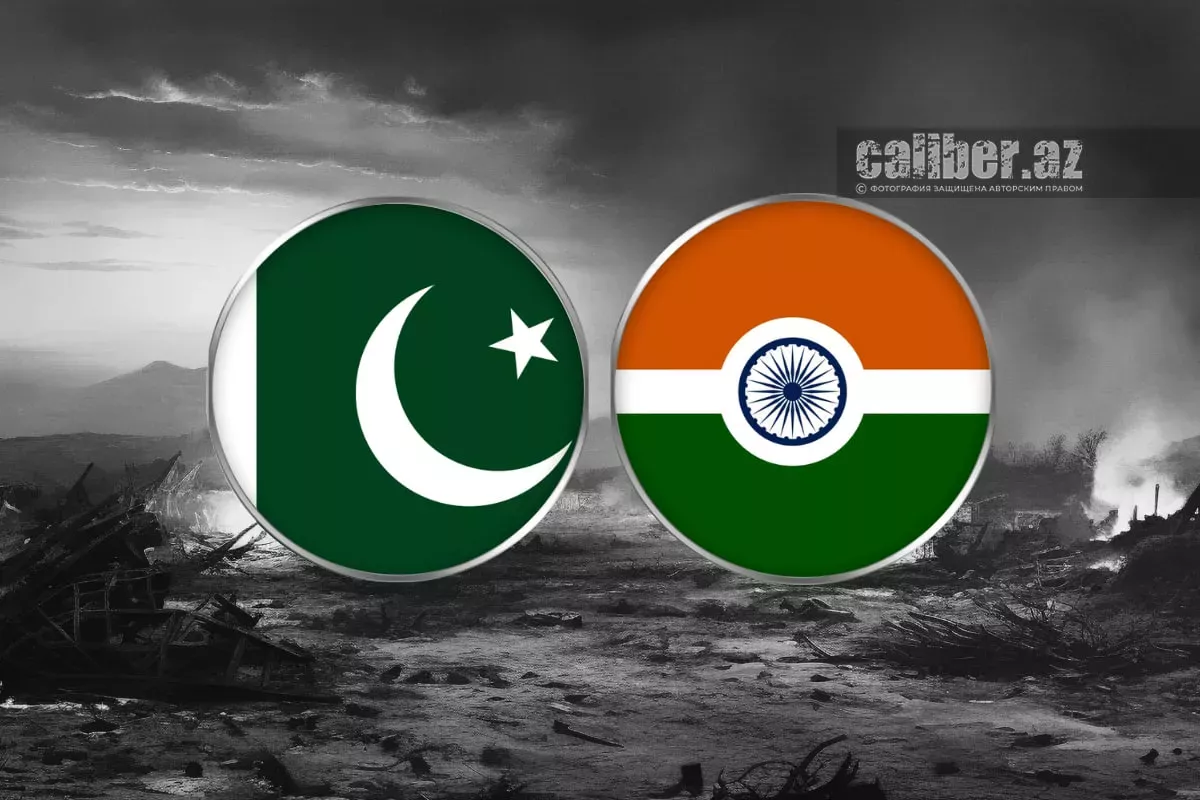
An article has been published on the Kashmir Media Service (KMS) website offering an analysis of the India–Pakistan confrontation that took place in May 2025, examining in particular how the escalation and its outcomes reshaped the strategic balance and deterrence dynamics in South Asia. Caliber.Az brings this piece to its readers.
“For decades, a dominant realist orthodoxy in International Relations – echoed by deterrence theorists from Kenneth Waltz to S. Paul Kapur – held that Pakistan, facing a conventional asymmetry with India, would inevitably rely on the 'nuclear first-use' doctrine to offset Indian military superiority. This logic underpinned the concept of 'sub-conventional warfare' as a tool for India, assuming that Pakistan’s conventional threshold was permanently capped.
The events of May 2025 have categorically falsified that assumption. The successful execution of Operation Bunyaan-un-Marsoos and the strategic failure of India’s Operation Sindoor have demonstrated that Pakistan has not only closed the conventional gap but has leapfrogged into a domain of integrated strategic deterrence – blending kinetic, electronic, quantum, and cyber capabilities. This marks a pivotal moment in South Asian strategic history, best understood through the International Relations lens of 'Offense-Defense Balance': when a defender’s technology neutralizes an attacker’s numerical advantage, the stability-instability paradox is resolved in favor of the stable defender.

The Indian False Flag Legacy: From 1971 to Pahalgam 2025
India has long used false flags to justify aggression in Indian illegally occupied Jammu and Kashmir (IIOJK), to appease the hawkish Indian populace, to mask internal instabilities, and to secure electoral gains: 2000 (staged attack before Clinton’s visit), 2001 (Parliament attack), 2008 (Mumbai), 2016 (Pathankot/Uri), and 2019 (Pulwama). The latter led to Balakot airstrikes, ending with two Indian jets shot down and Abhinandan captured.
On 22 April 2025, an attack in Pahalgam killed 26 civilians. India immediately accused Pakistan without evidence, then suspended the Indus Waters Treaty, downgraded ties, shut trade routes, and launched Operation Sindoor – BrahMos missile strikes on six Pakistani cities, killing over 31 people. To date, India has provided zero evidence linking Pakistan to Pahalgam.
The Real Threat: India as a Regional Bully
India has territorial disputes with all neighbors. Its Hindutva-driven aggressive posture – especially 'surgical strikes' – threatens regional stability, pushing South Asia dangerously close to the nuclear threshold.
Pakistan’s strategic leap comes from high-tech integration with China. From quantum encryption to AI cyber defense, Pakistan neutralized India’s S-400 system using Chinese EW suites and destroyed BrahMos depots via precision strikes. This partnership has shattered India’s hegemonic pretensions.
Three Phases of the 2025 Conflict: A Military-Academic Breakdown
Phase I (May 7-8, 2025): India’s Miscalculated Assault
India launched 24 missile attacks on six cities. The largest air dogfight since WWII ensued: ~125 jets clashed for 60+ minutes. Pakistan shot down five Indian aircraft (including three Rafales) without losing a single jet. The S-400 system failed entirely.
Phase II (May 8-9, 2025): Drone Saturation & Media Warfare
India sent drones; 90 were neutralized. Pakistan did not retaliate. India then created a media frenzy, falsely claiming attacks – Pakistan dismissed this as storytelling.
Phase III (May 9-10, 2025): Operation Bunyaan-un-Marsoos – The Decisive Retaliation
After India targeted three Pakistani bases (all intercepted), Pakistan announced its operation. Within minutes, strikes destroyed: Beas BrahMos depot, Udhampur S-400, Pathankot Airbase, Jalandhar Airbase, Nagrota BrahMos site, Akhnoor Brigade HQ, Uri Supply Depot, Srinagar Northern Command HQ, Chandigarh Weapons Depot, Sirsa Airbase, and Military Intelligence HQ in Rajuri.

Cyber & Electromagnetic Warfare: The Silent Revolution
Pakistan’s integrated cyber component disabled 10% of India’s SCADA network, took 70% of the Northern Grid offline, shut urban power/wind systems, destroyed Indian Railways’ digital network, disabled Delhi’s gas supply and IIOJK’s electric grid, and wiped BJP/BSF websites. This is South Asia’s first combined kinetic-cyber-electromagnetic response.
India lost 70% of air capability to cyber strikes. BrahMos depots and S-400 destroyed. Six jets lost, including Rafales – 26 total sites hit. Modi’s aggressive approach failed; Pakistan’s transparent narrative earned global respect.
The Kashmir Conflict: Re-Internationalized
A final, critical consequence: The Kashmir conflict has been internationalized once again. By staging false flags to justify its illegal occupation and the subjugation of innocent Kashmiris – and then escalating to cross-border missile strikes – India has undone decades of its own diplomatic effort to declare Kashmir a 'bilateral issue.' Global powers, watching the S-400’s failure and the BrahMos depots burning, are now reassessing the region.
The Lesson of 2019 and 2025
In 2019, India learned the hard way: Pakistan’s air defence is impregnable, and false flags end in downed jets and captured pilots. India cannot win wars with lies. False flags may fool the world for a moment – but Pakistan’s response is always real, precise, and devastating. The Pahalgam operation was not brave. It was a script repeated from a failed playbook. And just like 1971, 2001, 2008, and 2019, the only loser will be India’s credibility.
With Pakistan’s steadfast, responsible, restraint-based approach combined with highly integrated modern technology and sensible information warfare – not misinformation propaganda like India – Pakistan achieved a decisive strategic success. In the academic lexicon of deterrence theory, what Pakistan has accomplished is 'asymmetric escalation dominance' – the ability to punish an adversary disproportionately in a domain they believed they controlled.
Operation Bunyaan-un-Marsoos is no longer just a military operation; it is a case study for future war colleges. And for India’s so-called hegemonic ambitions, it is a tombstone,” the article concluded.







 editor@caliber.az
 +994 55 444-88-98
 Азербайджан, Баку, ул. Низами, 203, Af Business House, 5-й этаж