










Russia poised to base nuclear-capable Oreshnik missiles in eastern Belarus Reuters findings / photo
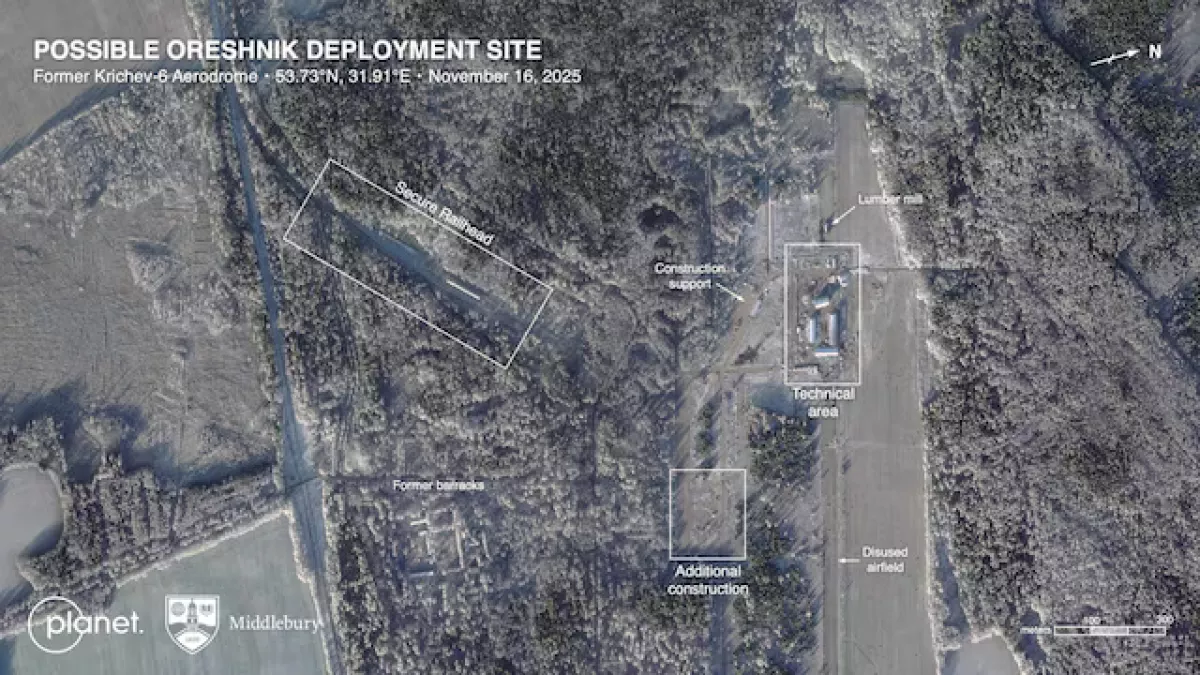
Moscow is likely deploying new nuclear-capable hypersonic ballistic missiles at a former airbase in eastern Belarus, a move that could significantly enhance Russia’s ability to strike targets across Europe, according to two US researchers who analysed satellite imagery, cited by Reuters in its exclusive report.
The assessment broadly aligns with US intelligence findings, according to a person familiar with the matter who spoke on condition of anonymity because they were not authorised to discuss the issue publicly.
Russian President Vladimir Putin has previously announced plans to deploy intermediate-range Oreshnik missiles in Belarus, but the precise location had not been reported before. The Oreshnik has an estimated range of up to 3,400 miles (5,500 km).
Experts say such a deployment would underscore the Kremlin’s growing reliance on nuclear threats as it seeks to deter NATO countries from supplying Ukraine with weapons capable of striking deep inside Russian territory.
Belarus’s state-run Belta news agency quoted Defence Minister Viktor Khrenin as saying the deployment would not change the balance of power in Europe and described it as Minsk’s response to what he called the West’s “aggressive actions.”
The researchers, Jeffrey Lewis of the Middlebury Institute of International Studies and Decker Eveleth of the CNA research organisation, said satellite images from Planet Labs showed features consistent with a Russian strategic missile base. They said they were about 90% certain that mobile Oreshnik launchers would be stationed at a former airbase near Krichev, about 190 miles (307 km) east of Minsk and roughly 300 miles (478 km) southwest of Moscow.
Russia tested a conventionally armed Oreshnik missile against a target in Ukraine in November 2024. Putin has claimed the weapon is impossible to intercept due to speeds reportedly exceeding Mach 10.
John Foreman, a former British defence attaché in Moscow and Kyiv and now an expert at Chatham House, said Putin aims to deploy the missile in Belarus to extend its reach deeper into Europe. He added that the move also appears to be a response to US plans to station conventional missiles, including the hypersonic Dark Eagle, in Germany next year.
The potential deployment comes just weeks before the expiration of the 2010 New START treaty, the last remaining arms control agreement limiting US and Russian strategic nuclear weapons. Putin said in December 2024, after meeting Belarusian leader Alexander Lukashenko, that Oreshnik missiles could be deployed in Belarus in the second half of this year — marking the first time since the Cold War that Russia has based nuclear weapons outside its own territory.
Lukashenko said last week that the first missiles had already been deployed, without specifying a location, and added that up to 10 Oreshnik systems could be based in Belarus. The US researchers assessed that the identified site could likely accommodate only three launchers, suggesting additional missiles may be stationed elsewhere.
The researchers also identified signs of rushed construction beginning in early August, including a rail transfer point secured by fencing and a concrete pad at the end of the runway that was later covered with earth, features they said were consistent with a camouflaged missile launch site.
Pavel Podvig, a Geneva-based expert on Russian nuclear forces, said he was sceptical the deployment would provide Moscow with meaningful military or political advantages beyond reassuring Belarus of Russian protection. However, Lewis argued the move carries clear political symbolism.
“There is no military reason to put the system in Belarus, only political ones,” he said, adding that it sends a message about Russia’s increasing reliance on nuclear weapons.
The development comes as US President Donald Trump seeks to negotiate an end to Russia’s war in Ukraine. Kyiv has pressed Western allies for long-range weapons capable of striking deep inside Russia, though Trump has so far rejected Ukraine’s request for Tomahawk cruise missiles. Britain and France have supplied cruise missiles, while Germany announced in May plans to co-produce long-range missiles with Ukraine without restrictions on range or targeting.
By Tamilla Hasanova







 editor@caliber.az
 +994 55 444-88-98
 Азербайджан, Баку, ул. Низами, 203, Af Business House, 5-й этаж