










Ukraine files espionage charges against Russian intel officer photo
Ukraine’s Security Service (SBU) has announced that it has brought charges in absentia against a Russian military intelligence officer accused of coordinating strikes and espionage activities targeting critical infrastructure in western Ukraine.
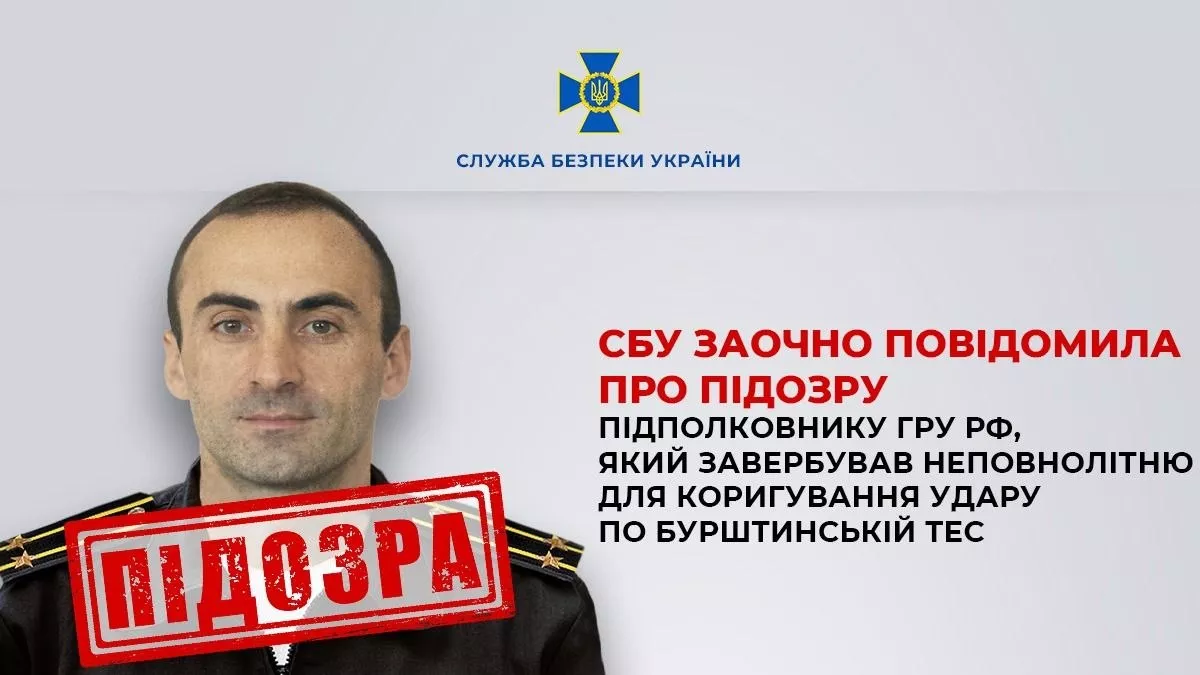
According to the SBU, Marat Tsevelev, an officer of the Main Directorate of the General Staff of the Russian Armed Forces (GRU), coordinated preparations for missile and drone attacks on the Prykarpattia region in January. The identified targets included the Burshtyn Thermal Power Plant, defence-related facilities, and one of the region’s key electrical substations.
In order to adjust the strikes, Tsevelev allegedly recruited a 17-year-old graduate of a local technical college, whom he identified through Telegram channels where she was seeking “quick earnings.”
Following his instructions, the girl carried out reconnaissance near the Burshtyn Thermal Power Plant and a major electrical substation to assess the condition of the facilities after previous attacks. She was then tasked with taking photo and video footage of a Ukrainian Armed Forces site and marking its geolocation on a Google map.
Tsevelev subsequently instructed her to compile and transmit the collected information via a messaging application.
The SBU stated that it uncovered the intelligence operation and systematically documented the suspect’s communications with her handler. Earlier this year, the agency detained the girl “red-handed” while she was photographing a military facility. A smartphone containing evidence was seized at the scene.
According to the investigation, Tsevelev serves in the 317th Naval Special Operations Center of the Russian GRU, based in temporarily occupied Sevastopol. The SBU said this unit uses networks of agents and informants to gather targeting data for missile and aerial strikes across Ukraine, employing naval, air, and ground-based systems.
Based on the evidence collected, SBU investigators have formally notified Tsevelev in absentia of suspicion under Part 1 of Article 114 of Ukraine’s Criminal Code, which pertains to espionage, the agency said in its statement.
By Tamilla Hasanova







 editor@caliber.az
 +994 55 444-88-98
 Азербайджан, Баку, ул. Низами, 203, Af Business House, 5-й этаж