










Geopolitical rivalries, AI revolution pose biggest risk for businesses, WEF says
The World Economic Forum (WEF) has identified rivalries among global powers and mounting strategic standoffs as the most severe near-term risks that businesses are expected to face heading into 2026.
The influential international think tank released its annual Global Risks Report this week, just in time for its flagship meeting in Davos, where political leaders, business executives, and policymakers from around the world are set to convene in the Swiss alpine city from January 19 to 23.
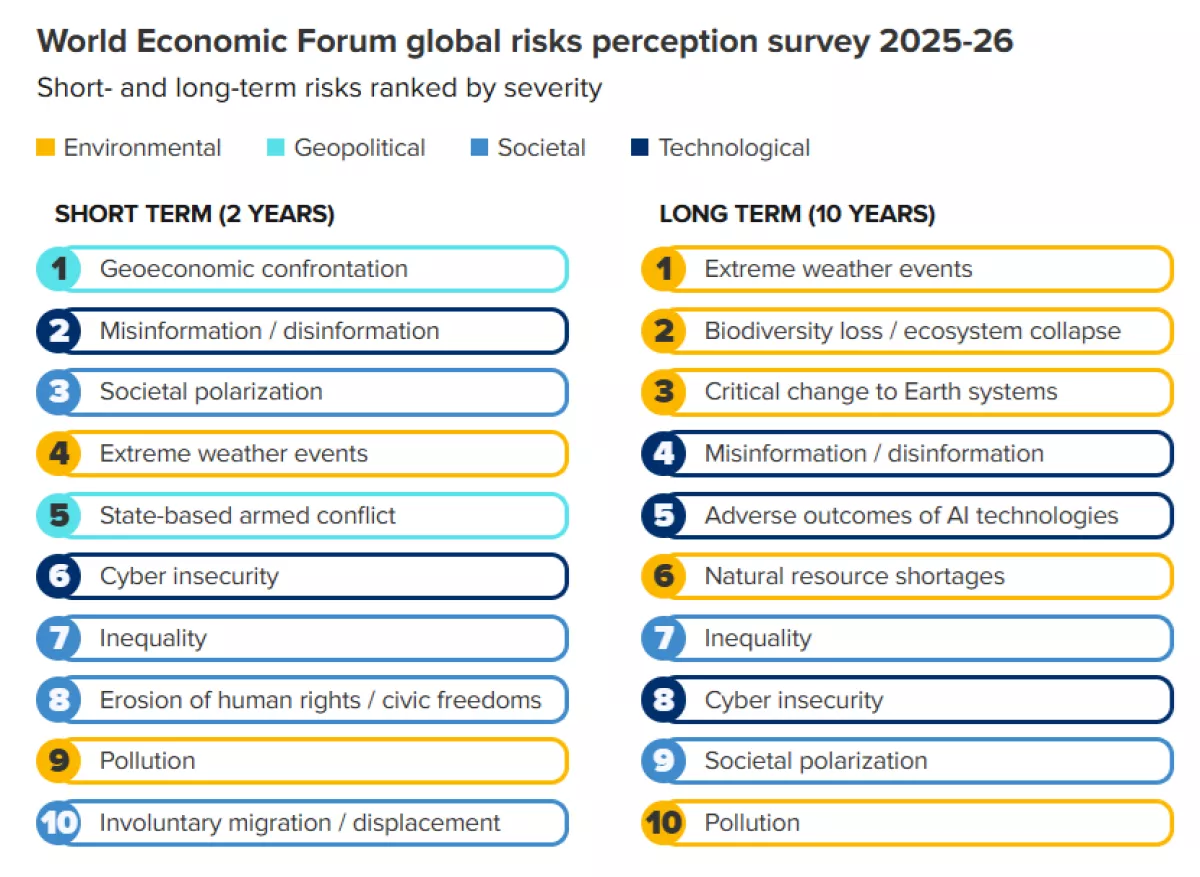
Based on a survey of 1,300 leaders from government, business, and other institutions, the report highlights a rapidly shifting risk environment in which “geoeconomic confrontation” has surged to the top of the list of business concerns over the next two years.
The report attributes this shift to intensifying global competition and the growing use of economic instruments—including tariffs, regulatory measures, supply-chain controls, and capital restrictions—as tools of statecraft.
“It’s very much about state-based armed conflict and the concerns around that. So overall, nearly a third of our respondents are very concerned in 2026 about what that means for the global economy and essentially the state of the world,” WEF Managing Director Saadia Zahidi said in an interview with CNBC.
The report notes that concerns over economic risks in the near term have risen more sharply than any other category tracked by the WEF, raising the prospect of a significant slowdown in global trade.
“Concerns [are] growing over an economic downturn, rising inflation and potential asset bubbles as countries face high debt burdens and volatile markets,” Zahidi wrote in the report.
Beyond geoeconomic tensions, misinformation and disinformation rank as the second most pressing short-term risk, followed by societal polarisation, defined as widening divisions between sharply opposed groups. Over a longer horizon, inequality is identified as the most interconnected risk over the next decade, with all of the risks summarised in the graph below.
The report is produced in collaboration with Marsh, the world’s largest insurance brokerage. Marsh Chief Executive Officer John Doyle described the current global environment as a “moment of poly-crises,” rather than a single overarching emergency. He cited trade wars, culture wars, rapid technological change, and the escalating impacts of extreme weather as simultaneous challenges confronting businesses worldwide.
Among the fastest-rising risks in the survey is the potential for adverse outcomes linked to artificial intelligence. The issue jumped dramatically from 30th place among short-term risks in last year’s report to fifth place among long-term risks in the latest rankings, reflecting growing unease about AI’s societal and economic implications.
While environmental risks appear to have been pushed down the priority list in the short term, Zahidi noted that climate-related threats remain dominant over the longer term. Extreme weather events continue to top the list of concerns for the next decade among surveyed leaders.
The US outlet notes that global insured losses from natural catastrophes are projected to reach $107 billion in 2025, marking the sixth consecutive year in which losses have exceeded $100 billion—a sharp increase compared with levels seen in the early 2000s.
By Nazrin Sadigova







 editor@caliber.az
 +994 55 444-88-98
 Азербайджан, Баку, ул. Низами, 203, Af Business House, 5-й этаж