










Legendary Russian figure skater reveals how he deals with criticism Plushenko embraces haters as career decisions in spotlight
Russian figure skating coach and two-time Olympic champion Evgeni Plushenko has addressed how he responds to critical voices, describing negative reactions as a source of motivation. His comments come in light of himself and his family having faced heightened public attention over several career-related decisions in recent months.
“You need to approach hate the right way, [namely] with love. I receive a lot of criticism, but that’s good too — it means moving forward,” the legendary figure skater told reporters during an event marking Moscow Sports Day at the Russian capital’s Luzhniki sports stadium.
The legendary figure skater faced increased scrutiny this summer after his son Alexander changed his sporting nationality from Russia to Azerbaijan earlier this year and joined the Azerbaijani national figure skating team. The move will allow the young skater to represent Azerbaijan in international competitions beginning with the 2026–27 season. His transfer was approved by the Russian Figure Skating Federation and subsequently cleared by the International Skating Union.
Changing sporting nationality is by no means a new phenomenon. Athletes have made such moves for decades for a range of reasons, from access to better training environments to the prospect of greater professional opportunities. While many Russian-born athletes have made similar choices in recent years amid restrictions imposed by various international sporting federations, switching national representation is a global practice that has occurred across countries and disciplines.
Several such cases that have also attracted significant international attention include these of baseball player Alex Rodriguez, who represented the Dominican Republic after previously competing for the United States; basketball player Becky Hammon, who switched from the United States to Russia; footballers Diego Costa and Kevin-Prince Boateng, who moved their international allegiance from Brazil to Spain and Germany to Ghana, respectively; and freestyle skier Eileen Gu, who switched from the United States to China.
Alexander’s mother, Russian music producer Yana Rudkovskaya, has also previously addressed her son’s decision, saying that he had been issued an Azerbaijani passport for a fixed period of five years.
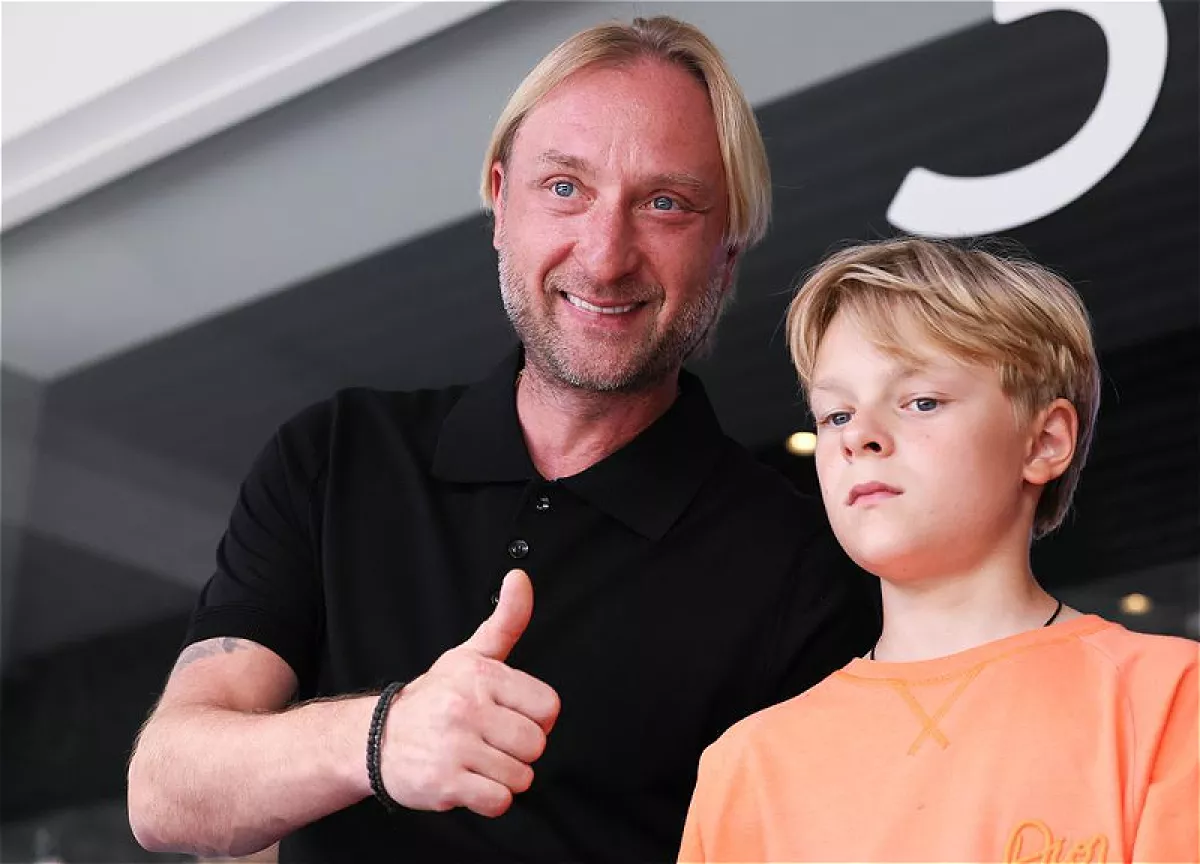
The decision has received support from several prominent figures in Russia’s highly regarded figure skating community. Among those backing the young skater is Alexei Yagudin, another celebrated Russian figure skater whose rivalry with Plushenko helped define an era of men’s figure skating. Anton Sikharulidze, President of the Figure Skating Federation of Russia, has also expressed support for the move, wishing the young Plushenko success in his future endeavours.
Svetlana Zhurova, a member of Russia’s State Duma and a former Olympic champion in speed skating, likewise defended the decision, recalling that it was "the athlete’s right" provided that "all the proper legal procedures have been followed." She also questioned the scale of the public reaction, arguing that "if this wasn't Plushenko’s son, no one would be talking about it."
Plushenko has separately attracted public attention over an application for a 24 million ruble (approximately $270,000) state grant to stage a new ice show through his figure skating academy, "Plushenko's Angels." The academy trains athletes who continue to compete for Russia at major sporting events, including Sofiya Muravyeva, Makar Ignatov and Aleksandra Trusova.
By Nazrin Sadigova







 editor@caliber.az
 +994 55 444-88-98
 Азербайджан, Баку, ул. Низами, 203, Af Business House, 5-й этаж