










NASA's Mars rover discovery could flip scientists' long-held beliefs of planet
NASA’s Perseverance rover has identified an unusual desk-sized rock on Mars that appears to be an iron-rich meteorite, highlighting that even well-studied regions of the planet can still yield unexpected discoveries. The rock, nicknamed Phippsaksla, measures roughly 80 centimeters across and was found in the Vernodden area just beyond Jezero Crater, a site that has been the focus of extensive exploration. If confirmed to be indeed a meteorite, scientists would have to change their assumptions about how are formed on the Red Planet.
Initial analyses indicate that Phippsaksla contains iron and nickel, a chemical signature consistent with iron-nickel meteorites, which are metal-rich rocks originating in space. The composition closely matches that of meteorites formed from the metallic cores of ancient asteroids, according to an article published by the online Earth outlet.
Its appearance also sets it apart from surrounding rocks: Phippsaksla has a sculpted shape and a slightly elevated position compared with the flatter, broken stones scattered across the crater rim.
The rock’s placement is particularly intriguing. It rests on fractured bedrock outside Jezero Crater, terrain shaped by ancient impacts. This suggests that Phippsaksla may preserve clues about how earlier collisions reshaped the region’s landscape. The research was led by Candice Bedford, a scientist at Purdue University who specializes in the study of Martian rocks, and draws on nearly five years of data gathered by Perseverance during its mission.
Perseverance has been exploring Jezero Crater, an ancient lake basin where water once collected and deposited layered sediments. One of the rover’s main objectives is to collect rock and dust samples for eventual return to Earth, guided by studies that carefully map the geological context of potential sampling sites. The discovery of a metal-rich rock along this well-travelled route underscores that Mars continues to hold geological surprises.
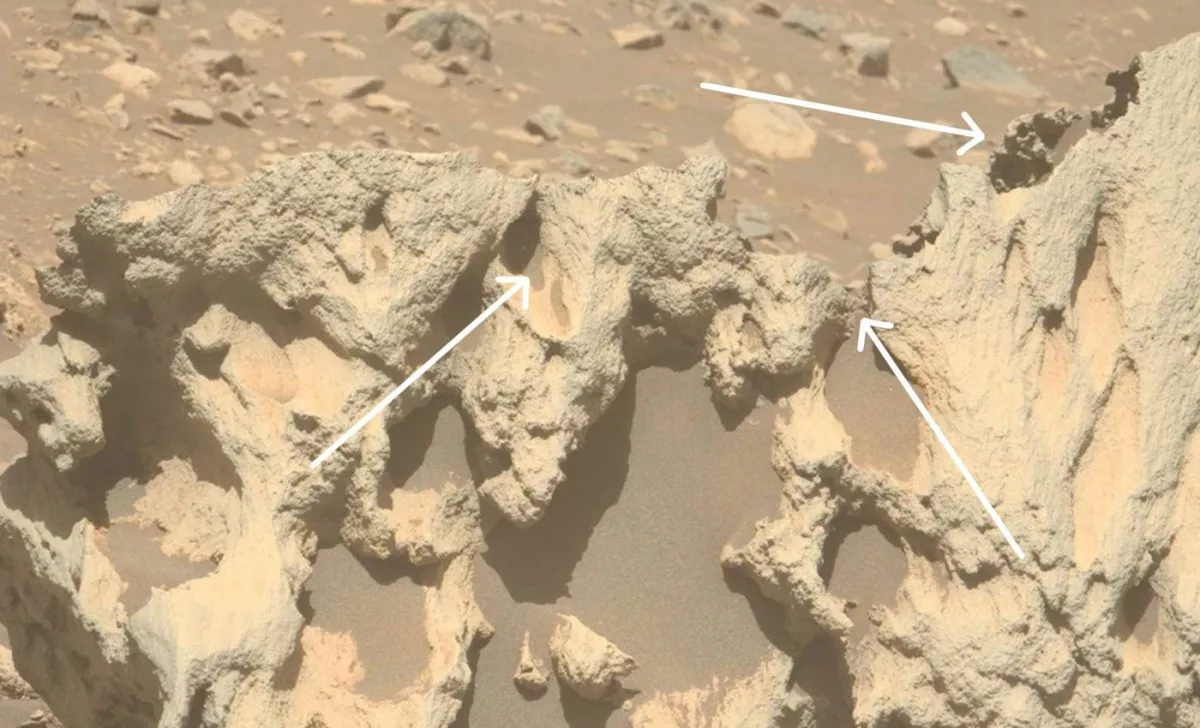
The Vernodden outcrop lies along the crater rim, where past impacts fractured solid bedrock and scattered blocks across the surface. On both Earth and Mars, rocks rich in iron and nickel are typically linked to the remnants of large asteroids whose interiors melted early in the solar system’s history. In those bodies, heavy metals separated from lighter rock, forming metallic cores that later shattered during collisions.
If Phippsaksla is confirmed as a fragment of such a core, it would represent a rare opportunity to study deep asteroid material directly on Mars, without the need for a dedicated mission. Mars’ thin atmosphere and dry environment also help preserve metal-rich rocks, allowing them to remain exposed for long periods with relatively little corrosion or erosion.
As meteorites travel through space, they are bombarded by cosmic rays, leaving measurable changes that scientists can use to estimate how long the rocks travelled between planets and when they landed. While hundreds of Martian meteorites have been identified on Earth and studied to infer conditions on Mars, a confirmed meteorite sitting on the Martian surface would reverse that perspective, offering insight into material that arrived on Mars from elsewhere in the solar system.
Such a meteorite would also provide an external reference point in Mars’ geological record. If researchers can date both the meteorite and the rocks beneath it, they can refine timelines of impact events and better understand the planet’s collision history. Beyond scientific value, metal-rich meteorites could one day serve as practical resources, offering accessible sources of iron for future human explorers on Mars.
By Nazrin Sadigova







 editor@caliber.az
 +994 55 444-88-98
 Азербайджан, Баку, ул. Низами, 203, Af Business House, 5-й этаж