










Saab’s fifth-generation A26 submarine set to shift Europe’s maritime balance
The last century of submarine development has been marked by expanding range, stealth, and mission adaptability. With the rise of next-generation platforms, undersea warfare and maritime strategy may be on the cusp of a major transformation. Among these innovations is Swedish Saab’s A26, described as the world’s first “fifth-generation” conventional submarine. Combining endurance, stealth, and modularity in unprecedented ways, the A26 challenges assumptions about what diesel-electric platforms can do.
The submarine is designed as a multi-domain asset capable of gathering intelligence, deploying unmanned systems, supporting special forces, and monitoring undersea infrastructure, as noted by Geopolitical Monitor, all while remaining extremely hard to detect. Its capabilities show how advanced conventional designs can offer flexible, lower-cost alternatives to nuclear submarines across diverse missions and theatres.
Throughout the early 20th century, diesel-electric boats faced significant limitations, needing frequent surfacing for power and air. Gradual improvements in batteries, hull designs, snorkels, and sensors helped extend submerged endurance after World War II.
Experiments with air-independent propulsion (AIP) and modular layouts expanded tactical versatility. The introduction of nuclear propulsion in the 1950s brought a revolutionary leap: nuclear submarines could travel faster and remain submerged for months, reshaping global strategy and enabling long-range strikes.
Yet conventional submarines retained key advantages. At low speeds, they remained quieter than nuclear boats, were cheaper to build and operate, and were better suited for shallow coastal environments. The A26 builds on these strengths, employing modular bays, advanced sonar, and compatibility with unmanned systems, representing a shift toward multi-domain influence rather than purely weapons-centric warfare.
Technical, operational capabilities
Stealth lies at the core of the A26. Saab’s design goes beyond standard acoustic reduction, using hull shaping, specialized coatings, and electronic degaussing to reduce magnetic, electrical, infrared, radar, and hydrodynamic signatures. A Stirling-engine AIP enables the A26 to remain submerged for weeks without surfacing, ideal for covert surveillance and persistent intelligence operations.
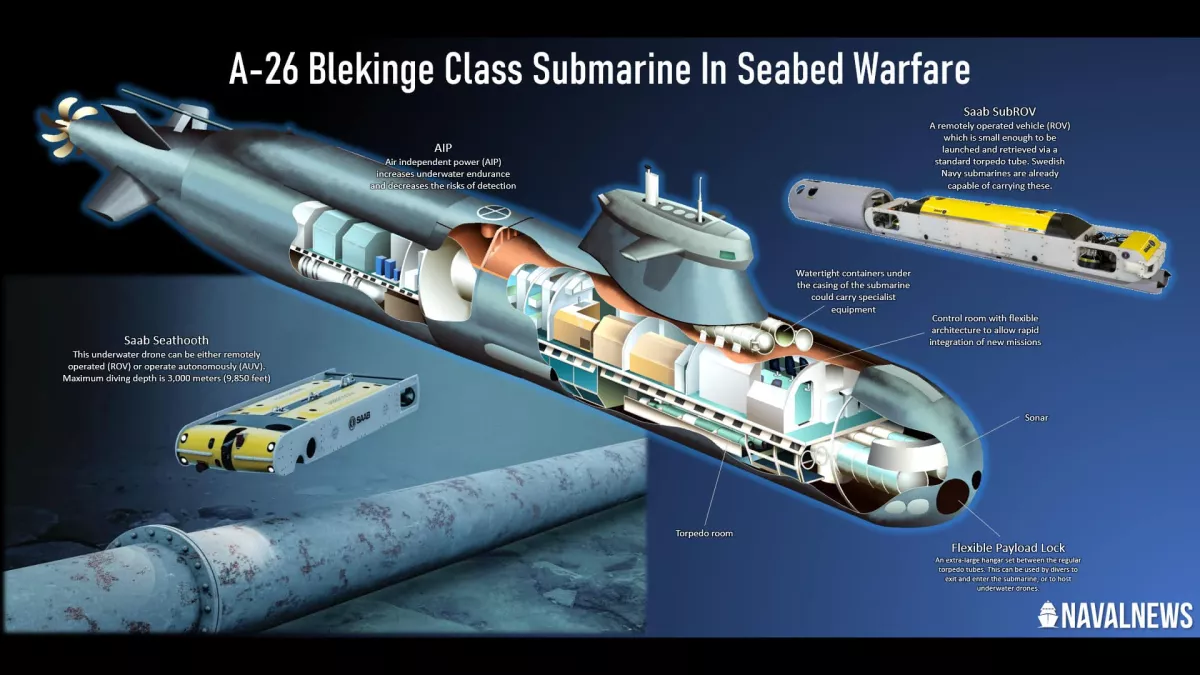
The submarine’s modular mission bay can accommodate unmanned underwater vehicles (UUVs), seabed sensors, divers, and special forces. An advanced communications architecture links the A26 to wider intelligence networks, connecting activity across undersea, electromagnetic, and cyber domains. As global data cables face increasing vulnerability, this capability allows operators to discreetly monitor critical infrastructure in contested waters.
UUV deployment further expands its reach, allowing the submarine to map the seabed, inspect cables, or gather reconnaissance without exposing itself. Equipped with modular payloads, a single A26 can shift between grey-zone missions, distributed surveillance, or support for allied cooperation in ways earlier conventional submarines could not.
Strategic impact in Europe
In European waters, the A26 offers new potential for deterrence and situational awareness. Russia continues to operate and modernize submarine forces in the Baltic and Arctic, using both nuclear and diesel-electric vessels to secure key zones like the Baltic Sea and the North Sea approaches. Despite facing maintenance and operational challenges, the Russian navy remains active and strategically ambitious.
A26-class submarines could covertly track these activities, map vulnerable infrastructure, and provide intelligence to NATO and partner nations. Their stealth and endurance enable a persistent presence in contested littoral areas, while modular systems and UUVs allow diverse mission sets without relying heavily on nuclear fleets. As the article argues, platforms like the A26 empower middle powers to contribute meaningfully to collective defense, strengthening distributed deterrence and regional security. The Polish government has accepted Sweden's offer of providing Saab’s A26 submarines to to replace the current Kilo-class submarine in November 2025, as reported by Naval News.
Private, state innovation driving naval capabilities together
The A26 also highlights how private industry accelerates naval innovation. Saab’s combination of GHOST (Genuine Holistic Stealth) technology, Stirling AIP, and modular design produces a level of adaptability difficult to replicate in large, state-run programs. Collaborations with hybrid autonomous systems such as the Sabretooth expand reconnaissance and seabed operational capabilities.
Other firms, such as Germany’s ThyssenKrupp Marine Systems and France’s state-owned Naval Group, continue to introduce advances in propulsion, modular payloads, unmanned integration, and weapons systems. Together, private and government-backed firms act as vital strategic partners, enabling faster modernization and ensuring conventional submarines remain highly relevant amid multi-domain threats and grey-zone competition.
By Nazrin Sadigova







 editor@caliber.az
 +994 55 444-88-98
 Азербайджан, Баку, ул. Низами, 203, Af Business House, 5-й этаж