










Pashinyan's ally suggests external hand behind Church opposition movement
A senior ally of Armenian Prime Minister Nikol Pashinyan has accused former president Robert Kocharyan and senior figures linked to the Armenian Apostolic Church of preparing to interfere in church affairs, raising fresh tensions between the government and the country’s highest religious institution.
According to Caliber.Az, Armenia’s Deputy Speaker of Parliament Ruben Rubinyan made the remarks in a post on his Facebook page.
“Kocharyan and the Russian businessman (the arrested oligarch Samvel Karapetyan, — ed.), who for months accused us of interfering in the internal affairs of the Mother See of Holy Etchmiadzin and of its ‘plundering,’ are today themselves preparing to interfere in the internal affairs of the Church and to encroach upon the Mother See of Holy Etchmiadzin,” Rubinyan wrote.
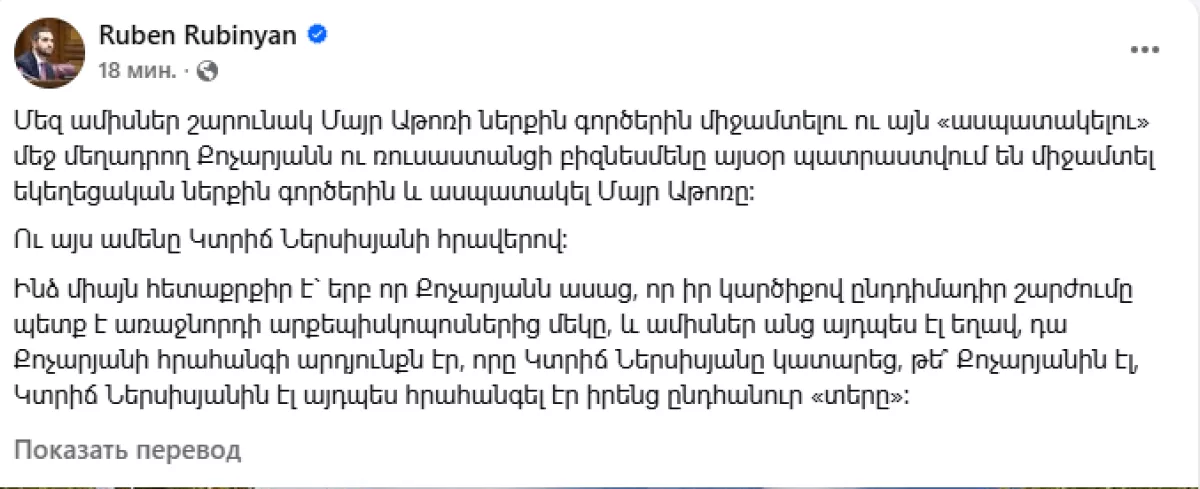
He added that, in his view, these actions were being taken “by invitation of Ktrich Nersisyan,” using the secular name of Garegin II, the Catholicos of All Armenians.
Rubinyan said he was primarily interested in one question. Referring to an earlier statement by Kocharyan, he recalled that the former president had once suggested that an opposition movement should be led by one of the archbishops, and that months later this scenario had indeed materialised.
“When Kocharyan said that, in his opinion, the opposition movement should be led by one of the archbishops, and months later that is exactly what happened — was this the result of an instruction given by Kocharyan and carried out by Ktrich Nersisyan, or was an instruction given to both Kocharyan and Ktrich Nersisyan by their common ‘master’?” Rubinyan wrote.
Relations between Prime Minister Pashinyan and the Armenian Apostolic Church have been deteriorating steadily since Armenia’s defeat in the 2020 Second Karabakh War. Following the conflict, senior clergy openly criticised the government’s handling of the war and called for Pashinyan’s resignation. Garegin II backed appeals for national unity but did not distance the Church from opposition-led protests, which further strained relations with the authorities.
Tensions deepened in 2021–2022 as prominent church figures, including Archbishop Bagrat Galstanyan, became associated with protest movements challenging Pashinyan’s legitimacy and opposing concessions in negotiations with Azerbaijan. The government increasingly accused sections of the clergy of political activism and interference in state affairs.
After Armenia lost full control over Karabakh in 2023, the confrontation intensified further. Senior clerics continued to criticise the prime minister, while Pashinyan and members of his team publicly accused the Church leadership of serving external interests, particularly Russia, and of promoting what they described as “revanchist” narratives. Pro-government media escalated criticism of Garegin II, questioning his moral authority and leadership.
In 2024 and 2025, the standoff entered a more confrontational phase. Pashinyan openly questioned Garegin II’s suitability to remain Catholicos, while law enforcement bodies detained or questioned several high-ranking clerics on allegations ranging from incitement to suspected coup plotting. The prime minister also began attending church services where the Catholicos’s name was omitted — a move seen as a serious breach of Armenian Apostolic Church canon law.
By late 2025, pressure on the Church leadership intensified further, with public calls from pro-government figures for Garegin II’s resignation and discussions emerging over possible interim leadership arrangements.
By Tamilla Hasanova







 editor@caliber.az
 +994 55 444-88-98
 Азербайджан, Баку, ул. Низами, 203, Af Business House, 5-й этаж