










Swedish PM enters deal with far-right party ahead of consequential elections
Sweden's political landscape experienced a foundational shift this week when its prime minister promised to allow the far-right Sweden Democrats (SD) into government for the first time if his coalition secures victory in the next general election.
Prime Minister Ulf Kristersson announced during a press conference that SD would be granted key ministerial roles in the event of a win in the September vote, as Swedish media report.
The far-right party has grown to become Sweden’s second-largest political force after the Social Democrats, but it is not formally part of Kristersson’s current minority coalition. Instead, it has played a “supporting role” to the government—a dynamic that could shift significantly after the election.
Kristersson, leader of the centre-right Moderate Party, said this week that if his four-party bloc prevails, SD would wield “big political influence and important ministerial posts within immigration and integration”.
The proposed coalition would consist of the Moderates, the Christian Democrats, the Liberals, and the Sweden Democrats.
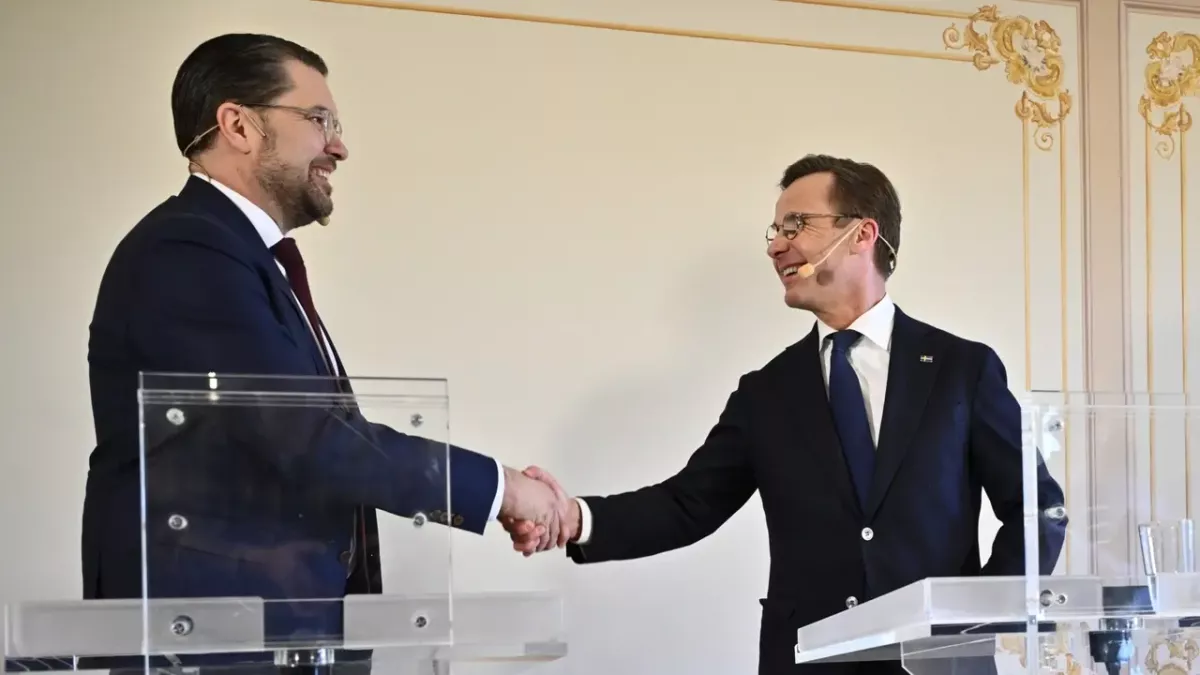
The prime minister made the announcement alongside SD leader Jimmie Åkesson, who has led the party since 2005, when it was still a marginal force in Swedish politics. Åkesson said he expected his party’s influence to reflect its electoral strength.
“We have been clear that after the next election we will either be a governing party or an opposition party,” he said.
SD’s platform includes restricting asylum access for people from outside Sweden’s “immediate area,” a move that could conflict with international human rights law, as well as ensuring that “more of those who do not have the right to be in Sweden leave than come to Sweden”.
Kristersson’s statement is widely seen as a watershed moment in Swedish politics, where SD—a party that is understood to have neo-Nazi roots—has long been treated as a political outlier, similar to dynamics seen in countries such as Germany and Austria.
Opposition figures reacted sharply. Nooshi Dadgostar, leader of the Left Party, called the prospect of SD entering government “disgusting” and urged leaders to reconsider.
“Now there is a lot at stake and now we know that we can have right-wing extremist ministers in the government,” she told a Swedish newspaper. “Now we have to come together to offer a different path for Sweden.”
SD's rise to power
Since overtaking the Moderates as Sweden’s second-largest party in 2022 and assuming a supporting role in government, SD has exerted considerable influence—particularly on immigration policy.
Its rhetoric has shaped debate across the political spectrum, including within the opposition Social Democrats, who have adopted tougher positions on immigration and integration, similar to policies pursued in Denmark under Mette Frederiksen.
The party argues that mass immigration has “changed Sweden for the worse” and led to “many societal problems”. Islam-related rhetoric has also featured prominently in its messaging. In a recent documentary, Åkesson said that being Muslim and being Swedish was “a contradiction”.
This week’s announcement follows a significant shift by Simona Mohamsson, leader of the Liberals, who last month reversed her party’s stance and signaled willingness to join a government that includes SD, despite previously describing the party as racist.
By Nazrin Sadigova







 editor@caliber.az
 +994 55 444-88-98
 Азербайджан, Баку, ул. Низами, 203, Af Business House, 5-й этаж