










China builds strategic military networks in Africa, Middle East
Following the Gaza war, China has intensified its use of military diplomacy and professional training to engage Arab and African military elites, led by the Central Military Commission (CMC) and the country’s most prestigious military academy. This effort relies on expanded professional military education for officers and senior security officials across Africa and the Arab world.
The strategy is designed to help graduates later assume senior command positions in their home countries, fostering what Beijing describes as a “strategic understanding” with China through a network of aligned military elites, according to an analysis published by Modern Diplomacy.
At its core, the initiative seeks to gradually shift the loyalties of future military leaders away from the United States and toward Beijing. Chinese planners aim to present China as a credible alternative security partner and a source of stability in the Horn of Africa, the Middle East, the Gulf, and the wider Arab world.
The approach is also intended to counter Washington’s long-standing role as a global “military policeman,” which for decades helped secure the loyalty of African, Arab, and Gulf military leaders to the US, which took place often at the expense of China’s security interests, as the article notes.
To achieve this, the CMC and the People’s Liberation Army National Defense University (PLAU) have expanded education programs for officers and senior ranks from the Global South, alongside broader support for developing-country militaries.
Beijing’s military leadership, under President Xi Jinping, has framed its engagement in the Middle East and the Horn of Africa around concepts of “common global security and developmental mediation” while avoiding direct military involvement. At the same time, China has worked to deepen its strategic footprint in key regions through training, partnerships, and institutional links.
A central feature of the Professional Military Education (PME) strategy is the export of China’s governance model, which closely links the military to the ruling party and political authority. This “political-military” framework is embedded in training curricula and promoted as an alternative to Western civil-military models. In Africa, the strategy also focuses on strengthening ties in the Horn of Africa and redefining the role of China’s base in Djibouti, which has evolved from a logistics hub into a platform for regional military cooperation and joint exercises.
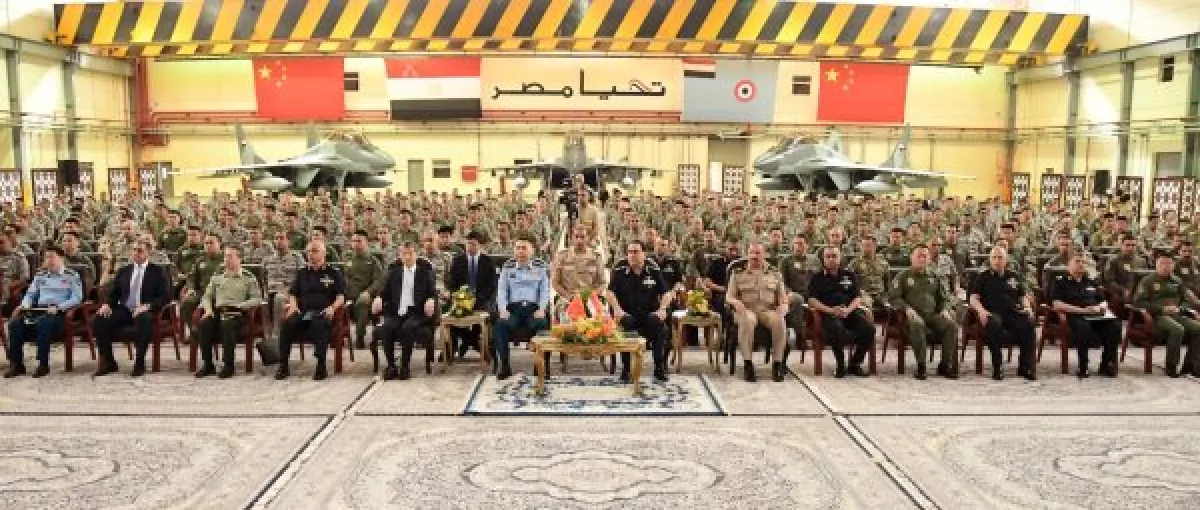
Military education ties with Egypt have expanded in parallel. Cooperation between Egyptian institutions, including the Nasser Military Academy, and the PLAU has grown through exchanges of delegations and expertise in strategy and national security. Chinese programs host Egyptian faculty members and senior officers in Beijing to discuss regional crises, including the Gaza war and the Palestinian issue. Several advanced courses are tailored for foreign officers at the rank of colonel and above, helping China cultivate long-term relationships with what it sees as the future elite of Arab militaries.
Through these programs, Chinese military academies aim to project soft power and promote Chinese military doctrine and Beijing’s vision of global security, particularly across the Global South. This aligns with China’s “Position Paper,” which emphasizes comprehensive political solutions to conflicts such as the Gaza war and reflects positions broadly shared by Arab states.
The PLAU has also expanded outreach across the Arab world. It has organized virtual and in-person seminars with leaders of higher military education institutions in 16 Arab countries to explore joint curricula and academic cooperation. In June 2024, a senior PLAU delegation visited Oman to strengthen ties with the Academy of Strategic and Defense Studies, a model repeated with Egypt and other Arab states as part of China’s push for a “comprehensive strategic partnership” and President Xi’s vision of a China–Arab community with a shared future.
In November 2024, Egypt’s Military Academy, which oversees the country’s higher military education system, hosted a high-level Chinese delegation to discuss deeper cooperation in training and personnel development. This engagement coincided with reforms within China’s own military education system and a broader modernization drive that led to the creation of three new PLA-affiliated academies in May 2025. These institutions focus on areas such as information support, joint logistics, and land weapons, underscoring Beijing’s long-term investment in shaping military partnerships abroad.
By Nazrin Sadigova







 editor@caliber.az
 +994 55 444-88-98
 Азербайджан, Баку, ул. Низами, 203, Af Business House, 5-й этаж