










China's Tianwen-2 sends back first close-up image of Earth's "minimoon" PHOTO/VIDEO
China's Tianwen-2 spacecraft has reached Earth's quasi-satellite Kamoʻoalewa and returned its first close-up image of the small asteroid, marking a major milestone in the country's first asteroid sample-return mission.
The China National Space Administration (CNSA) said the spacecraft arrived at its primary destination after travelling for 13 months and covering nearly 1 billion kilometres following its launch from the Xichang Satellite Launch Centre on May 29, 2025, according to Scince Alert.
Since July 2, Tianwen-2 has been operating about 20 kilometres from Kamoʻoalewa, where it captured the asteroid's first close-range portrait.
Kamoʻoalewa, officially designated asteroid 2016 HO3, is often referred to as Earth's "minimoon," although it is not a true natural satellite. Unlike the Moon, it orbits the Sun rather than Earth, but its orbit keeps it close to the planet over long periods, earning it the rare classification of a quasi-satellite. It is one of only seven known quasi-satellites associated with Earth.
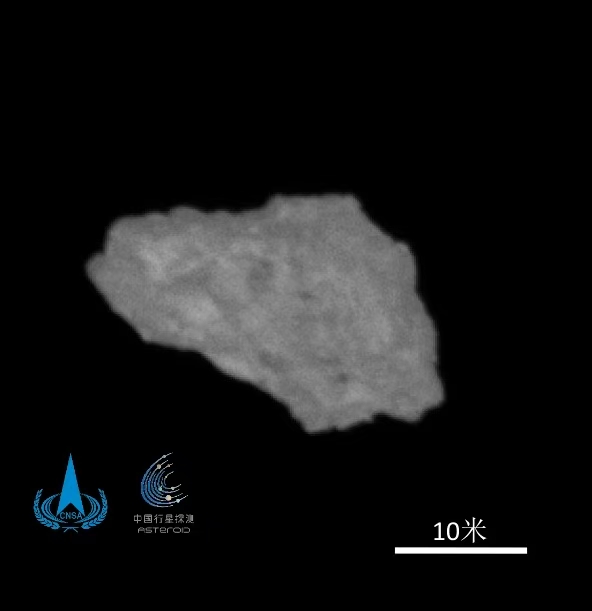
The asteroid belongs to the Apollo group of near-Earth asteroids and is estimated to measure between 40 and 100 meters across, potentially making it the smallest asteroid ever visited by a spacecraft.
According to CNSA, Tianwen-2 first detected Kamoʻoalewa optically on June 6. By June 19, the spacecraft had closed to within 2,000 kilometres before moving to just 20 kilometres from the asteroid in early July.
During its approximately nine-month stay, Tianwen-2 will conduct detailed observations of the asteroid and collect samples for return to Earth.
Scientists hope the mission will answer longstanding questions about Kamoʻoalewa's composition, structure and origin. Researchers plan to determine whether the object is a loose rubble pile or a solid body, investigate whether it contains traces of water, and study how its orbit has evolved. They also aim to better understand the effects of the solar wind on the asteroid.
Previous telescope observations have suggested that Kamoʻoalewa could be a fragment of the Moon that was ejected during an ancient impact. Samples returned by Tianwen-2 are expected to help test that hypothesis.
In a research paper published in January in Space Science Reviews, scientists described Kamoʻoalewa as an exceptionally rare Earth co-orbital object. Its orbit closely matches Earth's, allowing relatively low-energy transfers while maintaining a stable distance of about 0.1 to 0.3 astronomical units from the planet, making it well suited for long-term spacecraft operations.
After completing its work at Kamoʻoalewa, Tianwen-2 will release its sample capsule during an Earth flyby before continuing to its second target, main-belt comet 311P, located beyond Mars. The comet is known for its unusual multi-tailed appearance, and scientists hope close-up observations will provide new insights into its structure and evolution.
By Sabina Mammadli







 editor@caliber.az
 +994 55 444-88-98
 Азербайджан, Баку, ул. Низами, 203, Af Business House, 5-й этаж