










How the US–Iran war could affect TRIPP and the South Caucasus Foreign Policy analysis
An article in the American magazine Foreign Policy discusses the potential consequences of a U.S.–Iran war for the peace process between Baku and Yerevan. Caliber.Az presents an excerpt from this material for its readers.
The article notes, in particular, that last year U.S. President Donald Trump achieved a remarkable feat: through an unexpected summit at the White House and a creative approach to diplomacy, he managed to give a new impetus to the peace process between Azerbaijan and Armenia. However, the consequences of the U.S.–Iran war now threaten these achievements in the South Caucasus. Even with a ceasefire in place, the White House will remain focused on Iran for some time.
When Trump became involved in the peace process between Baku and Yerevan, dialogue between the two capitals was already at an advanced stage. Through a series of operations from 2020 to 2023, Azerbaijan had regained all the territory occupied by Armenian forces during the 1990s war. Since Armenia was weakened and unable to continue hostilities, both sides were now ready for serious negotiations. By early 2025, they had already refined the text of a peace agreement.
However, two critically important issues remained. One concerned the Constitution of Armenia, which contained territorial claims on Karabakh. Azerbaijan demanded that these provisions be removed before the final peace treaty could be signed.
The second issue involved the creation of a transport corridor connecting mainland Azerbaijan with Nakhchivan through southern Armenia. This was first mentioned in the trilateral ceasefire statement mediated by Russia, which included a provision that the corridor would be secured by Russian border troops. However, following Russia’s invasion of Ukraine in 2022, Moscow’s influence in the South Caucasus sharply declined, rendering this arrangement unfeasible.
Baku remains highly interested in this corridor, which would provide access to Nakhchivan and onward to Türkiye. It demanded that the route be unobstructed.
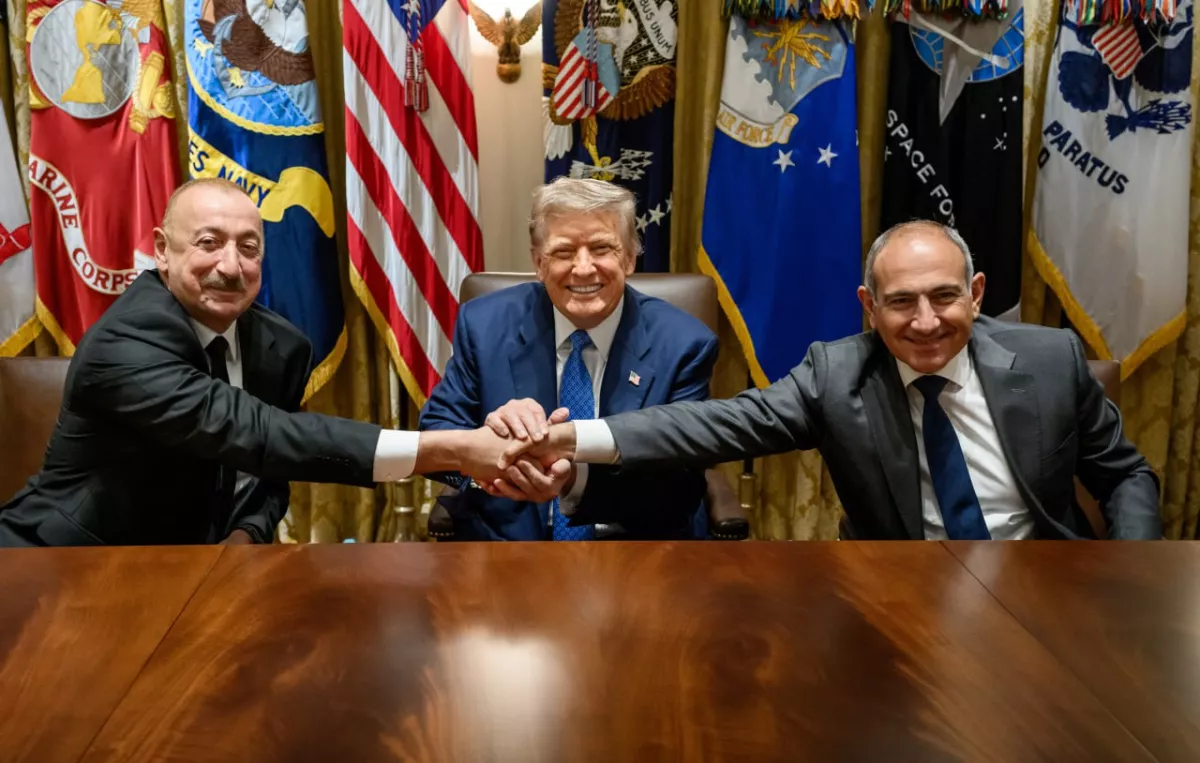
This is where Trump stepped in. His team proposed a solution under which Armenian officials would legally retain control of the border, but inspections would actually be carried out by employees of a private company from a third country. The corridor would be managed by an Armenian–American joint enterprise. In August 2025, Trump invited the leaders of both countries to the White House to sign the agreement. A photograph of him smiling and shaking hands with the Armenian and Azerbaijani leaders became a moment that many in the South Caucasus never expected to see.
After the White House summit, both sides began actively taking steps to normalise relations. Experts from Azerbaijani think tanks started visiting Yerevan, and vice versa. Azerbaijan began supplying fuel to Armenia for the first time and allowed the transit of grain from Russia and Kazakhstan through its territory. All of this would have been hard to imagine just a year earlier.
In January, the U.S. and Armenia published the text of an agreement outlining the framework for TRIPP. This served as proof that the Americans had done significant behind-the-scenes work and that critics’ scepticism was unfounded. In early February, Vice President J.D. Vance visited Armenia and Azerbaijan, demonstrating the United States’ determination to see the TRIPP project through to completion.
However, the companies the U.S. had hoped to involve in constructing and operating the corridor are now reassessing the security risks for their potential investments. Sources in Yerevan report that a visit by an American company, which was supposed to survey the area, has been postponed due to the war.
Ideally, the U.S.–Iran war should push Armenia and Azerbaijan to engage more actively in the peace process. Both countries share similar concerns about the potential consequences of the conflict, which could encourage them to intensify bilateral cooperation. They might develop short-term transit agreements to address the issue of closed borders and exchange information on air defence in response to threats from the Islamic Republic of Iran.
“That is a best-case scenario, though. If that scenario is not realized, the Iran war and its aftermath could undermine one of Trump’s real achievements,” the author of the Foreign Policy article wrote.







 editor@caliber.az
 +994 55 444-88-98
 Азербайджан, Баку, ул. Низами, 203, Af Business House, 5-й этаж