










Message behind Oreshnik strike far more devastating than its sheer firing power PHOTO
Russian forces have once again deployed the Oreshnik medium-range ballistic missile in their latest offensive against Ukraine, this time striking the western city of Lviv. While Ukrainian officials have released few details about the precise target or the extent of the damage, analysts say the real significance of the weapon lies less in its destructive power than in the political signal it sends.
The overnight strike on January 8 marked only the second confirmed use of the hypersonic missile since the start of the war in Ukraine in 2022, as an article published by El País recalls. The weapon was first used in late November 2024, when it targeted what appeared to be a vacant factory in the city of Dnipro.
The missile is designed for nuclear warfare scenarios and travels at hypersonic speed, making it extremely difficult for air-defence systems to intercept.
Known as the Oreshnik — Russian for “Hazel Tree,” a reference to the streaks of light created when its warheads descend — the missile is equipped with multiple independently targetable reentry vehicles (MIRVs). Unlike conventional missiles that strike with a single warhead, the Oreshnik fragments during the final phase of its flight, releasing several warheads that fall simultaneously on a target.
The missile reaches suborbital altitude and can reportedly carry up to six warheads, either nuclear or conventional. Its speed and the very short warning time before impact make it a particularly potent addition to Russia’s arsenal.
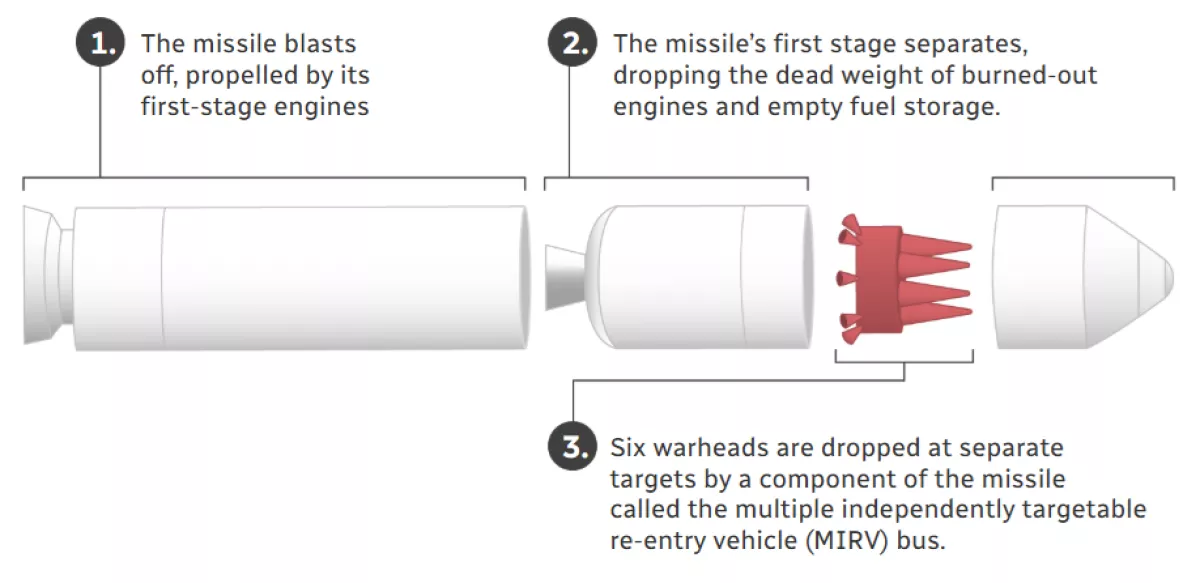
Because its warheads reenter the atmosphere at far higher speeds than older missile systems, their impact alone can generate shockwaves capable of destroying underground bunkers without relying on a large explosive payload. Russian President Vladimir Putin has previously said the missile can reach speeds of Mach 10, or roughly 12,300 kilometers per hour. “One of the newest medium-range missiles has been tested under combat conditions,” he said at the time.
Western intelligence agencies, however, believe the Oreshnik is not an entirely new design but rather a modified version of an existing system. “This IRBM was based on Russia’s RS-26 Rubezh intercontinental ballistic missile model,” said Sabrina Singh, deputy spokeswoman for the US Department of Defense, without elaborating, following the missiles’ first launch in 2024.
Symbolic significance more fearful than sheer fire power
The missile’s use has renewed tensions between Russia and the United States over the now-defunct Intermediate-Range Nuclear Forces Treaty, which sought to ban such weapons in Europe. Washington withdrew from the treaty in 2019, and the 2024 and recent deployments of the Oreshnik effectively violate its original provisions.
Following the Lviv strike — carried out just 70 kilometres from the Polish, therefore European Union's border — the bloc's foreign policy chief Kaja Kallas described the attack as “a clear escalation against Ukraine and meant as a warning to Europe and to the US” She called for increased sanctions to raise the cost of the war for Moscow.
Military analysts also question the tactical logic of deploying such a costly weapon. Glen Grant, a retired British lieutenant-colonel and defence expert with the Baltic Security Foundation, told Canadian media that it made little sense to use an advanced hypersonic missile against targets Russia has already been striking with drones and conventional missiles. Instead, he argued, the launch was intended as a message. “In other words, if we can fly it this far, we can fly it all the way to Warsaw or we can fly it to Riga, or we fly to Tallinn,” he told CBC News.
Moscow has claimed the strike was retaliation for an alleged Ukrainian attack on Putin’s residence in the Novgorod region in December — an accusation Kyiv dismissed as “an absurd lie” aimed at derailing peace talks.
Ukraine’s air force said the missile travelled at around 13,000 kilometers per hour but did not disclose what it hit. Russian officials, including former president Dmitry Medvedev, confirmed the launch, with Medvedev likening the strike to an anti-psychotic drug needed in a world of “unhinged actors” and “dangerous psychotics.”
By Nazrin Sadigova







 editor@caliber.az
 +994 55 444-88-98
 Азербайджан, Баку, ул. Низами, 203, Af Business House, 5-й этаж